

Get In. Stand Out. Get Hired: The Practitioner’s Guide to Real Estate Education
Students often ask us the same questions about commercial real estate education: Do I need a real estate degree? Which program is worth the investment? And what will help me stand out to employers? Those questions require different decisions. A degree alone won’t guarantee a job. Relationships, financial modeling skills, and increasingly, AI proficiency all play a role in helping candidates stand out.
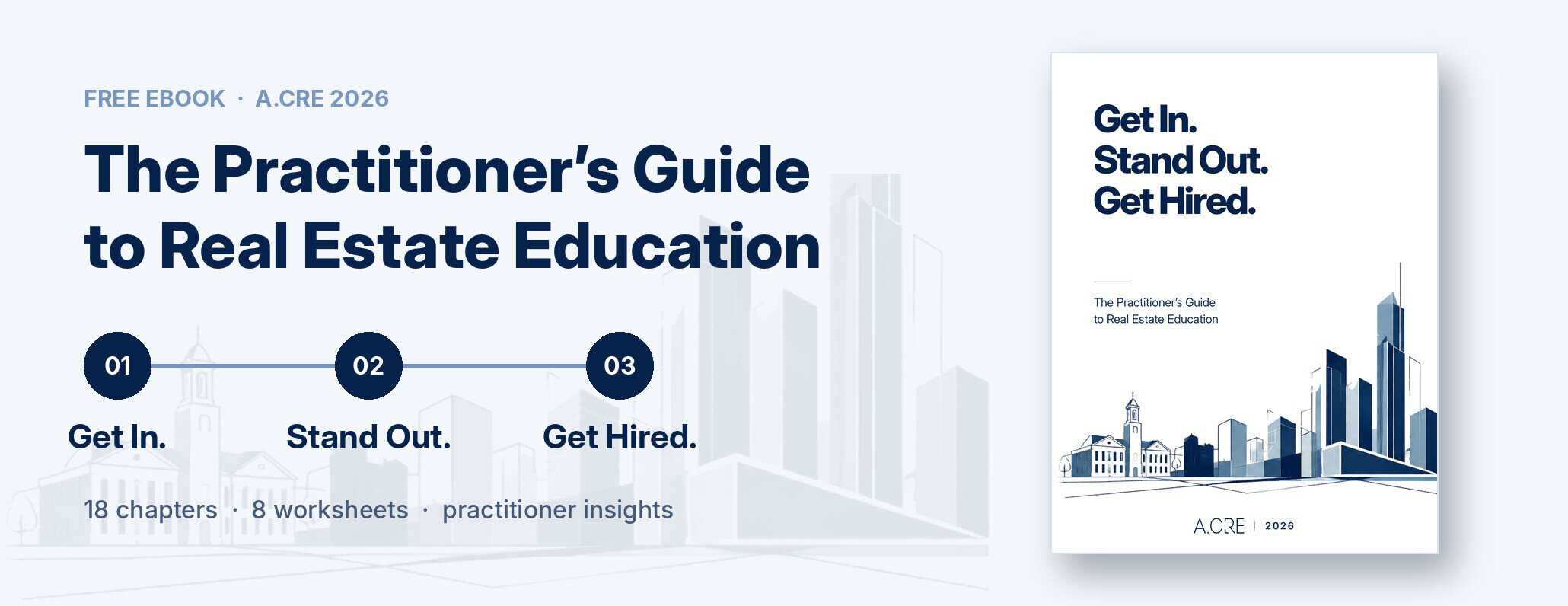
That’s why we created Get In. Stand Out. Get Hired. The Practitioner’s Guide to Real Estate Education, a free ebook built around the outcomes that matter.
Why We Wrote a Practitioner’s Guide to Commercial Real Estate Education
Most education advice starts with the school. We start with the career. This guide examines which opportunities a program creates, how to use them, and what employers need to see. Since 2020, thousands of students have participated in our Accelerator through university-sponsored cohorts. We’ve also spoken with faculty, program directors, club leaders, and hiring managers about where students succeed and miss opportunities.
We brought those perspectives together:
- Two education paths. Spencer Burton pursued a master’s in real estate; Michael Belasco completed a three-year MBA and MRE dual degree. Both explain why.
- Educators and practitioners. Insights from university program directors, faculty, and experienced real estate professionals who have mentored students and helped them navigate the industry.
- The employer’s perspective. Contributions from executives and recruiters at a leading national real estate investment and development firm, a major commercial real estate brokerage, and an established retail real estate owner and developer.
- Student experiences. Club presidents, competition winners, and recent graduates share their paths from target and non-target schools.
The result brings years of our real estate education content into one practical resource.
What’s Inside the Guide
Across 84 pages and 18 chapters, the ebook follows three career stages.
- Part One: Get In. Evaluate undergraduate and graduate education options, compare a master’s in real estate with an MBA, and decide when graduate school may not be the right investment.
- Part Two: Stand Out. Use your time in school well, build substantive relationships, contribute through clubs and competitions, develop modeling skills, and understand where AI fits.
- Part Three: Get Hired. Approach internships, pursue opportunities, understand employer expectations, and prepare for technical interviews.
Eight worksheets put the advice to work, including a Program Scorecard, graduate-school Go or Skip Audit, Contact Tracker, Technical Interview Countdown, and 18-point modeling Sign-Off Check. Consider this story, after Spencer taught 40 students, one asked to speak with him. That conversation led to introductions at several firms, the other 39 never asked. Opportunity only matters when you act on it.
How to Get the Most From It
Start with the decision in front of you. You don’t need to read in order.
- Choosing a program? Read Part One and use the Program Scorecard before your next visit.
- Already in school? Start with Part Two. Identify one relationship to build, one skill to develop, and one opportunity to contribute.
- Recruiting now? Go to Part Three. Use the Sign-Off Check and Technical Interview Countdown to find and address your gaps.
The worksheets turn advice into decisions and next steps.
Who This Guide Is For
- Undergraduates exploring commercial real estate, including students without a dedicated real estate program
- Graduate school applicants weighing a master’s in real estate, an MBA, or neither
- Career changers looking for a path into the industry
- Faculty, program directors, and club leaders advising students
Start Building Your Edge
The students who stand out aren’t always from the biggest-name schools. They take initiative, build meaningful relationships, and develop skills they can demonstrate. The guide helps you decide where to focus next.
For hands-on training, the A.CRE Accelerator teaches real estate financial modeling, while AI.Edge helps develop AI proficiency. You can also explore our real estate education resources.

