

Type I vs. Type II Errors in Commercial Real Estate: A Lesson in Risk I Learned Early in My Career
Early in my career, as a new associate working for a large institutional real estate investor, I took a trip to Denver with a director on my team and our managing director.
Both were named Mike. Both are people I highly respected.
Our managing director, Mike, had been with the firm over 30 years. He was highly regarded, well respected in the industry, and someone whose perspective I valued.
We were driving between property visits when the topic of Type I and Type II errors came up.
At some point, one of the Mikes turned to me and asked, “Spencer, do you know what a Type I versus Type II error is?”
I admitted that I didn’t.
Our managing director proceeded to explain a concept that, years later, I still think about when making real estate investment decisions.

Understanding Type I and Type II Errors
The concept of Type I and Type II errors comes from statistics, where the terms describe two different kinds of mistakes in hypothesis testing.
But Mike was using the terms in the context of investment management and, more specifically, our responsibility as (small f) fiduciaries of institutional capital.
He explained that when you’re entrusted with managing billions of dollars, there’s an expectation that you’re going to be prudent. You’re expected to do your homework, understand the risks you’re taking, and exercise good judgment.
And in that context, there are two types of errors you can make.
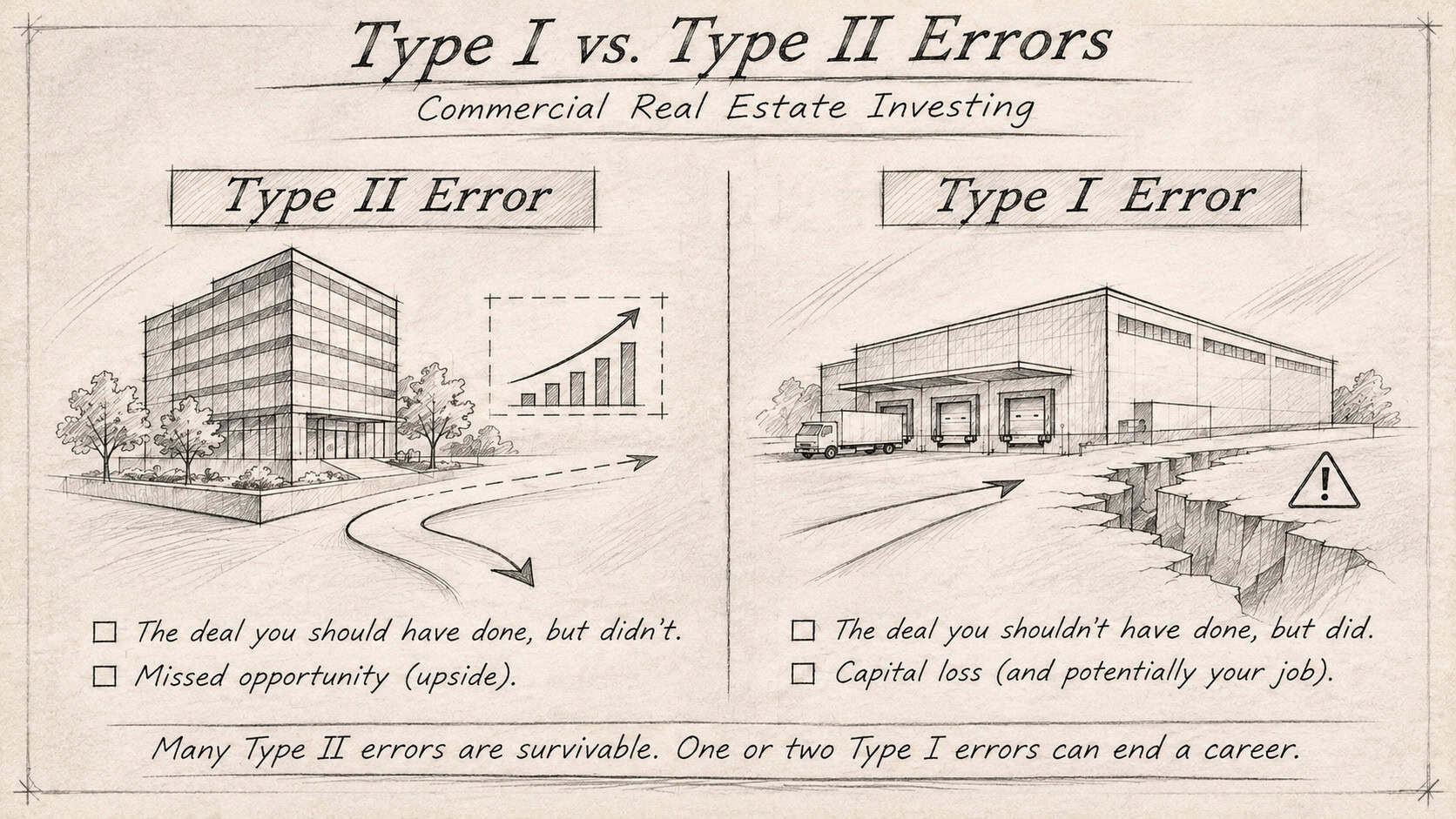
Type II Error: The deal you should have done, but didn’t.
You pass on an investment that ultimately would have been a good one. Maybe you were too conservative in your assumptions, underestimated the market, or simply couldn’t get comfortable with a particular risk.
Whatever the reason, you missed an opportunity.
Type I Error: The deal you shouldn’t have done, but did.
You make an investment that you should have passed on. Perhaps you overestimated future rent growth, underestimated capital requirements, or failed to appreciate a risk that ultimately materialized.
And now you’ve put investor capital at risk, potentially resulting in a permanent loss.
Then he made a point that has stuck with me ever since.
You can make near-unlimited Type II errors over the course of your career and largely be okay. But you can only get away with one or two Type I errors before your career is over.
Why Institutional Investors Think This Way
Consider the incentives of an investment professional responsible for managing billions of dollars in institutional capital.
There will always be more deals to evaluate. Every day, investment opportunities come across your desk, and your job is to determine which ones merit the capital you’ve been entrusted to invest.
You might evaluate 100 opportunities, pursue 10, and ultimately close on one or two.
Of the 90 you passed on, several might turn out to have been excellent investments. And that’s okay. You can’t invest in everything, nor should you try.
Those are your Type II errors.
But suppose one of the deals you actually closed suffers a significant loss. And suppose that loss resulted from a risk that, with proper diligence and judgment, you should have identified.
That’s a Type I error.
For an institutional investment manager, a few such decisions can have serious career consequences. Investors expect their managers to protect their capital, and their tolerance for avoidable losses is understandably low.
Of course, every investment carries risk. A poorly performing investment doesn’t automatically mean someone made a Type I error. Good investment decisions can have bad outcomes.
The distinction comes down to whether the decision was prudent given the information available at the time.
This Applies Far Beyond Institutional Capital
At the time, Mike was talking about investing billions of dollars on behalf of some of the world’s largest institutional investors.
But over the years, I’ve come to appreciate how broadly this principle applies across commercial real estate.
Consider a few examples.
As a broker advising a client
Your client is considering acquiring their first commercial property. You recommend they pass on a deal because of concerns about the tenant’s creditworthiness or the property’s capital needs. The property ultimately performs well, and your client misses out on a good investment. That’s a Type II error.
Now imagine you encourage that same client to buy a property while failing to adequately investigate those risks. The tenant defaults, major capital expenses follow, and your client suffers a substantial loss. That’s a Type I error.
As a developer working for an institutional firm
You pass on a development site because your projected rents don’t justify the construction costs. Another developer acquires the land, builds the project, and earns an attractive return. Type II error.
Alternatively, you proceed with a development despite warning signs about supply, costs, or achievable rents. The project delivers into a weak market, and investors lose a meaningful portion of their equity. Type I error.
As someone managing family capital, or even your own
The same principle applies.
Passing on a good investment means giving up a potential return. Making a bad investment can permanently impair the capital you have available for future opportunities.
And when that capital represents decades of savings, a family’s financial security, or money entrusted to you by people who believe in your judgment, the consequences are particularly personal.
The Other Side of the Equation
Now, there’s an important nuance to all of this.
If you take the lesson too far, you might conclude that the best investment strategy is to avoid taking risks altogether.
But that’s obviously problematic.
An investment professional who consistently passes on every opportunity will eventually fail to fulfill their mandate. Capital needs to be invested, return objectives need to be met, and excessive caution carries its own costs.
In fact, an organization that becomes overly focused on avoiding Type I errors can create an environment where nobody wants to make a decision.
I’ve seen how this mentality can influence investment committees and approval processes. When the personal consequences of a bad investment are disproportionately greater than the rewards of a good one, people naturally become more conservative.
And sometimes, that conservatism can become excessive.
So the goal is to understand the consequences of both types of errors and make decisions accordingly.
The appropriate balance will vary depending on the investor, the strategy, and the capital involved.
A core-plus fund investing pension capital should probably have a very different tolerance for certain risks than an opportunistic investor pursuing higher returns.
Both, however, should understand the distinction.
A Lesson I’ve Carried Throughout My Career
I’ve worn a number of hats in commercial real estate over my career. I’ve worked as a broker, developer, acquisitions professional, investment manager, President, and principal investing my own capital.
And throughout those roles, I’ve found myself returning to this concept.
When evaluating an opportunity, I think about the consequences of being wrong.
What happens if we pass and the deal turns out to be a winner? What happens if we proceed and the investment performs materially worse than expected? How much capital is at risk? And do we sufficiently understand what could go wrong?
I also think about whether the potential loss is something we can recover from.
Because for those of us entrusted with other people’s capital, the ability to participate in the next opportunity depends, in part, on how responsibly we manage the opportunities in front of us today.
That MD, Mike, has since retired. I haven’t kept in touch with either Mike, although writing this makes me think I probably should.
I doubt either remembers that particular conversation as we drove between properties in Denver. For them, it was likely one of hundreds of conversations they’d had with new associates over the years.
For me, it was a lesson that stuck.
And years later, I’m still grateful to both of them for taking the time to teach a new associate something about the business.
<h2>Frequently Asked Questions about Type I and Type II Errors in Commercial Real Estate Investing</h2>
What is a Type I error in commercial real estate investing?
A Type I error occurs when a real estate investor makes a deal they should have passed on. The investment may expose capital to risks that should have been identified during underwriting or due diligence. For fiduciaries managing other people’s money, repeated Type I errors can result in significant capital losses and potentially end a career.
What is a Type II error in real estate investing?
A Type II error occurs when an investor passes on a deal they should have made. Perhaps the investor was overly conservative, underestimated market growth, or misjudged the property’s potential. The result is a missed investment opportunity. Unlike a Type I error, the investor generally hasn’t lost capital on the deal.
Which is worse, a Type I or Type II investment error?
For institutional real estate investment managers, Type I errors are generally more consequential. Missing a profitable investment is unfortunate, but making an imprudent investment can permanently impair investor capital. As I learned early in my career, you can make many Type II errors and largely be okay. One or two serious Type I errors, however, can end a career.
How can real estate investors reduce Type I errors?
Investors can reduce Type I errors through disciplined underwriting, thorough due diligence, realistic assumptions, sensitivity analysis, and careful evaluation of downside risks. The objective is to understand what could go wrong before committing capital. Even well-underwritten investments can lose money, so the quality of the decision should be evaluated based on the information available when it was made.
Why is human judgment still critical when AI is used to make commercial real estate investment decisions?
Artificial intelligence can help real estate professionals underwrite deals, analyze markets, review documents, and evaluate investment risks. But AI can also produce incorrect analyses, overlook important information, or recommend investments that should be rejected. When an AI system makes a bad recommendation and a professional acts on it, responsibility for that investment decision remains with the person or organization overseeing the AI. A fiduciary cannot excuse a poor investment decision by blaming the AI. This makes experienced human judgment, verification, and oversight particularly important as AI assumes more analytical work in commercial real estate.
How do Type I and Type II errors apply to AI-assisted real estate underwriting?
AI can contribute to both types of errors. If an AI underwriting assistant incorrectly recommends rejecting an attractive acquisition, the investor may commit a Type II error by missing a good deal. If the AI recommends acquiring an overpriced property or overlooks a material risk, and the investor proceeds, the result may be a Type I error. The investment professional remains responsible for evaluating the recommendation and deciding whether to commit capital.