

• Link to Facebook
  • Link to Youtube
  • Link to LinkedIn
  • Link to X
  • Link to Tiktok
  • Link to Instagram
  • EN ESPAÑOL
    • Inicio
    • Glosario de Términos
    • Modelos Financieros
    • Tutoriales Cortos
  • A.CRE HELP
    • Support Section
    • Contact Us
  • LOGIN/REGISTER
  • Shopping Cart Shopping Cart
    0Shopping Cart
Adventures in CRE
  • A.CRE
    • A.CRE Home
    • A.CRE Help
    • Accelerator
      • Learn More
      • Login
    • AI.Edge
      • Learn More
      • Login
    • Artificial Intelligence
    • Careers
    • CRE Event Calendar
    • CRE Job Board
    • Education
    • Library of Excel Models
    • Meet the A.CRE Team
  • RE Modeling
    • 1031 Exchange
    • Audio Series
    • All-in-One (Ai1) Model
      • Download
      • Guides and Tutorials
      • Support
    • Ask Me Anything (Live)
    • Beginner’s Guide to Excel
    • Excel Models
      • Excel Add-ins
      • Library of Excel Models
      • All-in-One (Ai1) Model
      • Apartment
      • Condo
      • Debt
      • Development
      • Equity Waterfall
      • Hotel
      • Industrial
      • Office
      • Portfolio
      • Retail
      • Single Family
      • Tutorial
    • Excel Tips
    • Practice Library of Case Studies
    • Stochastic Modeling
    • Argus
    • My Downloads / My Account
  • Careers
    • About Careers in Real Estate
    • Ask Me Anything (Live)
    • Audio Series
    • Compensation in Real Estate
    • CRE Job Board
      • Find a Job
        • Browse Jobs
        • Post a Resume
        • Register
        • Login
      • Post a Job
    • CRE Event Calendar
    • CRE Interviews
    • Day in the Life Series
    • Real Estate Legal Content
    • What CRE Pros Do
  • Education
    • Accelerator
    • AI.Edge
    • A.CRE 101
    • Ask Me Anything (Live)
    • A.CRE Audio Series
    • Audio Series
    • Book Reviews
    • CRE Event Calendar
    • Deep Dive Series
    • Glossary of CRE Terms
    • Real Estate Legal Content
    • Real Estate Clubs
    • University Profiles
    • Watch Me Build
  • AI
    • AI Skills
    • AI Use Cases in CRE
    • AI for CRE Training
    • AI Tools for CRE
    • AI.Edge Membership
      • Learn More
      • Login
  • Accelerator
    • Accelerator Reviews
    • Accelerator Story
    • Enroll Now
    • Learn More
    • See What’s New
    • Enterprise Members Only
      • General Enterprise Login
      • ICSC Login
      • M&M Login
    • Members Only
      • Extend/Renew Membership
      • Login
      • Manage Membership
  • My Downloads
    • View My Downloads
    • Find an Excel Model
    • Register
    • Login
  • Click to open the search input field Click to open the search input field Search
  • Menu Menu
You are here: Home1 / Glossary of Commercial Real Estate Terms2 / Chunking
Alex Lopez
English

Chunking

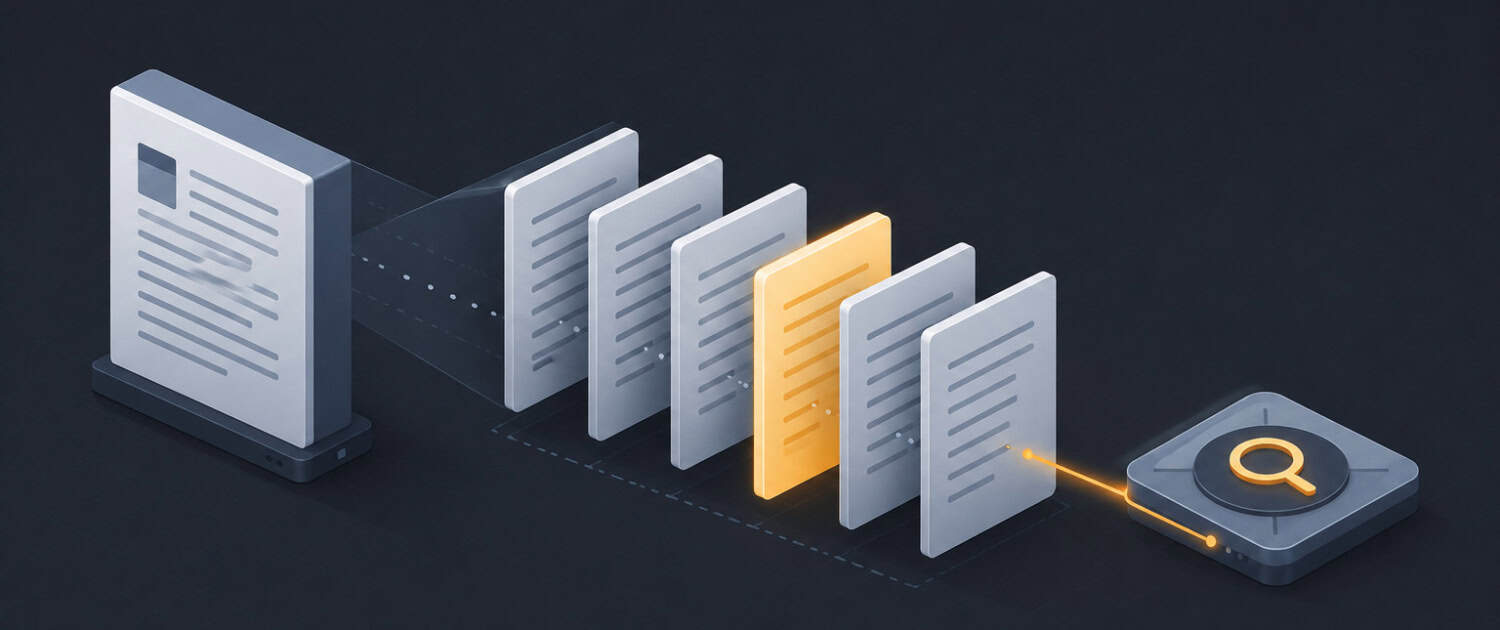
The process of breaking large documents into smaller, discrete segments for processing by an AI model or for storage in a vector database. Because AI models have finite context windows and vector search works best on focused pieces of text, chunking is a foundational step in building RAG systems. In commercial real estate, chunking is particularly relevant when processing large documents such as lease packages, appraisal reports, and offering memoranda, where the goal is to retrieve only the specific clause or section relevant to a given question rather than loading the entire document into context.
Putting Chunking in Context

A CRE firm building an internal document search tool splits each lease in its portfolio into discrete chunks at the section level, storing each chunk separately in a vector database so that when an asset manager asks whether a specific tenant has a co-tenancy clause, the system retrieves only the relevant lease sections rather than processing the entire document, reducing both retrieval time and the risk that unrelated lease language dilutes the precision of the answer.


Frequently Asked Questions about Chunking

How should CRE documents be chunked for best retrieval performance?

The most reliable approach for structured CRE documents is to chunk at natural boundaries such as lease sections, article headings, or defined clauses rather than splitting at arbitrary character counts. A chunk containing an entire rent escalation provision retrieves more usefully than one that cuts mid-sentence across two unrelated clauses. For less structured documents like appraisal narratives or market reports, overlapping chunks that share a sentence or two at their boundaries help prevent important context from being lost at the seam between adjacent segments.

What happens if chunks are too large or too small?

Chunks that are too large reduce retrieval precision because the vector embedding captures a blend of multiple topics, making it harder for the search to surface the chunk in response to a narrow question. Chunks that are too small may omit the surrounding context needed to interpret a clause correctly, such as a defined term that appears several sentences before the provision that relies on it. Finding the right chunk size for a given document type is an empirical process, and CRE teams building document search tools should test retrieval quality against real queries before settling on a chunking strategy.

Does chunking strategy affect the accuracy of AI answers in a RAG system?

Chunking strategy is one of the most significant variables in RAG system performance, because the AI model can only answer as well as the chunks that are retrieved for it. A well-chunked document library ensures the model receives the specific, relevant text it needs to answer accurately, while a poorly chunked one may retrieve tangentially related sections or miss the relevant passage entirely, leading to incomplete or incorrect answers even when the information exists somewhere in the document set.

How does chunking interact with metadata in a CRE document search system?

Each chunk stored in a vector database should carry metadata tags identifying its source document, section type, property address, tenant name, and any other attributes relevant to how it will be queried. Without metadata, a retrieved chunk about a renewal option could come from any lease in the portfolio and the system has no way to filter by property or tenant before returning results. In a CRE document library spanning hundreds of leases across multiple assets, metadata filtering is what makes chunking operationally useful rather than just technically functional.

Is chunking something a CRE professional needs to configure manually, or is it handled automatically by AI tools?

Many no-code and low-code RAG platforms apply a default chunking strategy automatically, typically splitting documents at fixed character or token counts, which works adequately for general text but often performs poorly on the structured, clause-dense documents common in CRE. Teams that need reliable extraction from lease packages, loan agreements, or appraisal reports will generally get better results by configuring a custom chunking approach that respects the document’s natural structure, even if that requires working with a developer or a more configurable platform than the default tooling provides.


Click here to get this CRE Glossary in an eBook (PDF) format.
by Alex Lopez
Share this entry
  • Share on X
  • Share on LinkedIn
  • Share by Mail
  • Link to Instagram
  • Link to Youtube
https://adventuresincre.com/wp-content/uploads/2022/04/logo-transparent-black-e1649023554691.png 0 0 Alex Lopez https://adventuresincre.com/wp-content/uploads/2022/04/logo-transparent-black-e1649023554691.png Alex Lopez2026-05-12 16:59:392026-05-12 16:59:39Chunking

Featured Content

  • RE Financial Modeling Accelerator
  • A.CRE Job Search
  • Library of Real Estate Excel Models
  • Real Estate Financial Modeling
  • Real Estate Education
  • Real Estate Careers
  • AI in Real Estate

Recent Posts

  • A.CRE Real Estate Financial Models Download Guide (Updated Jun 2026)
  • Episodio 3 de Multiplicadores: La Brecha de la IA Ya Está Aquí
  • Nuevo Contenido en Español (Actualizado Junio 2026)
  • An AI Skill for the A.CRE Short-Term Rental Acquisition Model
  • Short-Term Rental Acquisition Model (Updated June 2026)
Accelerator - Learn More

Search Adventures in CRE

Search Search

Have a Question or Need Help?

Visit our Help Section

Contact Adventures in CRE

  • Visit A.CRE Help
  • Via Email
  • Via LinkedIn

You Might Also Like

  • Real Estate Modeling Courses
  • Real Estate Financial Modeling
  • A.CRE Job Board
  • Careers in Commercial Real Estate
  • Real Estate Education

A.CRE Library of Excel Models

  • Browse Excel Models
  • Login/Register
  • View My Downloads
  • Edit Account Details

Terms, Policies, and Disclaimer

  • Privacy Policy
  • Cookie Policy
  • AI Usage Policy
  • Terms of Use
  • Disclaimer
© 2014 - Present - Copyright - www.AdventuresinCRE.com, LLC | Adventures in CRE | A.CRE
  • Link to Facebook
  • Link to Youtube
  • Link to LinkedIn
  • Link to X
  • Link to Tiktok
  • Link to Instagram
Link to: Autonomous Agent Link to: Autonomous Agent Autonomous Agent Link to: Zero-Shot / Few-Shot Prompting Link to: Zero-Shot / Few-Shot Prompting Zero-Shot / Few-Shot Prompting
Scroll to top Scroll to top Scroll to top