

Autonomous Agent
See AI Agent. An autonomous agent is an AI system capable of executing multi-step tasks independently, making decisions along the way without requiring human input at each step. The term emphasizes the degree of independence, as the agent perceives its environment, selects actions, and iterates toward a goal on its own. In commercial real estate, autonomous agents are beginning to be deployed for tasks such as continuous market monitoring, automated deal screening, and recurring asset management reporting.
Putting Autonomous Agent in Context
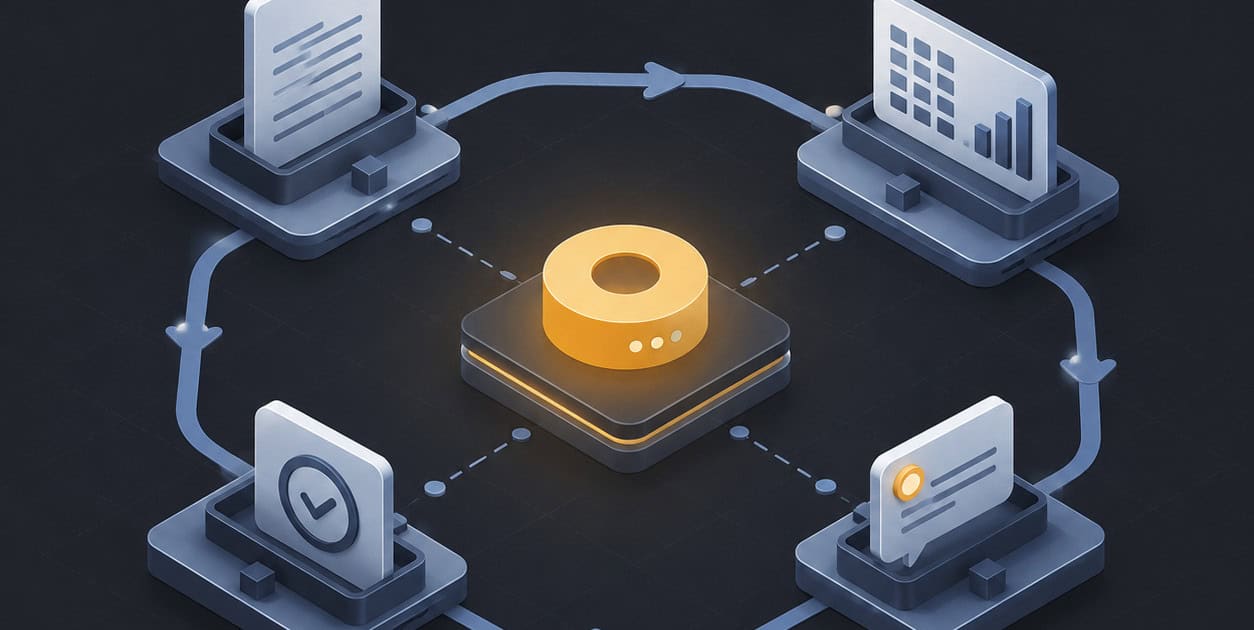
A CRE investment firm deploys an autonomous agent to monitor a target market for acquisition opportunities, where the agent pulls new listings from data feeds each morning, screens each deal against the firm’s investment criteria, discards those that fall outside the parameters, and delivers a ranked shortlist with a one-paragraph summary of each qualifying opportunity to the acquisitions team’s inbox, completing a process that previously required two to three hours of analyst time each day.
Frequently Asked Questions about Autonomous Agent
How is an autonomous agent different from a standard AI assistant or chatbot?
A standard AI assistant responds to a single input and waits for the next prompt from the user, making it a reactive tool that requires a human to direct each step. An autonomous agent is designed to pursue a goal across multiple steps without waiting for that direction, deciding on its own what action to take next based on what it observes in its environment. In a CRE context, the difference is roughly the distance between asking an AI to summarize one lease and deploying an agent that monitors a lease portfolio continuously, identifies approaching expirations, pulls relevant market data, and drafts renewal recommendations without being asked each time.
What CRE tasks are best suited for autonomous agents today?
The tasks best suited for autonomous agents are those that are recurring, rule-governed, and time-consuming but do not require judgment calls that carry significant financial or legal consequence. Continuous deal screening against defined acquisition criteria, recurring market data aggregation for asset management reports, automated rent comps monitoring, and scheduled portfolio performance summaries are all well within current capabilities. Tasks involving negotiation, relationship-dependent decisions, or outputs that go directly to investors or counterparties without review are generally not appropriate for fully autonomous deployment at this stage.
How do I maintain oversight of an autonomous agent running in a CRE workflow?
The most practical oversight mechanism is a structured human review checkpoint at the point where the agent’s output connects to a consequential action, such as a deal being added to the active pipeline or a report being sent to a capital partner. Logging each step the agent takes and the reasoning it applied, where the platform supports it, also allows the team to audit a run after the fact and identify where the agent made a decision that should have been escalated. Agents given access to external systems like a property management platform or a shared data repository should operate under clearly scoped permissions so that errors remain contained.
What are the risks of deploying an autonomous agent in a CRE investment workflow?
The primary risk is that errors compound across steps without a human catching them in between, meaning a flawed assumption or misread input early in a multi-step task can propagate into downstream outputs before anyone reviews the result. In a deal screening context, this could mean qualified opportunities being filtered out based on a misconfigured criterion, or disqualified deals advancing further than intended. Scope creep is also a practical risk when agents are given broad system access, as an agent designed to pull data can inadvertently modify records if its permissions are not tightly defined from the start.
Do autonomous agents replace analysts in a CRE firm, or do they change how analysts work?
In current deployments, autonomous agents are more accurately described as absorbing the repetitive, lower-judgment portions of an analyst’s workflow rather than replacing the analyst role itself. The time recovered from tasks like data gathering, initial screening, and report formatting is typically redirected toward higher-value work such as deeper due diligence, relationship management, and investment committee preparation. Whether that dynamic holds as agent capabilities expand is an open question, but firms deploying agents today are generally finding that the bottleneck shifts rather than disappears.
Click here to get this CRE Glossary in an eBook (PDF) format.