

AI Crossed a Threshold. Let Us Help You Prepare.
I’m sitting in warm Miami, looking out over Biscayne Bay. Super yachts glide past fishing boats. A soft drizzle is settling over the water, and still the steady stream of vessels continues. The sun most certainly will be back out soon and these low clouds will be long gone.
The scene is unnervingly… peaceful. This Saturday afternoon, pure bliss. And yet, I’m unsettled.
I don’t write blog posts like this. Almost never. And yet here I am. Punching keys into a worn keyboard like it’s 2019 (most of my writing these days is AI-assisted, but not this).
This is too important a piece.
I’m an eternal optimist. I believe in technology. I believe in progress. But I’m deeply concerned about what this moment means for my family. For my friends. For those who are part of the A.CRE community.
Am I doing enough to prepare? Are you doing enough, or anything at all?
Because something material has shifted.

View of Miami’s Biscayne Bay, taken by author, February 28th, 2026
What Has Happened in the Past 90 Days
To catch you up.
In the past 90 days, AI coding crossed a meaningful threshold. New frontier models such as GPT-5.3 Codex and Claude Opus 4.6 can now build, test, debug, and refine full applications with surprisingly little human input.
I see this firsthand with our engineering team at CRE Agents. Their role has fundamentally changed. They are no longer writing and editing most of the code. They are designing the architecture, specifying the outcome, and reviewing what the AI produces. The AI does the heavy lifting while the human supervises.
Andrej Karpathy, former Director of AI at Tesla and one of the original cofounders of OpenAI, described it this way:
“It is hard to communicate how much programming has changed due to AI in the last 2 months: not gradually and over time in the ‘progress as usual’ way, but specifically this last December. There are a number of asterisks but in my opinion coding agents basically didn’t work before December and basically work since — the models have significantly higher quality, long-term coherence and tenacity and they can power through large and long tasks, well past enough that it is extremely disruptive to the default programming workflow.”
Programming now requires fewer people to produce the same output. And software was not chosen at random. AI labs prioritized coding because improving code accelerates the development of AI itself. When the tool can help build the next version of the tool, progress compounds.
And so, if this were confined to software engineering, it would matter far less. I would not be spending a Saturday afternoon writing this!
But I am convinced it won’t stay confined.
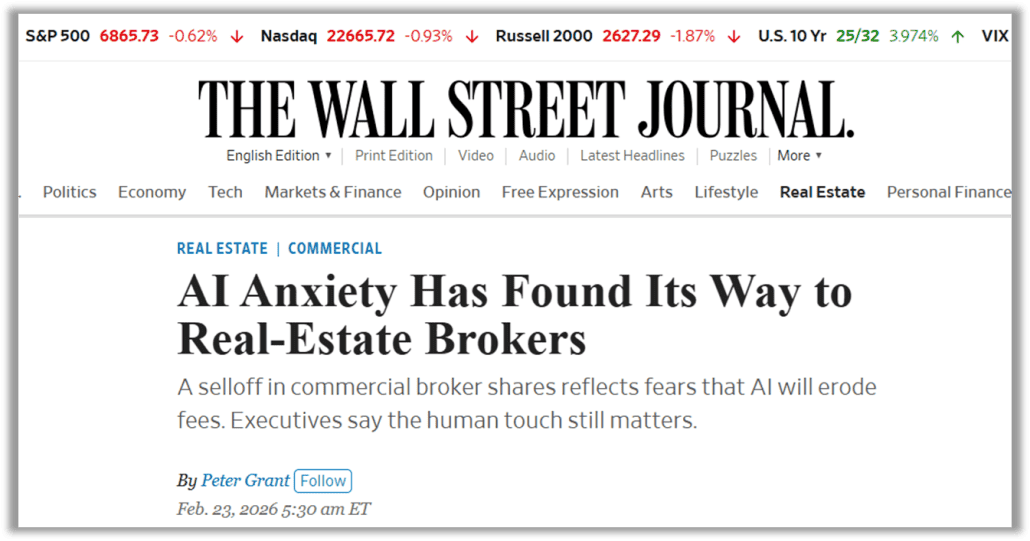
WSJ: AI Anxiety has found its way to real estate brokers, Feb 23 2026
This is Real. AI Has Crossed a Threshold. The Narrative Has Shifted.
When I say the narrative has shifted, I do not mean enthusiasm has increased. I mean skepticism has turned into concern paired with conviction, while what was hypothetical is now real. AI has crossed a threshold.
1. Howard Marks
I start here because Howard Marks carries a level of credibility – especially for CRE professionals – that few voices do. Less than 90 days ago, Marks asked the question many disciplined investors were asking: “Is It a Bubble?”
Marks is not prone to hype – it’s why we all love reading his memos. He built his reputation by resisting crowd enthusiasm and identifying cycles before they unwind. When he wrote in December, his tone questioned whether AI excitement had outrun fundamentals.
Two months later, less than 48 hours ago, he published a follow up to that piece: “AI Hurtles Ahead.”
And his tone has dramatically changed. He now concludes the technology is real.
Furthermore, Marks now writes that AI’s potential is “more likely to be underestimated today than exaggerated,” and that he is “terribly concerned” about job displacement outpacing society’s ability to adjust.
2. Andrej Karpathy
If Howard Marks represents disciplined capital, Andrej Karpathy represents the frontier.
Karpathy was one of the original founding members of OpenAI and served as Director of Artificial Intelligence at Tesla. Today he is pursing independent work focused on what he calls “AI-native software.”
Three days ago, he posted something on X that shouldn’t be ignored:
“It is hard to communicate how much programming has changed due to AI in the last 2 months… not gradually… but specifically this last December… Coding agents basically didn’t work before December and basically work since.”
To illustrate, he described giving an AI agent a detailed set of technical instructions for building a local video analysis dashboard. He walked away. Thirty minutes later, the agent had logged in, configured tools, written and debugged code, resolved errors, tested functionality, set up services, and produced a written report.
“All of this could easily have been a weekend project just 3 months ago but today it’s something you kick off and forget about for 30 minutes…Programming is becoming unrecognizable… that era is over.”
AI Has Crossed a Threshold. The era of manually writing code is coming to an end, and it foretells a similar future for all knowledge work.
3. Citrini Research and the Financial Markets
While Karpathy’s account shows AI has crossed a threshold, the financial world’s reaction shows the narrative has shifted.
In late February, a small macro analysis firm named Citrini Research published a fictional memo titled “The 2028 Global Intelligence Crisis.” It modeled a scenario where AI-driven productivity gains lead to widespread white-collar displacement, weakening wage growth, stressing consumption, and ultimately pressuring the $13 trillion mortgage market.
It was speculative (and a bit fantastical), but investors reacted.
On the day the memo spread, major U.S. indexes slipped as traders digested the implications. Tech and financial stocks were among the most affected.
This, of course, did not happen in isolation.
On February 3, legal and publishing tech stocks sold off sharply after Anthropic unveiled a Claude legal plugin capable of performing various tasks. Just days later, on February 12 and 13, office-focused real estate stocks sold off sharply amid growing AI disruption fears while CBRE fell nearly 9% and JLL 7.6%. The signal was clear. Investors were moving away from labor-intensive, fee-driven business models perceived as vulnerable to automation.
That explains Citrini. The memo did not introduce a new idea, but it crystallized one. Markets are not perfect, but they are forward-looking discounting machines.
Thus, the question is no longer whether AI is impressive but how fast and how deep its economic consequences will be.
4. Michael Belasco
One final, and more personal, anecdote to make this concrete.
You know Michael. My cofounder here at A.CRE. Co-host of the A.CRE Audio Series and our Multipliers: An A.CRE podcast. President of Firm Ridge Real Estate.
Around here we lovingly wear “In Belasco I Trust” shirts.
Michael sits squarely in the upper end of the band of AI interest and proficiency among real estate professionals. He has been using ChatGPT consistently. He works with custom GPTs and Claude Skills that the A.CRE team has built over the past few years. He experiments and he pays attention.
But he has also been measured, busy, and largely watching this AI thing play out, like most CRE professionals. In that way, he was not unlike Howard Marks.
Then two weeks ago, that changed.
Michael was on vacation with his family. I had introduced him to the AI coding platform Replit a few weeks prior. On a whim, he decided to build something. He is a builder at heart. Just look at the Excel models he has created and shared with this community.
In a single weekend, he built something that, a year ago, would have required a team of engineers. That experience changed him and got him thinking about a more important question:
What does this mean for neighborhoods like his own? Upper middle-class communities filled with knowledge workers who did everything right. Went to college. Built specialized skills. Landed comfortable office jobs. And built stable, above-average lifestyles.
What happens if AI can now competently perform the very knowledge work that underwrites those lifestyles?
Cropped image from Citrini Research’s ‘The 2028 Global Intelligence Crisis’
A Personal Threshold Moment
I have lived through a threshold moment like this before.
In 2008, during the Global Financial Crisis, I went broke. I was unprepared. Uneducated in ways that mattered. Overconfident. Naive. I mistook momentum for mastery.
My wife and I had two young toddlers at the time. We went from outsized success to living in my in-laws’ basement. It was humbling.
That moment was very different from this one in many ways. But it was similar in one important respect: there were winners and losers. There were people who saw the wave forming and positioned themselves accordingly. And there were people, like me, who did not.
I did not see the wave coming, I wasn’t even watching. And no one warned me it was coming let alone coached me on how to prepare.
And so, it slammed into me rather than me riding it.
That experience changed how I look at structural shifts. Call it wisdom or call it scar tissue. Either way, it has made me hyper aware when something feels structurally different.
And this feels structurally different.
I am not alone in that sentiment.
Howard Marks.
Andrej Karpathy.
Citrini Research.
Michael Belasco.
Different vantage points but similar message: a large wave is forming and so please get ready.

Imagine generated by Nano Banana 2, Google’ AI image generation model. Using the above section input to the prompt.
Why Most CRE Professionals Are Stuck
Over the past 12 months, I’ve had the privilege of speaking live and virtually to nearly 10,000 real estate professionals on this topic.
And it has become clear to me that most are still operating in a 2023 ChatGPT world. They are using AI as a better search engine + a writing assistant.
They are not delegating tasks to AI, let alone redesigning entire processes or drafting AI skills to support those processes. Many are unsure where to begin. Others are uncertain whether the outputs can be trusted.
In short, they may see the wave forming but they remain frozen.
Recently, I was discussing this phenomenon with our partner at A.CRE and co-host of the Multipliers Podcast, Sam Carlson, who experienced a similar reckoning during the GFC.
He offered a diagnosis that resonated deeply with me.
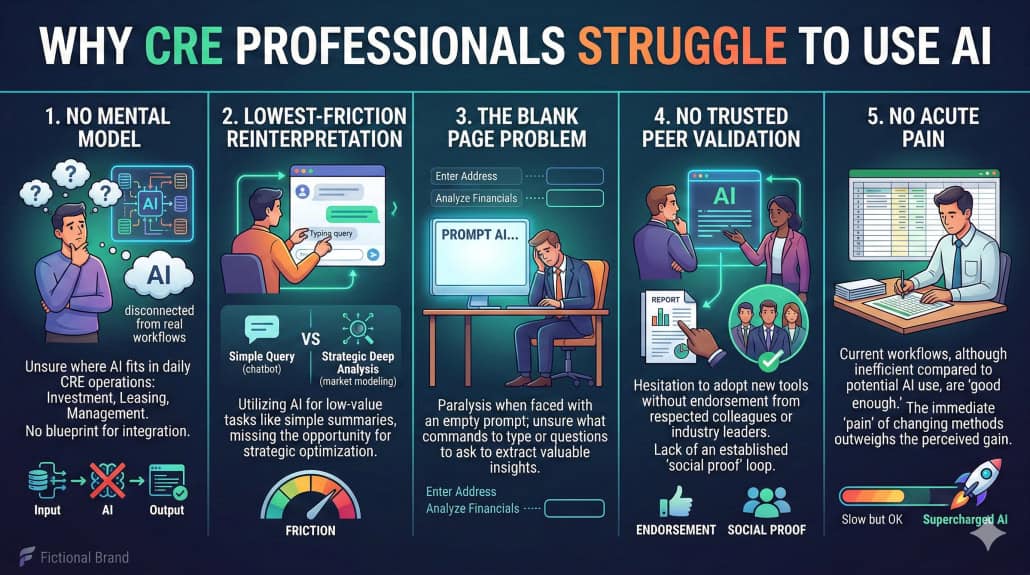
1. No Mental Model
Most professionals have no internal framework for what AI actually is or how it works. Without a mental model, the brain defaults to the nearest familiar category (e.g. AI as a Google alternative).
Which leads directly to the second barrier.
2. Lowest-Friction Reinterpretation
People do not choose to use AI like Google. Their brains automatically map it onto the closest thing they already understand.
Humans do not sit in confusion. We collapse new things into familiar things. That is cognition, not laziness.
3. The Blank Page Problem
AI requires you to meet it halfway. You need to know how to prompt it, which assumes you already understand what it can do.
It is circular. You need understanding to use it, but you gain understanding by using it.
4. No Trusted Peer Validation
Adoption in professional communities spreads peer to peer, not expert to layperson. A broker seeing another broker win with AI is more powerful than any keynote speech (or blog post!).
5. No Acute Pain
Enthusiasm does not produce action. Threat does. Until competitive pressure becomes visible, most professionals and firms will remain curious observers rather than committed adopters.
These five forces work together as a system of resistance. And they explain why so many professionals and firms are underestimating the magnitude of what is coming. That human tendency to not act until it’s too late is the most dangerous.
How We’re Positioned to Help
Preparation is not panic, it is positioning.
Our mission at A.CRE is simple: to help you prepare for what is coming. We have been building resources around AI and commercial real estate intentionally for years.
Many of these resources are free. Some require investment, albeit less than what you’d pay for one credit hour at many universities!
Even so, if cost is a barrier, email us. We will do what we can to help.
1. Master the Fundamentals, Then Layer AI
If you are early in your career, master the technical skills that matter to commercial real estate. Either you, or an AI that you manage, will be performing those technical skills.
In a world where AI can do the busy work, there will almost certainly be fewer real estate analysts. The real estate analysts or associates hired will be those that have mastered the technical skills plus know how to instruct an AI to perform those technical skills on their behalf.
This is our bread-and-butter. We’ve been teaching these skills, real estate financial modeling in particular, for over a decade.
Now, you might be asking, if the AI can do the technical work why do I have to learn it? Well, I would ask you this, why did your 4th grade teacher require you to do long division by hand rather than allowing you to use a calculator?
If you don’t know how an input becomes and output, you’re not qualified to manage the machine (or AI) that takes your inputs and turns them into outputs.
- Watch Me Build Series (Free). Follow along and use our watch me build series to learn to manually do this technical work.
- Download and Use Financial Models (Free). We’ve personally built and shared over 70 institutional-quality real estate financial models. Those models have been updated hundreds of times, thanks to the feedback from the A.CRE community. Use those models to learn the nuance of each. Alpha is earned at the edges, in the nuance.
- Real Estate Specific Tutorials (Free). We’ve posted hundreds of tutorials to A.CRE. As you
- Complete the A.CRE Accelerator (Paid). Used widely by top universities and companies, it is the gold standard for real estate financial modeling proficiency. It uses a guided approach (hence “accelerator) to quickly teach you the proverbially “long division by hand” so that you can then competently use “the calculator”. Join an elite group of specialists by getting the ‘A.CRE Accelerator Certificate of Completion‘ and leverage it to stay competitive.
AI amplifies those who understand, it does not replace understanding. I can’t imagine any firm in commercial real estate relying 100% on AI to perform their technical skills.
But most firms will have fewer analysts/associates, who are best-in-class trained technically, to manage the AI.
2. Learn to be the “AI person in the room”
While the above resources use a proven method for teaching the technical skills that matter, “mastering AI” requires a different approach.
To be the “AI person in the room”, is less about taking a course – although that’s a part of it – and more about tinkering, experimentation, regularly updating your knowledge, and understanding what it means to partner with technology.
On the AI-specific front, we have a few resources that can help:
- AI Use Cases (Free). While these are constantly evolving, we regularly share uses cases for how AI can be used in real estate.
- AI Tools (Free). We’re regularly building (what we call tinkering) and sharing AI solutions as we explore the frontier capability of this technology.
- Join AI.Edge Basic (Free). The basic tier of our AI.Edge community gives you access to daily AI prompts, a collection of third-party AI tools we’re tracking, access to our ‘Built Competition’ where you can compete as well as get inspiration from others, and access to our free AI Multipliers – AI apps be build exclusively for the AI.Edge community.
- Join AI.Edge Pro (Paid). The Pro tier of AI.Edge is where you set yourself apart. Take our AI.Edge courses, learn new skills, read our monthly intelligence brief, access our Pro-level AI multipliers, and network with AI leaders in commercial real estate.
Pairing the technical skills with the AI acumen, will position you to ride this wave rather than be crashed by it.
3. Leverage Purpose-Built Tools
While most of the A.CRE community fits squarely in the bucket of power users and builders, we recognize that not everyone wants or can become an AI expert in commercial real estate.
Firms want to be able to use AI, but aren’t sure how to train it to produce the outputs that they can trust. And many professionals want to leverage AI without necessarily having to learn to prompt, draft skills, understand tool calling and RAG, manage memory, and engineer agentic processes that produce an optimal output.
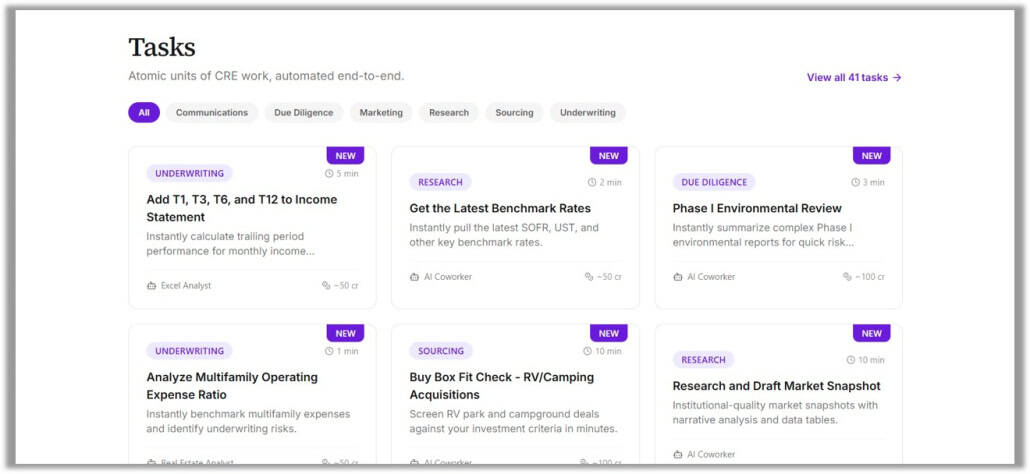
For that, we’ve spent 18 months building a platform where we’ve built real estate “tasks” that AI can do. And the user simply delegates a task to the AI. So, for instance, rather than building an AI agent to take a historical operating statement, map it to a standard chart of accounts, and then put it in the column immediately to the left of the Pro Forma, the CRE Agents team does. And then you just use that AI task to do more with less.
Admittedly it’s not cheap, although it’s not CoStar expensive! At $200/mo and it puts the power of AI into your hands so that you can focus on the things that matter.
This Time Is Different. So Is My Response.
In 2008, I did not see the wave. This time, it’s obvious to me. It may not crest tomorrow. It may take years to fully reshape commercial real estate. But the capability threshold has been crossed.
The narrative is shifting, the markets are beginning to price it, and there will be winners and losers.
Our objective at A.CRE is simple: We want to help you ride the wave and be a winner in the era of AI.
Frequently Asked Questions: AI Has Crossed a Threshold
What does it mean that “AI crossed a threshold”?
It means AI systems have moved from being helpful assistants to capable agents that can complete complex, multi-step tasks with limited supervision. In coding specifically, frontier models can now build, debug, test, and refine full applications. The concern is that this capability will not remain confined to software engineering, it will expand into broader knowledge work.
Why is this moment different from previous AI hype cycles?
The shift is not just excitement or media enthusiasm. Credible voices across capital markets, technology, and real estate are acknowledging that AI capability has materially improved in a short period of time. When skeptics begin expressing concern about underestimation rather than exaggeration, the narrative has changed.
How does this affect commercial real estate professionals?
Many roles in CRE involve structured knowledge work: underwriting, financial modeling, market research, document drafting, and reporting. As AI becomes more capable at handling these tasks, firms may need fewer analysts performing manual work. The professionals who thrive will be those who combine strong technical fundamentals with the ability to manage and direct AI systems.
Why are most CRE professionals still stuck in a “2023 ChatGPT mindset”?
Most professionals use AI as a better search engine or writing assistant. Barriers include lack of a mental model for how AI works, the tendency to map it onto familiar tools, difficulty knowing where to start, limited peer validation, and absence of immediate competitive pressure. These forces create inertia even as capability accelerates.
Is this message meant to create panic?
No. The message is about preparation, not panic. Structural shifts create both risk and opportunity. The goal is to encourage proactive positioning: strengthening technical skills, experimenting with AI tools, and building capability before competitive pressure forces reactive change.
If AI can do the technical work, why should I still learn it?
Because managing AI requires understanding the mechanics behind the output. Just as learning long division builds mathematical intuition beyond using a calculator, mastering financial modeling fundamentals allows you to evaluate, direct, and validate AI-generated analysis. AI amplifies understanding; it does not replace it.
What does it mean to become the “AI person in the room”?
It means developing practical fluency with AI tools, understanding their strengths and limits, and knowing how to integrate them into real estate workflows. This is less about coding expertise and more about experimentation, pattern recognition, and consistent application in real business processes.
What resources does A.CRE offer to help professionals prepare?
A.CRE provides free financial models, tutorials, AI use cases, and community resources, along with structured programs like the A.CRE Accelerator and AI.Edge. For firms seeking turnkey solutions, CRE Agents offers purpose-built AI tasks designed specifically for commercial real estate workflows.
Will AI eliminate jobs in commercial real estate?
AI will likely reduce demand for purely manual, repetitive analytical roles. However, it will increase the premium on professionals who combine technical expertise, judgment, relationship-building, and the ability to supervise AI systems effectively. The shift is more about role evolution than wholesale elimination.
What is the key takeaway from this post?
A structural wave is forming. The capability threshold has been crossed, and the economic implications will unfold over time. Those who prepare early, by mastering fundamentals and integrating AI into their workflow, will be positioned to ride the wave rather than be disrupted by it.

