

What Is MCP and Why Should CRE Professionals Pay Attention?
Everyone in commercial real estate is talking about AI agents right now. Fewer people are asking what is MCP, the piece of infrastructure that makes those agents actually useful.
If you haven’t heard of it yet, you will.
MCP stands for Model Context Protocol. Anthropic introduced it in late 2024, and within about a year it became the standard for connecting AI models to the real-world systems and data they need to do meaningful work.
OpenAI adopted it in March 2025. Google DeepMind followed in April. By the end of 2025, it had over 97 million monthly SDK downloads and more than 10,000 active servers built on top of it.
This post breaks down what MCP is for commercial real estate professionals: what it means, what it does, and whether it’s worth paying attention to right now. The short answer: yes, and sooner than most people in this industry expect.
- Learn to apply AI to CRE underwriting, modeling, and analysis: AI.Edge by A.CRE
The problem MCP solves
AI models (Claude, ChatGPT, Gemini) are trained on enormous amounts of data. But they’re isolated. Out of the box, they don’t know what’s in your Dropbox, they can’t pull a number from your property management software, and they have no way to check what a lease says unless you paste it into the chat yourself.
That limitation is the ceiling on what AI can actually do for knowledge workers. You can ask it to analyze a deal, but you have to hand it all the relevant data first. You can ask it to draft a memo, but you have to give it the context manually. The model is smart; the workflow is still manual.
Before MCP, developers who wanted to connect an AI to an external system had to build a custom integration every single time: one for Google Drive, another for Salesforce, another for a proprietary database. Every connection was its own project, maintained separately, and broke whenever an API changed. It didn’t scale.
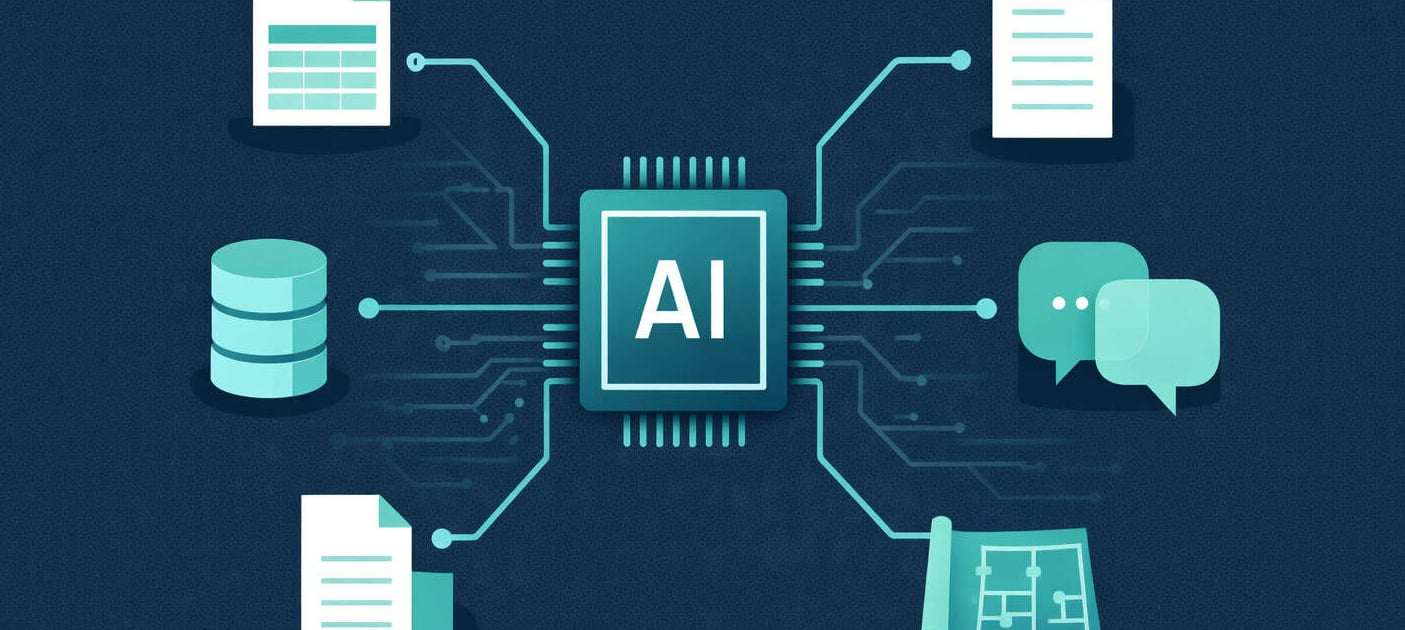
MCP fixes this by giving AI systems and external tools a shared language. Instead of building a custom connector for every combination of AI model and data source, you build one MCP server for each tool. Any MCP-compatible AI client (Claude, ChatGPT, Cursor, Gemini) can then connect to that server without additional custom work. One integration, usable everywhere.
What MCP actually is (without the jargon)
The USB-C analogy gets used a lot here, and it works. Before USB-C, every device had its own cable. Switching from one device to another meant finding a different cable, a different port, a different adapter. USB-C standardized the connector so one cable works with everything.
MCP does the same thing for AI integrations. It’s not a product you buy or a platform you sign up for. It’s a specification: a defined standard for how an AI model and an external system should talk to each other. Once a tool has an MCP server built for it, any AI that supports MCP can use that tool without any additional custom work.
Here’s a practical example. Say you’re asking an AI assistant to pull the rent roll for a specific property and flag any leases expiring in the next 90 days. Without MCP, that means you find the file, open it, copy the relevant data, paste it into the chat, and then ask the question. With MCP connecting your AI client to your property management platform, you just ask. The AI sends a request through the MCP layer, the system returns the data, and you get your answer without touching the file yourself.
The AI doesn’t gain new intelligence. It gains reach.
Why MCP matters for commercial real estate
Commercial real estate runs on data that lives in a lot of different places. Lease abstracts in one system. Financial models in Excel. Market comps in a third-party database. Investor reports in Dropbox. Email threads in Gmail. For most CRE teams, pulling any kind of cross-system view still requires someone to open each system manually, export or copy what they need, and assemble it somewhere else.
That’s exactly the kind of workflow MCP is built to eliminate. As MCP servers get built for the tools CRE professionals already use (property management platforms, deal pipeline tools, financial modeling software, document storage), AI agents can start operating across those systems without a human acting as the connector.
PriceHubble, a property intelligence platform, has already built an MCP server that lets AI agents pull verified property data (valuations, comparables, market trends) directly, without custom integrations. That’s one early example. The pattern will repeat across the proptech stack as more vendors add MCP support to their platforms.
For a CRE analyst, this means an AI agent could eventually pull data from your deal pipeline, cross-reference it against market data, run a sensitivity check in your financial model, and draft a summary, without you copying a single cell. The data handoff between systems becomes the AI’s job.
What MCP looks like in practice today
Right now, MCP adoption is concentrated in software development tools. IDEs like Cursor and Windsurf have made MCP server setup a one-click process for developers. Claude Desktop supports MCP connections. ChatGPT’s desktop app does too. There are already MCP servers built for Google Drive, Slack, GitHub, Postgres, Notion, Stripe, and dozens of other common tools.
For non-technical users, the experience is still a bit rough. Claude Desktop requires manual JSON configuration to set up MCP connections. Not a huge lift if you’re comfortable with that kind of thing, but not quite plug-and-play yet. That gap is narrowing. The MCP roadmap for 2026 is focused on making the protocol more reliable at production scale and easier to deploy in enterprise settings.
What’s practical today: if you’re using Claude or ChatGPT as part of your workflow, you can already connect MCP servers for tools like Google Drive or Notion to let the AI read from and work with your files directly. That alone removes a lot of copy-paste friction for anyone already using AI in their day-to-day work.
How fast this is moving
MCP was announced in November 2024. By December 2025, just over a year later, Anthropic had donated the protocol to the Agentic AI Foundation, a directed fund under the Linux Foundation, co-founded by Anthropic, OpenAI, and Block. AWS, Google, Microsoft, Cloudflare, and Bloomberg joined as supporting members.
That governance move matters. It means MCP is no longer one company’s project. It’s industry-shared infrastructure, the same way HTTP and Linux are. The organizations with the most to gain from AI agents actually working in production all signed on to maintain and extend the standard together.
MCP is becoming the plumbing layer for agentic AI. For CRE professionals, the question isn’t whether this will affect your workflows. It’s when, and whether you’re paying attention before it does.
- Check out A.CRE’s Podcast Season 6 to learn more about the era of artificial intelligence in commercial real estate here: Welcome to Season 6.
What to do with this information
Understanding what MCP means for commercial real estate is one thing. Knowing what to actually do with that information is another. You don’t need to set up an MCP server today. Most CRE professionals are not at that stage yet, and the tooling for non-developers is still maturing. But there are a few things worth doing now.
First, if you’re using Claude or ChatGPT Desktop, it’s worth experimenting with connecting a Google Drive or Notion MCP server to see how it changes the experience of working with your documents. It’s the fastest way to develop an intuition for what this layer actually enables.
Second, pay attention to which proptech platforms announce MCP support. That’s a signal that the platform is thinking seriously about AI-native workflows. Worth factoring into how you evaluate tools going forward.
Third, if your team is starting to think about AI agents (workflows where AI takes actions across multiple systems, not just answers questions), MCP is the infrastructure layer those agents will run on. Understanding it now puts you in a better position to evaluate what’s actually being built versus what’s being marketed.
The CRE industry has always had a data integration problem. MCP doesn’t solve all of it, but it’s the most credible attempt at a solution that’s reached real adoption. That’s worth knowing.
How Claude Desktop Uses MCP to Organize Your Files (No Coding Required)
Frequently Asked Questions: What Is MCP and Why Does It Matter for CRE?
What does MCP stand for?
MCP stands for Model Context Protocol. It’s an open standard introduced by Anthropic in November 2024 that defines how AI models communicate with external tools, data sources, and systems. It has since been adopted by OpenAI, Google DeepMind, Microsoft, and dozens of other companies.
Is MCP only for Claude?
No. MCP is a vendor-neutral open standard. Any AI client that supports MCP, including Claude, ChatGPT, Cursor, Gemini, and Microsoft Copilot, can connect to any MCP-compatible server. The whole point is interoperability: build the integration once, and any compliant AI tool can use it.
Do I need to be a developer to use MCP?
Not necessarily, though some technical comfort helps with current setups. Claude Desktop and ChatGPT Desktop support MCP connections, and pre-built servers exist for common tools like Google Drive, Notion, and Slack. The configuration still requires some manual steps today, but the barrier is dropping as the tooling matures.
MCP vs. a regular API: what is the difference?
A traditional API is a custom connection built between two specific systems. Every combination of tools requires its own integration. MCP standardizes that connection layer so one MCP server can work with any MCP-compatible AI client, and any AI client can connect to any MCP server. It replaces a many-to-many integration problem with a single shared standard.
What CRE tools already have MCP support?
Adoption in CRE-specific platforms is still early. PriceHubble has built an MCP server for pulling property data, valuations, and market comparables. Broader tools commonly used in CRE operations (Google Drive, Slack, Notion) already have MCP servers available. Expect more CRE-specific platforms to announce support through 2026.
What is an AI agent, and how does MCP relate to it?
An AI agent is an AI system that can take actions: not just generate text, but actually interact with external systems, make decisions, and complete multi-step tasks. MCP is the infrastructure layer that allows those agents to connect to the tools and data they need. Without MCP or something like it, agents are limited to whatever information is manually pasted into the chat window.
How is MCP different from what AI tools already do today?
Most AI tools today still require you to bring the data to them: you copy a document, paste a spreadsheet, or upload a file. MCP flips that. It lets the AI reach out to live systems directly, pull the data it needs, and take actions in those systems. The difference is between answering a question and completing a workflow.
Is MCP secure?
Security is a legitimate concern with MCP, and worth understanding before implementing it. Early versions of the protocol had gaps around authentication and access controls. The 2025 spec update added OAuth 2.1 authorization and structured permission scoping. As with any integration layer that gives AI access to business systems, careful configuration and access controls are essential. This is an area the protocol’s maintainers are actively working on for 2026.
Where can I learn more about applying AI to commercial real estate work?
If you want to go deeper on what MCP means for commercial real estate workflows, A.CRE’s AI.Edge is a structured training program built specifically for CRE professionals applying AI to real work. You can find it at aiedge.ac. The A.CRE Accelerator also covers AI integration as part of its financial modeling curriculum, more at adventuresincre.shop/accelerator.

