

CAGR (Compounded Annual Growth Rate)
A metric that annualizes/averages out the returns received from an investment over the invested number of years. Also known as the Geometric Mean, CAGR projects the rate at which the initial investment will grow over time until the end of the invested period.
CAGR offers a more subdued result than IRR and makes sense where the cashflows are highly uneven over the investment holding time.
Formulas:
CAGR = Equity Multiple ^(1/n) – 1
Geometric Mean = [ (1+r1) + (1+r2) +…..+ (1+rn) ] ^ (1/n) – 1
Where n = number of invested years
Below example demonstrates that CAGR and Geometric Mean are one and the same.

Ingredients for CAGR Formula in the above example:
Total Cash Outflows = 100
Total Cash Inflows = 350
n = 5 years
Ingredients for Geom. Mean Formula in the above example:
n = 5 years
(1+ r) as calculated below.
CAGR is 28.47% and GM is also 28.47%
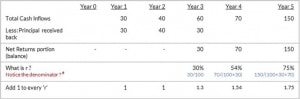
| # Denominator consists of the Principal Invested + all returns (pure income) received previously |
Putting ‘CAGR (Compounded Annual Growth Rate)’ in Context
Scenario:
Liberty Storage Partners, a real estate investment firm specializing in self-storage properties, recently acquired Chestnut Street Storage, a 120,000-square-foot self-storage facility located in Philadelphia, Pennsylvania. The acquisition was a Core-Plus investment, with the potential for both stable income and modest value appreciation. The property was purchased for $8 million, with the business plan involving light renovations and improved management practices to increase occupancy and rental rates.
Investment Overview:
- Purchase Price: $8 million
- Initial Occupancy: 75%
- Target Occupancy Post-Renovation: 90%
- Investment Holding Period: 5 years
- Total Equity Invested: $2 million
- Total Cash Inflows Over 5 Years: $4.5 million
- Net Cash Flow Year 5: $3.5 million (including the sale of the property at $10 million)
CAGR Calculation:
CAGR is a metric used to determine the annual growth rate of an investment over a specified period, considering the effect of compounding. It provides a smoothed rate of return, ideal for comparing the performance of different investments over time, even if they have uneven cash flows.
The formula to calculate CAGR is:
CAGR = (Final Value / Initial Value)^(1/n) – 1
Where:
- Final Value is the total value of the investment at the end of the holding period (including any sale proceeds and cash flows).
- Initial Value is the initial investment or equity invested.
- n is the number of years the investment is held.
Application:
For Chestnut Street Storage:
- Final Value = $4.5 million (Total cash inflows over 5 years)
- Initial Value = $2 million (Equity invested)
- n = 5 years
Using the CAGR formula:
CAGR = (4.5 million / 2 million)^(1/5) – 1
CAGR = (2.25)^(1/5) – 1
CAGR ≈ 1.176^(1/5) – 1 ≈ 0.176 or 17.6%
Interpretation:
The 17.6% CAGR indicates that Liberty Storage Partners achieved an average annual return of 17.6% over the 5-year period from their investment in Chestnut Street Storage. This reflects the compounded growth of the initial $2 million equity investment, accounting for both the periodic cash flows and the final sale of the property. The CAGR offers a clear, annualized view of the investment’s performance, making it easier to compare with other potential opportunities or benchmark returns.
This scenario underscores how CAGR can be an essential tool for investors to evaluate the long-term growth potential of real estate investments, particularly when cash flows are irregular or when the holding period spans multiple years.
Frequently Asked Questions about CAGR (Compounded Annual Growth Rate)
What is CAGR and how is it used in real estate investing?
CAGR, or Compounded Annual Growth Rate, is a metric that annualizes the returns of an investment over a specific period, showing the constant rate at which the investment would have grown. In real estate, it helps investors understand the average annual return from equity invested, accounting for compounding.
How is CAGR different from IRR?
CAGR provides a smoothed annual rate of return and does not consider the timing of cash flows. In contrast, IRR (Internal Rate of Return) considers the specific timing and magnitude of each cash flow, often producing higher or more volatile figures for uneven cash flows.
What is the formula for calculating CAGR?
The formula is:
CAGR = (Final Value / Initial Value)^(1/n) – 1
Where Final Value is the total cash inflows, Initial Value is the equity invested, and n is the number of invested years.
Can you provide an example of CAGR in use?
Yes. In the Chestnut Street Storage investment:
Initial Equity = $2 million
Total Cash Inflows = $4.5 million
Holding Period = 5 years
CAGR = (4.5 / 2)^(1/5) – 1 = 17.6%
What is the relationship between CAGR and the Geometric Mean?
CAGR and the Geometric Mean are effectively the same. Both measure the average annual growth rate of an investment over time, accounting for compounding, and are useful for smoothing volatile returns across multiple years.
When should investors prefer CAGR over IRR?
CAGR is preferable when cash flows are uneven or when the goal is to understand the smoothed annualized return over a long holding period. It provides a more conservative and simplified view than IRR.
Click here to get this CRE Glossary in an eBook (PDF) format.