

Model Context Protocol (MCP)
An open standard that allows artificial intelligence applications to connect with external tools, data, and systems in a consistent way. Model Context Protocol, or MCP, creates a standardized connection between an AI Harness and outside capabilities, allowing AI to access information and perform actions beyond what is contained within the underlying AI model.
Features such as Connectors in Claude or Plugins in ChatGPT are made possible thanks to MCP.
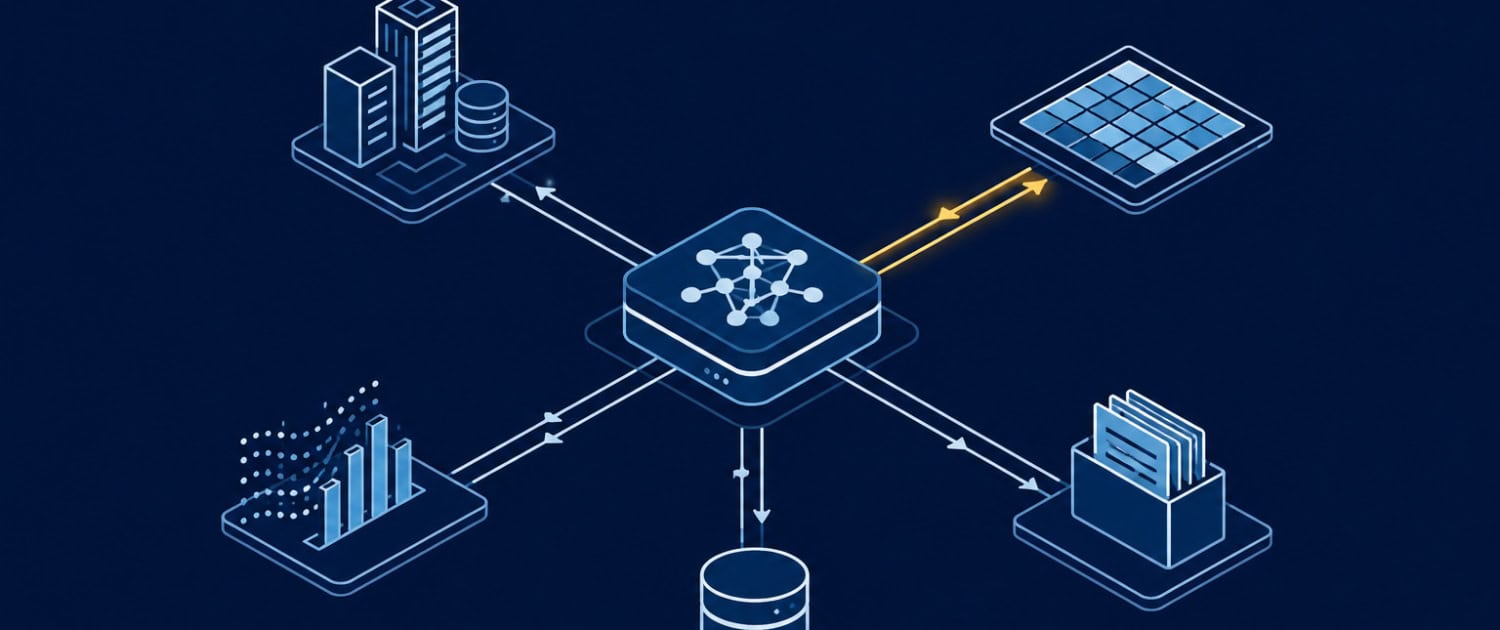
Putting Model Context Protocol (MCP) in Context
Large language models are incredibly capable, but the model itself is only one part of a useful AI system.
To perform real work, an AI often needs access to things outside the model.
It might need to search a database, retrieve a document, query a proprietary dataset, access a company’s internal knowledge, use a software tool, or execute a specialized workflow.
Historically, connecting AI applications to all of these outside systems required developers to build custom integrations.
Model Context Protocol, or MCP, provides a standardized way to make those connections.
Anthropic introduced MCP in 2024 as an open standard for connecting AI assistants to systems where data lives, including content repositories, business tools, and development environments. Rather than requiring every AI application and external system to create a unique integration with one another, MCP provides a common protocol through which they can communicate.
An analogy is USB.
Before standardized connections such as USB, different computer peripherals often required different proprietary connections. USB created a common interface between computers and a wide variety of external devices.
MCP attempts to solve a similar problem for AI.
Instead of creating a unique connection between every AI application and every external capability, MCP provides a common way for the two to communicate.
Frequently Asked Questions about Model Context Protocol (MCP)
What is Model Context Protocol (MCP)?
Model Context Protocol, or MCP, is an open standard that allows AI applications to connect with external tools, data, and systems in a consistent way.
Who created Model Context Protocol?
Anthropic introduced Model Context Protocol in 2024 as an open standard for connecting AI assistants with external data sources, tools, and systems.
Why does MCP matter?
MCP reduces the need to create a completely different integration between every AI application and every outside system. Instead, it provides a standardized protocol through which compatible AI applications and external capabilities can communicate.
What is an MCP server?
An MCP server makes external capabilities available to compatible AI applications through Model Context Protocol. Depending on the server, those capabilities might include tools, data, documents, specialized workflows, or connections to other software systems.
What is the difference between MCP and an AI Harness?
An AI Harness is the environment through which a person interacts with and uses AI. MCP is a protocol that can connect that environment to external tools, data, and other capabilities. In simple terms, the harness is the environment and MCP is the connection.
What is the difference between MCP and Context as a Service?
MCP provides a standardized way for AI applications to connect with external capabilities. Context as a Service provides specialized knowledge, methodologies, tools, and data that make an AI more useful within a particular domain. MCP can be one mechanism through which a Context as a Service provider delivers those capabilities to an AI Harness.
How can MCP be used in commercial real estate?
MCP can connect compatible AI Harnesses to commercial real estate-specific tools, data, and methodologies. CRE Agents, for example, uses MCP to make CRE-specific capabilities available to AI, allowing professionals to bring specialized real estate context into the AI environment where they already work.
Click here to get this CRE Glossary in an eBook (PDF) format.