

AI May Build a Model. Could You Sign Off On It?
An 18-point real estate financial modeling check for CRE professionals
One of the questions we hear most often today is some version of this: Is it still worth learning real estate financial modeling if AI is going to do it for me?

It’s a fair question, and as a team that has spent more than a decade building real estate financial models and teaching others to build them, our answer might surprise you. AI is already quite good at financial modeling. It’s getting better quickly, and in the hands of someone who knows what they’re doing, it can already handle meaningful portions of a model build. We use it ourselves, and we’ve built a growing library of AI Skills that pair with our own Excel models.
We know the limits firsthand, because building those AI Skills is what exposed them. Handed a blank prompt, general-purpose AI produces something that looks like a real estate model and quietly gets the mechanics wrong. Give it the structure, the conventions, and a reference file, and the output improves dramatically. That gap, between unguided and guided, is the subject of this article.
So, if your value as a real estate professional is simply that you can build a cash flow in Excel faster than the person sitting next to you, that advantage is shrinking. But that’s not really the skill that matters.
Regardless of who, or what, builds the model, someone still has to review it, defend the assumptions, and take responsibility for the output. Someone still has to walk into investment committee and explain a 17.2% IRR. Someone still has to tell a lender why the projected NOI supports the requested loan proceeds. And ultimately, someone still has to put their name behind the model.
So perhaps the better question isn’t, Can you build the model? It’s, Could you sign off on it?
Below are 18 real estate financial modeling skills we think every CRE professional responsible for underwriting should understand well enough to review, explain, and defend. It’s the same list we’ve built our training around for nearly a decade.
Why You Still Need to Learn How to Build a Real Estate Financial Model
Here’s the challenge with using AI for financial modeling: you can’t effectively check work that you don’t understand.
If a model produces an exit value, you need to know whether the terminal cap rate is reasonable, why it might differ from the going-in cap rate, and what happens to returns when you move that assumption 50 basis points. If an equity waterfall produces a promote, you need to understand how the preferred return, return of capital, catch-up, and hurdles interact. And if construction debt includes an interest reserve, you need to understand the circular relationship between draws, accrued interest, and the outstanding loan balance.
You learn those mechanics by building them. That doesn’t mean you’ll always build every model from scratch. In fact, we suspect AI will increasingly produce the first draft of many models. But someone still needs to tell the AI what to build, identify where it went wrong, correct the model, and ultimately take responsibility for the output. That’s why learning to build remains important.
Real Estate Financial Modeling Is Not Really About Excel
At A.CRE, we teach real estate financial modeling primarily in Excel because that’s where much of the industry still does its work. But Excel is the medium. It isn’t the subject.
The subject is how real estate cash flows behave: how revenue builds, when expenses hit, what happens when a lease rolls, how construction debt funds, how cash flows split between partners, and how all of those assumptions ultimately translate into value and investment returns.
Those mechanics existed before Excel and will exist long after today’s modeling tools have changed. If you understand the mechanics, you can adapt to whatever tool comes next. If you only memorize where the cells go, you’ll eventually have to start over.
The 18-Point Real Estate Financial Modeling Check
For each skill below, give yourself a score from 0 to 2:
0: I couldn’t confidently determine whether this was modeled correctly.
1: I could identify an obvious error, but I might miss a subtle one.
2: I could build it myself, explain the inputs, and defend the judgment calls.
There are 36 points available, but the total score matters less than where you scored 0 or 1. Those are the parts of a model you’re not yet ready to sign off on without help, and where you may be especially vulnerable to unguided AI output.
For each skill, we’ve included three things: the mechanic, or what needs to work mathematically; the check, or a quick way to identify whether something may be wrong; and the call, or the judgment that remains yours regardless of who, or what, built the model.
You’ll notice the 18 skills below barely mention AI. That’s deliberate. A rent roll is either modeled correctly or it isn’t, and the check is the same whether the file came from an analyst, a template you’ve used for years, or a prompt you wrote this morning.
Phase One: Real Estate Financial Modeling Foundations
1. Can you structure a workbook that someone else can audit?
The mechanic: Assumptions should be easy to identify, calculations should flow logically, and hardcoded numbers shouldn’t be buried inside formulas. Our modeling best practices and walkthrough on setting up date and period headers are a good place to start on these conventions.
The check: Pick an important output and trace it backward. Can you quickly get from the output to the underlying assumptions? If not, the model is difficult to audit.
The call: Deciding what belongs as an assumption. Every hardcoded input represents a decision, whether the modeler explicitly acknowledges it or not.
2. Can you value a stabilized property using direct capitalization and defend the cap rate?
The mechanic: Stabilized NOI divided by a capitalization rate. Our A.CRE 101 article on the income capitalization approach is a good introduction to the mechanics.
The check: Confirm what NOI you’re capitalizing. Does it include appropriate management fees and reserves? Is it trailing NOI or forward NOI?
The call: The cap rate. There is no formula that tells you exactly what a buyer will pay. Selecting the cap rate is ultimately a market judgment that you need to defend.
3. Can you value the same property using a DCF and explain why the values differ?
The mechanic: Project the future cash flows, discount those cash flows, and add the discounted value of the reversion.
The check: Compare the DCF value to the direct capitalization value and understand what assumptions are driving the difference.
The call: The discount rate, growth assumptions, and terminal value assumptions. A DCF is ultimately a set of claims about what happens between today and the exit.
4. Can you build a 10-year DCF line by line?
The mechanic: Build potential gross revenue down through vacancy and credit loss, operating expenses, capital items, and ultimately unlevered cash flow.
The check: Look closely at the transition from NOI to cash flow. Tenant improvements, leasing commissions, and capital expenditures generally sit below NOI. If they’re missing, the model may materially overstate cash flow.
The call: What is recurring versus capital. Reasonable people may classify certain items differently, and that decision can meaningfully affect value.
5. Can you calculate IRR, equity multiple, and cash-on-cash return, and explain which metric matters?
The mechanic: Each metric measures the same investment differently.
The check: Change the hold period. IRR and equity multiple should respond differently because IRR incorporates time while equity multiple does not.
The call: Which return metric deserves emphasis. A high IRR over a short hold and a lower IRR over a long hold tell very different stories.
Phase Two: Property-Type Underwriting
6. Can you build a retail income statement with percentage rent and tenant-specific recoveries?
The mechanic: Base rent, percentage rent above the applicable breakpoint, and recoveries that may differ by tenant.
The check: Confirm how the breakpoint is calculated and make sure percentage rent is triggered only when appropriate.
The call: Tenant sales. You’re forecasting the performance of someone else’s business, so precision should be treated accordingly.
7. Can you build a hotel income statement from ADR and occupancy?
The mechanic: ADR and occupancy drive RevPAR and rooms revenue, followed by departmental expenses, undistributed expenses, management fees, and fixed charges.
The check: Reduce occupancy and see how expenses react. A hotel model should appropriately distinguish between fixed and variable costs.
The call: The relationship between ADR and occupancy. Raising both indefinitely isn’t a realistic operating strategy.
8. Can you model office leases under both full service gross and triple net structures?
The mechanic: Understand how expenses and reimbursements flow differently under each lease structure.
The check: Find the expense stops. Under a full service structure, the landlord typically absorbs expenses up to the applicable stop before recovering excess expenses.
The call: Selecting the appropriate base year and confirming that the modeled recovery structure actually reflects the lease documents.
9. Can you build a multifamily income statement with loss to lease and concessions?
The mechanic: Start with gross potential rent, then account for loss to lease, concessions, vacancy, bad debt, non-revenue units, and other income.
The check: Compare physical occupancy with economic occupancy. If the two are identical despite concessions, loss to lease, or bad debt, something deserves a closer look.
The call: Whether loss to lease represents a genuine mark-to-market opportunity or a persistent feature of the property or submarket.
10. Can you build an industrial income statement and correctly model reimbursements?
The mechanic: Base rent plus recoveries, with expenses flowing through the applicable reimbursement structure.
The check: Compare reimbursement income to recoverable expenses and make sure the relationship makes sense under the leases.
The call: The recovery structure itself. The model needs to reflect the leases, not simply the shorthand found in a rent roll.
Phase Three: Advanced Real Estate Financial Modeling Mechanics
11. Can you model a rent roll lease by lease, including rollover, downtime, TI, and LC?
The mechanic: Existing leases expire. Some tenants renew and others don’t. New leases require assumptions around downtime, tenant improvements, leasing commissions, and market rent.
The check: Follow the largest tenant through expiration. Does rent stop during downtime? Do TI and LC hit in the correct period? Does the replacement lease begin at the appropriate rent?
The call: Renewal probability and downtime. Those are judgments about a specific tenant, property, and market. If you want to see the mechanics built step by step, watch us build a tenant rollover analysis model.
12. Can you build a development budget and construction draw schedule?
The mechanic: Development costs need to occur over a timeline that reflects how the project will actually be built.
The check: Look at the timing of major hard costs relative to acquisition, permitting, and construction milestones. A straight-line construction schedule may be mathematically convenient but operationally unrealistic.
The call: The development timeline and shape of the construction spend. Both materially affect financing needs and returns.
13. Can you model a loan with amortization, an interest-only period, and a binding sizing constraint?
The mechanic: Debt may be constrained by LTV, LTC, DSCR, debt yield, or some combination of those metrics before amortization is considered.
The check: Change the interest rate and observe what happens to loan proceeds. If a coverage constraint should be binding but proceeds don’t change, inspect the sizing mechanics.
The call: Which constraint is likely to bind and whether the modeled loan terms are actually available in the market.
14. Can you model construction debt with an interest reserve?
The mechanic: Construction debt funds project costs while unpaid interest may accrue to the loan balance. That additional balance creates additional interest, producing a circular calculation.
The check: Tie the ending loan balance back to draws and accrued interest. If it doesn’t reconcile, determine how the circularity was resolved. Our Construction Draw and Interest Calculation Model shows one approach, and The Circuit Breaker covers how to handle the circularity itself.
The call: Whether the interest reserve is sufficient for the construction schedule, including the impact of delays.
15. Can you build an equity waterfall with a preferred return, catch-up, and multiple hurdles?
The mechanic: Cash flows through a series of distribution tiers, with different splits applying as various hurdles are achieved.
The check: Tie total distributions across every tier back to total distributable cash. Then change the exit proceeds and make sure the promote responds as expected.
The call: Whether the modeled waterfall actually matches the operating agreement. A waterfall can work perfectly in Excel and still be wrong legally. For the mechanics, see our equity waterfall model with catch up and clawback.
Phase Four: Can You Put It All Together?
The final three skills are different because they’re less about an individual mechanic and more about integration. At this point, the question is whether you can take the individual pieces and make them work together inside a model someone else can understand and use.
16. Can you build an acquisition model from a blank workbook?
The build: Assumptions, rent roll, operating cash flow, debt, returns, and a summary that another person can understand, without starting from a template.
The check: Give the model to a colleague. Every place they have to ask what something means is an opportunity to improve the model.
The call: What to include and what to leave out. More complexity doesn’t necessarily produce a better model.
17. Can you build a development model from a blank workbook?
The build: Everything in an acquisition model, plus the construction period, development budget, draw schedule, construction loan, lease-up, and transition to stabilized operations.
The check: Follow a dollar of equity from the first capital contribution through the final distribution. You should be able to explain its path through the model.
The call: The timeline. Nearly every output in a development model is affected by assumptions about how long things take.
18. Can you build a value-add model from a blank workbook?
The build: Combine an operating property with a renovation program and model the transition from in-place operations through stabilization.
The check: Focus on the period when renovation ends and stabilization begins. Capital spending, downtime, renovated rents, and lease-up should transition logically.
The call: The renovation premium. You’re making a claim that a certain amount of capital will generate a certain increase in rent. In many value-add deals, that assumption is the deal thesis.
What Does Your Score Tell You?
Add up your score out of 36, but don’t get too hung up on the number. The more useful exercise is to look at your 0s, 1s, and 2s.
A 0 is a part of a model you’re largely trusting someone else to get right. A 1 is an area where you have enough knowledge to review the obvious issues, but perhaps not enough to identify a subtle error. A 2 is something you can build, explain, and defend.
That’s why we think the number of 2s is actually more interesting than the total score. Your 2s represent your current sign-off ceiling. They’re the portions of a model that you could comfortably stand behind if an investment committee member, lender, partner, or client started asking questions. The remaining skills provide a roadmap for what to learn next.
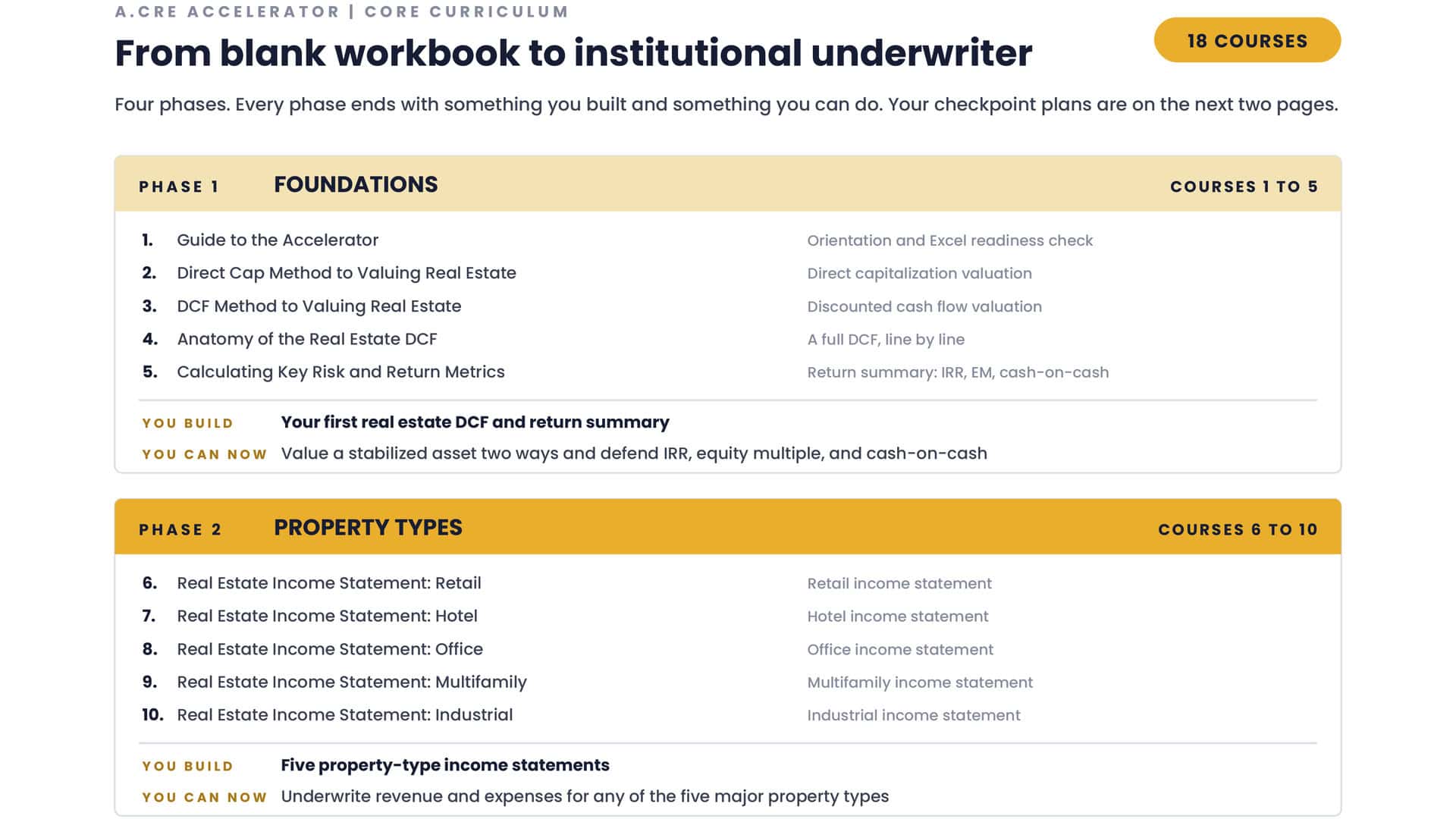
We’ve also put these 18 skills into a printable checkpoint plan, organized around the same four phases. That sequence is not arbitrary. It’s how we built the Accelerator curriculum, because it’s the order these skills actually have to be learned in. Score yourself, identify your gaps, and come back to it in 90 days.
AI Changes the Modeler’s Job, Not the Need to Understand the Model
This brings us back to AI. We don’t think AI makes real estate financial modeling skills irrelevant. We think it makes them more important.
As AI-generated models improve, errors will become harder to identify visually. The formatting will look right, the formulas will look reasonable, and the outputs will be plausible. Increasingly, the mistake won’t be arithmetic. It’ll be an exit cap rate nobody really thought through, a renewal probability that doesn’t reflect the tenant, a reimbursement structure that doesn’t match the lease, a construction timeline that’s too aggressive, or an operating agreement that doesn’t match the modeled waterfall.
Those aren’t Excel problems. They’re underwriting problems.
And that’s why we suspect the job of a strong real estate financial modeler will change. Instead of spending all of your time physically building models, you may spend more of it directing, reviewing, testing, and interpreting models built with the help of AI. If you’re reviewing four models instead of manually building one, the ability to quickly identify where each model is most likely to be wrong becomes incredibly valuable.
We’ve said for years that the purpose of learning real estate financial modeling isn’t simply to become good at Excel. It’s to understand a real estate investment well enough to know what is driving the deal. AI doesn’t change that. If anything, it makes the distinction clearer.
Where to Start
If this exercise exposed a few gaps, good. That’s the point.
Don’t start with the most complicated item on the list just because it sounds advanced. The progression above is intentional. Learn how NOI works before building a waterfall. Understand direct capitalization before debating terminal value. Learn property-level cash flow before layering on complicated debt. And understand the mechanics yourself before asking AI to reproduce them.
Everything linked throughout this article is available free in the A.CRE library of Excel models, so you can work through individual concepts as needed. If you’d rather test yourself against a full deal than a checklist, our library of real estate case studies is free as well.
What neither one gives you is the part that actually moves a 0 to a 2: building each component yourself, against a real case, in order, with somebody to ask when you get stuck. That is the A.CRE Accelerator, and these 18 skills are its curriculum.
Either way, the goal is the same. The next time someone hands you a model, whether it was built by an analyst, downloaded from A.CRE, or generated by AI, ask yourself one question: Could I put my name on this?
If the answer is yes, you’re not just operating the model. You understand it, and you can sign off on it.
