
Case Study #5 – The Jefferson Branded Condo Development – Case Only (Updated June 2024)
This is the fifth in a series of commercial real estate case studies shared by A.CRE. These case studies are meant to help you practice to master real estate financial modeling. The Jefferson Branded Condo Development puts you in the position of boutique condo developer considering investing in a to-be-built branded condo project. You are asked to assess the viability of a condo development project, including a challenging task of managing both a land loan and a construction loan that takes out the land loan at the commencement of construction.
This case is also the first that looks at for-sale real estate, rather than for-rent real estate. It thus becomes necessary to forecast sales over some period of time, as well as manage the payoff of the construction loan over time.
Practice makes perfect!
Each case study shared in this series mirrors real world situations, either in terms of the types of deals you will look at in various roles or the types of modeling tests you’ll be required to perform as part of the interview process. You can browse this and other case studies in the A.CRE Library of Real Estate Case Studies.
Are you an Accelerator Advanced member? Download this case study and view the solution file in the Career Advancement Endorsement. Not yet an Accelerator member? Consider enrolling today in the Accelerator, the industry’s go-to real estate financial modeling training program used by top companies and elite universities to train the next generation of CRE professionals.
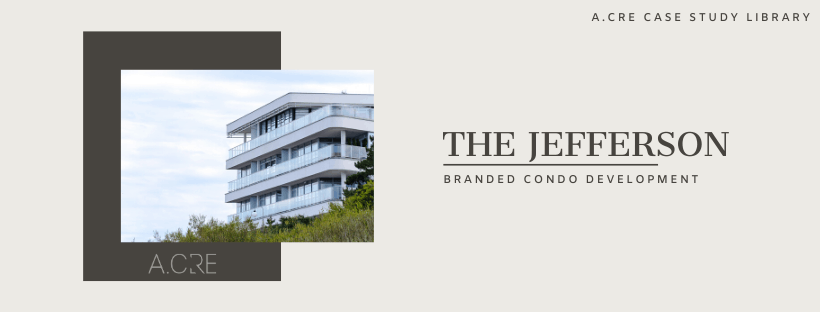
The Jefferson – Branded Condo Development
You are the owner A.CRE Development Company, a boutique developer of single-family and condo development projects. Your company has developed nearly 2500 units over the past decade in South Florida. Your target market largely consists of high net worth, international, second-home buyers who place great value on brand, location, and quality.
Given that your company is relatively unknown, you’ve found great success in the branded residences concept. You believe that by partnering with luxury brands, you’re able to communicate a certain level of quality and exclusivity that allows you to sell your units at a greater velocity and price.
You recently completed a $90 million Two Seasons branded condo project and have closed on 40% of the units. You expect to fully close out of that project within the next 12 months, and so you’re looking for your next project. Among several opportunities you’re considering, your favorite brokerage firm recently presented you with the chance to purchase a fully entitled project code-named “The Jefferson“.
The Jefferson – 55 Luxury Branded Condos
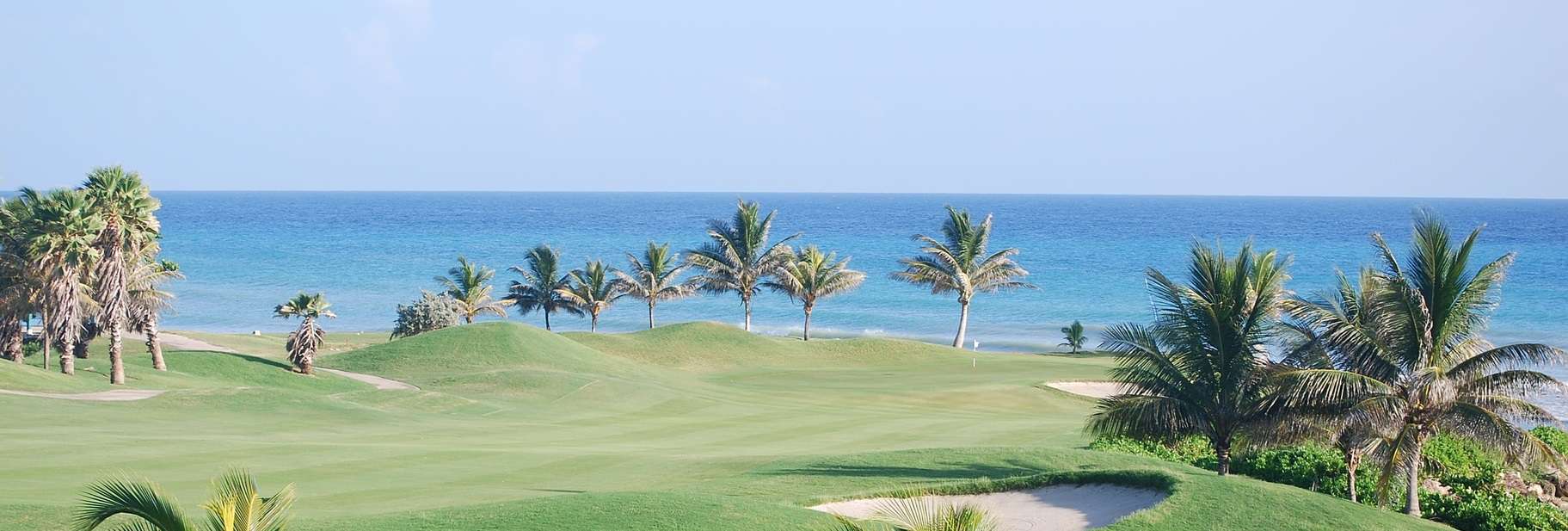
The Jefferson is a 1.9 acre parcel of land fully entitled for 55 condo units in a five-story building. The parcel lies at the center of a 330-acre master-planned resort community on the ocean consisting of a Tiger Nicklaus 18-hole championship golf course, a 300-key Harriott Hotel, 60,000 SF of high-end retail, two restaurants, and 220 luxury single-family homes.
The site sits 200 yards from the ocean, with units in the upper two floors of The Jefferson expected to enjoy pristine golf and ocean views. A walking trail leads from the building to the beach, passing between the 16th and 17th holes of the Tiger Nicklaus course. To maintain an air of exclusivity and luxury, the master plan requires that The Jefferson be branded ‘Harriott Residences at The Jefferson’. This branding carries a fee of 4%, which you believe can be recaptured in the form of higher unit prices.
Given your track record with this type of development, the master developer is giving you a first look at this opportunity. She is asking $28.75 million for the entitled land. You expect 12 months will be needed to finalize the building plans, fully bid out the project, and secure the building permits (i.e. pre-construction).
You expect to presell ~25% of the units, with the balance of the units selling at a rate of four units per month after construction completion. While Florida law, in certain instances, allows for condo buyer deposits to be used by the developer for actual construction and development of the condo building, you do not generally rely on those deposits to fund your projects.
Instead, you require a 10% of purchase price deposit and then simply put that deposit in a special escrow account with an independent agent. You don’t touch the deposit until the purchaser closes on the condo at completion.
The master developer has asked you to provide an answer this week as to whether you’re interested in moving forward. You have the schematic design complete, and your GC has provided estimated costs. Based on that, you have the assumptions you need to perform the financial analysis and make a decision.
The Jefferson – Assumptions
- Physical Description
- Land Area: 1.9 acres (82,764 SF)
- Building Area: 90,000 SF (18,000 SF per floor)
- Number of units: 55 (Floor 1: 5, Floor 2: 15, Floor 3: 15, Floor 4: 15, Floor 5: 5)
- Development Costs (Uses of Capital)
- Land acquisition cost, including closing costs: $28,750,000
- Pre-construction cost: $30,000/month for 12 months
- Hard costs: $350/SF
- Soft costs: $100/SF
- Sources of Capital
- Land loan: 50% LTC, 7% interest paid current, 1 point in 1 point out, 30/360 actual, funds at land acquisition (month 0), payoff in month 13
- Construction loan: – $50 million, 350 bps over Libor, assume Libor is 150 bps average, interest accrues 30/360 actual, pays off land loan in month 13 and funds 100% of construction until $50 million deployed, 100% of sale proceeds used to payoff loan until fully repaid
- Equity: Funds all uses not covered by land loan or construction loan
- Project Timing
- Land purchase: At analysis start (i.e. month 0)
- Pre-construction period: 12 months
- Construction period: 24 months
- Absorption
- Pre-sale units: 15
- Unit sales per month thereafter: 4 units/month
- Selling Assumptions
- Average unit sales price: $1,250/SF
- 4% branding fee from sales proceeds
- 3 % broker commission from sales proceeds
The Jefferson – Task
The Jefferson – Questions
- You generally target a 20% profit margin (net profit ÷ total project cost) and a 1.50x equity multiple on your investments. Based on those target metrics, is this project worth pursuing?
- How much equity will be required to fund this project?
CREATE YOUR OWN CASE STUDY
This case study offers a view of the strategic decisions involved in a real estate condo development project. As you apply the provided data and strategies in your financial models, you’ll gain insights into optimizing asset value and ensuring investment criteria are met, key skills for any CRE professional. For those looking to deepen their expertise, our Real Estate Case Study Creator provides a platform to test and enhance your modeling skills in a controlled, realistic setting.
This GPT creates completely custom real estate case studies from scratch and allows users to craft case studies to simulate scenarios they are interested in or expect to encounter in their professional lives. This customization allows users to focus on particular areas of interest or challenge, making the practice sessions as relevant and effective as possible.
Additionally, after completing this Case Study #5 – The Jefferson, you can use the Real Estate Case Study Creator GPT to analyze your results and provide an assessment of your strategies and outcomes. We encourage both seasoned practitioners and newcomers to use this resource to refine their approach and decision-making in commercial real estate investments.
- Note: Custom GPTs are now available to both paid and free users of ChatGPT. Click here to learn more.
Frequently Asked Questions about Case Study #5 – The Jefferson Branded Condo Development
What is the core objective of the Jefferson case study?
The case study challenges users to evaluate the viability of a luxury branded condo development. It requires modeling project cash flows, managing both a land loan and construction loan, forecasting sales, and calculating key return metrics such as unlevered/levered IRR, EMx, and net profit.
What makes this case different from previous A.CRE case studies?
This is the first A.CRE case study to focus on for-sale real estate rather than for-rent. It introduces complexities like unit sales absorption, presales, and a dual-loan structure, which more closely reflect the challenges of condo development.
What are the key sales assumptions for this development?
Key assumptions include an average unit sales price of $1,250/SF, a 4% branding fee, a 3% broker commission, and an expected presale of 15 units. Remaining units are expected to sell at a rate of 4 per month post-construction.
What are the major sources and uses of capital in this case?
Uses of capital include $28.75M for land, $30,000/month in pre-construction costs over 12 months, $350/SF in hard costs, and $100/SF in soft costs. Sources of capital are a 50% LTC land loan, a $50M construction loan, and equity funding the remainder.
How does the loan structure affect cash flow modeling?
The land loan is paid current with interest during the 12-month pre-construction period and is taken out by the construction loan at month 13. The construction loan accrues interest and is repaid from sales proceeds, impacting timing and equity needs.
What metrics should be calculated to evaluate this project?
You are asked to calculate unlevered and levered IRR, equity multiple (EMx), and net profit. A sensitivity analysis on sales price per square foot is also required to assess how returns shift with changes in revenue assumptions.
What are the developer’s investment targets for this project?
The targets include a 20% profit margin (net profit ÷ total project cost) and a 1.50x equity multiple. These benchmarks guide the go/no-go decision for the developer.
Is this case study suitable for interview prep?
Yes. It mirrors real-world investment decisions and financial modeling challenges common in CRE interview tests, especially for roles involving development underwriting or capital markets.
Can the developer use condo deposits for construction?
While Florida law may allow it in some cases, the developer in this scenario does not use buyer deposits to fund development. Instead, 10% deposits are held in escrow and only released upon final closing.
Where can I download and practice this case study?
You can find this case study in the A.CRE Library of Real Estate Case Studies. Accelerator Advanced members can also access the solution and analysis file through the Career Advancement Endorsement.