
Software 3.0 and What it Means for Real Estate Professionals
A couple of months ago, I shared a blog post detailing how I built a DCF Web App using an AI coding tool. What once would have required either deep technical skills or a developer’s help took less than 10 minutes to build, with ChatGPT and Lovable doing most of the heavy lifting.
That experience got me thinking. I’ve recently been hearing more and more about “Software 3.0” and realized it’s directly tied to what I and many of you are beginning to do – leverage powerful AI models to build custom tools, automate workflows, and speed up our decision-making. It marks a shift where the actual users of software, not just engineers, are building the tools they need.
And that’s a big deal.
So, if you’re unfamiliar. Allow me to introduce you to the term Software 3.0 and share my thoughts on its ramifications for us as CRE professionals.
What is Software 3.0?
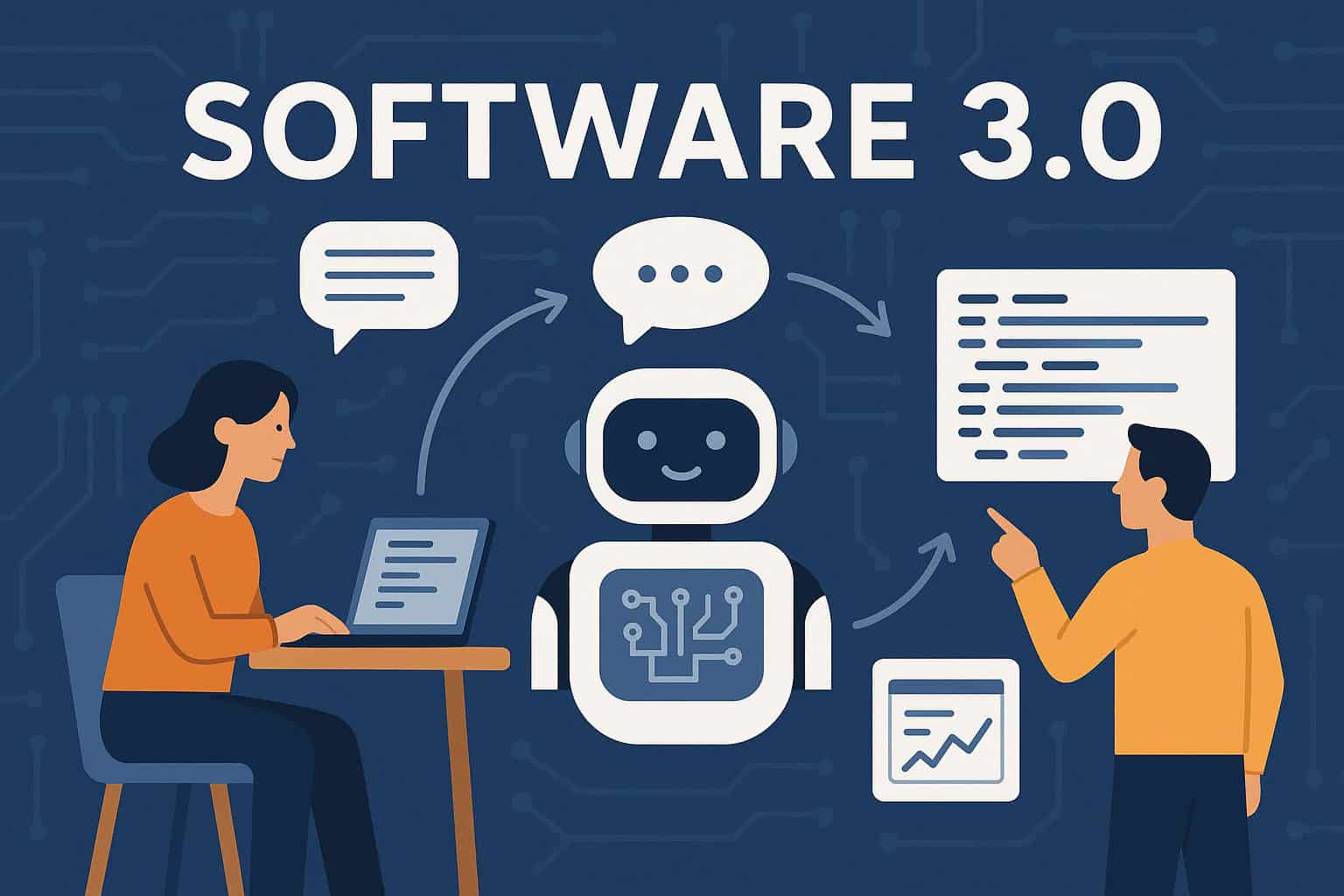
Software 3.0 is a new paradigm in software development that moves beyond explicitly writing code (Software 1.0) or training machine learning models (Software 2.0). In the Software 3.0 era, we build software by prompting large, pre-trained AI models with natural language.
Andrej Karpathy, former director of artificial intelligence at Tesla and co-founder of OpenAI, has championed the idea of software 3.0. Discussing the concept in his recent keynote at AI Startup School, Karpathy described natural language prompts as the new code.
“The hottest new programming language is English” – Andrej Karpathy
Instead of coding every line or needing a massive labeled dataset, you now tell the AI what you want, and it writes the code, drafts the memo, runs the analysis, or builds the app. Tools like ChatGPT, Claude, Lovable, (or even my own CRE Agents – couldn’t help the shameless plug!) are powered by foundation models that already know a ton about language, data, and logic. You just guide them.
This shift democratizes software creation, or as I would reframe it: Solution Creation. Anyone with domain knowledge and a bit of prompting skill can create bespoke tools. It’s a big leap from where we were even three years ago.
What This Means for Commercial Real Estate Professionals
So, what does this mean for us as commercial real estate professionals? Here are my thoughts:
The Builders Are the Users
We’re entering a time when real estate professionals – not software developers – are best positioned to build the tools they use. Why?
Because we understand the workflows, pain points, and decision frameworks. Using certain AI tools, a broker can build a custom proposal generator. An analyst can automate rent roll reviews. Or a developer can quickly sketch site plans. All using natural language rather than code.
Domain Knowledge Still Matters (More Than Ever)
While you might not have to build a 3-tier equity waterfall model in Excel from scratch in the future, you’d better know how it’s built and how it works. Because you’ll be the one guiding the AI to build it. If you can’t explain the logic, sequence, or return metrics, the AI won’t magically get it right.
Domain knowledge becomes your most valuable prompting input.
In fact, as AI tools become more capable, the importance of understanding the underlying task increases. The AI can build the model, write the memo, or run the analysis. But only if you clearly articulate what needs to be done and why. That articulation relies entirely on your domain expertise.
Think about how you’d instruct a junior analyst to build a model: you’d walk them through assumptions, logic, outputs, and edge cases. The same is now true for AI tools. And just like with a human analyst, if you don’t understand the task well enough to teach it, you’re not going to get a great result.
New Skills: Prompt Engineering + Tool Awareness
Creating the aforementioned DCF Web App required three things: (a) financial modeling knowledge, (b) the ability to instruct ChatGPT clearly (i.e. prompt engineering), and (c) knowing which AI tools could execute the task.
These are the emerging skill sets that will differentiate AI-native professionals from the rest.
In fact, I didn’t just ask ChatGPT to build the app. I first modeled the DCF in Excel, had ChatGPT analyze and explain the model, then prompted it to draft code using Lovable.
All of that required clear logic and communication; the modern equivalent of knowing both what you want and how to get it built.

Early Movers Will Have an Edge
We’re still early in this shift – especially in our industry. That means the few who learn how to use “Software 3.0” tools (i.e. become an AI-native CRE professional) effectively will stand out. Whether it’s faster analysis, smarter underwriting, better client service, 100x the output, or just having more time to do high value things, early adopters will do more, faster, and cheaper.
Eventually, just like spreadsheets or cloud storage, these capabilities will become the norm. But today, they are a competitive advantage.
Final Thoughts – Explore the Topic in Podcast Style
I wanted to share this concept of Software 3.0 not because I think the term itself matters all that much, but because the shift it describes is real and is coming to our industry.
To give you another way to explore this concept, I created a NotebookLM Podcast that discusses this. Check it out:
Here’s to the exciting future ahead!
Frequently Asked Questions about Software 3.0 and What it Means for Real Estate Professionals
What is Software 3.0?
Software 3.0 is a paradigm where users build software not by coding or training models, but by prompting large, pre-trained AI models using natural language. As Spencer Burton notes, “you now tell the AI what you want, and it writes the code, drafts the memo, runs the analysis, or builds the app.”
How does Software 3.0 differ from previous software paradigms?
Software 1.0 involved traditional hand-written code. Software 2.0 introduced machine learning models trained on large datasets. Software 3.0 uses natural language prompts to instruct foundation models that are already trained and capable of generating software or solutions on demand.
Why is Software 3.0 important for commercial real estate (CRE) professionals?
It allows CRE professionals to create custom tools, automate workflows, and enhance decision-making without needing to write code. As the blog states, “real estate professionals – not software developers – are best positioned to build the tools they use.”
What role does domain knowledge play in the Software 3.0 era?
Domain knowledge becomes essential. Spencer emphasizes, “Domain knowledge becomes your most valuable prompting input.” You must understand the logic and purpose behind the task to properly instruct the AI to build it.
What new skills do CRE professionals need to thrive in Software 3.0?
Key emerging skills include:
Prompt engineering (clearly instructing AI)
Tool awareness (knowing which AI tools to use)
Process design (structuring workflows the AI can execute)
These allow professionals to build solutions faster and more effectively.
Can you give an example of a Software 3.0 tool built by a CRE professional?
Yes. The author built a DCF Web App in under 10 minutes using ChatGPT and Lovable. He first modeled the DCF in Excel, then prompted ChatGPT to generate and explain code, and finally used Lovable to convert that code into a working web app.
Why do early adopters of Software 3.0 have a competitive edge?
Spencer states, “The few who learn how to use ‘Software 3.0’ tools effectively will stand out.” Early adopters can do more, faster, and cheaper—creating models, automations, or client tools that improve performance and productivity before it becomes standard.
Will traditional coding still be necessary?
While traditional coding may still be useful, Software 3.0 lowers the barrier for creating tools. “The hottest new programming language is English,” says Andrej Karpathy, highlighting that clear communication and logic are replacing code for many tasks.