

Double Your Output with AI in 2026 Workshop: The Multiplier Framework for CRE (Updated Jan 2026)
On January 15, over 700 commercial real estate professionals joined me live (nearly 1,400 registered) to learn a simple idea:
Any CRE professional, regardless of technical skill or AI knowledge, can multiply their output.
Not by working longer hours. Not by hiring a bigger team. But by taking a disciplined, systematic approach to the work that sits between you and your results, then using AI and automation to collapse the time required.
If you missed the live session, or want to go deeper, this post gives you:
- The full 90‑minute workshop replay
- A clear walkthrough of the five‑step Multiplier Framework
- A link to the Multiplier Framework app, a free tool we built to help you apply this
- Pointers to AI.Edge and CRE Agents if you want to learn more and build custom solutions
Watch the 90‑Minute Workshop Replay
Note: Click here and then scroll about halfway down the page to find the slides used in the workshop
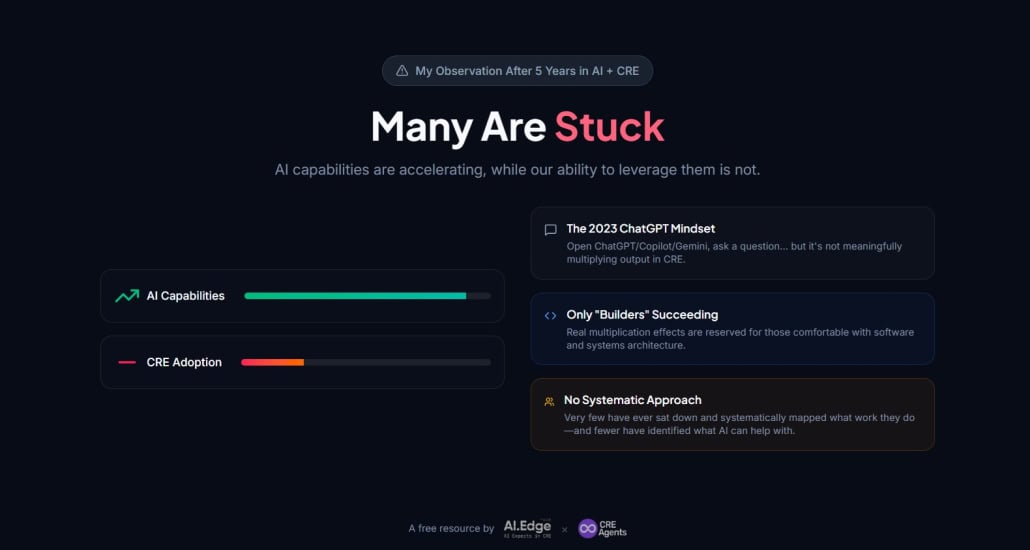
Why Most CRE Professionals Are Still “Stuck in 2023”
We ran a poll during the workshop. Over 70 percent of attendees said they use AI only occasionally and without any systemized approach.
Most are in a 2023 ChatGPT mindset:
- Use AI Chat as a smarter search engine
- Ask it to draft an email or memo here and there
- Get burned once or twice by hallucinations
- Then more or less stop pushing forward
Meanwhile, the technology has quietly leaped ahead in the last 6 months. It can now:
- Monitor inboxes
- Parse offering memorandums
- Trigger workflows
- Move data between systems
- Draft and redraft analysis as information changes
In other words, it can start to do work, not just answer questions.
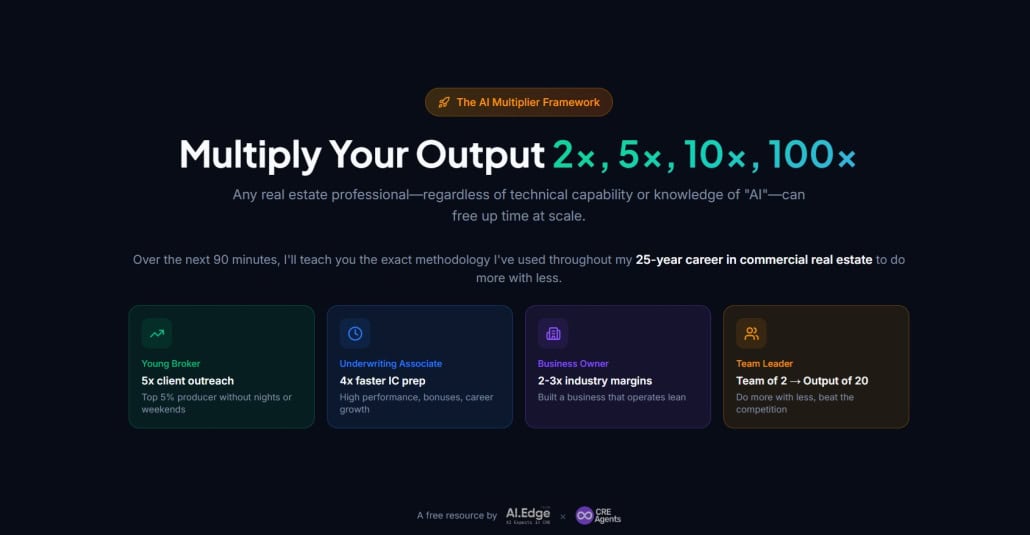
During my career I have used versions of this framework to:
- Reach out to roughly 5 times as many prospective clients as a young broker
- Cut IC prep time by roughly 75 percent as an underwriting associate
- Double margins in my current business
- Help a team of 2 produce work equivalent to a team of 20 at Stablewood
The hard part is not the implementation. The hard part is finding the multipliers! Once you know what you need, implementation is usually easier than people think.
The Deeper Why: Time Is Our Most Valuable Asset
As we get older, something interesting happens. The value of a dollar goes down in our personal calculus. The value of time goes up.
In the workshop, I shared the story of John, a 90‑year‑old farmer. He owned incredibly valuable land. Developers tried for years to buy it. At one point he said, “I might have one good year left. I do not want to spend that year negotiating a sale.”
At that point, more money did not matter. More time did.
I am past midlife now. I feel that shift personally. The real promise of AI in CRE is not just more fees, higher carry, or a bigger bonus. It is the ability to unlock time at scale in a way no previous technology has.
That is what the Multiplier Framework is designed to do.
The Five‑Step Multiplier Framework
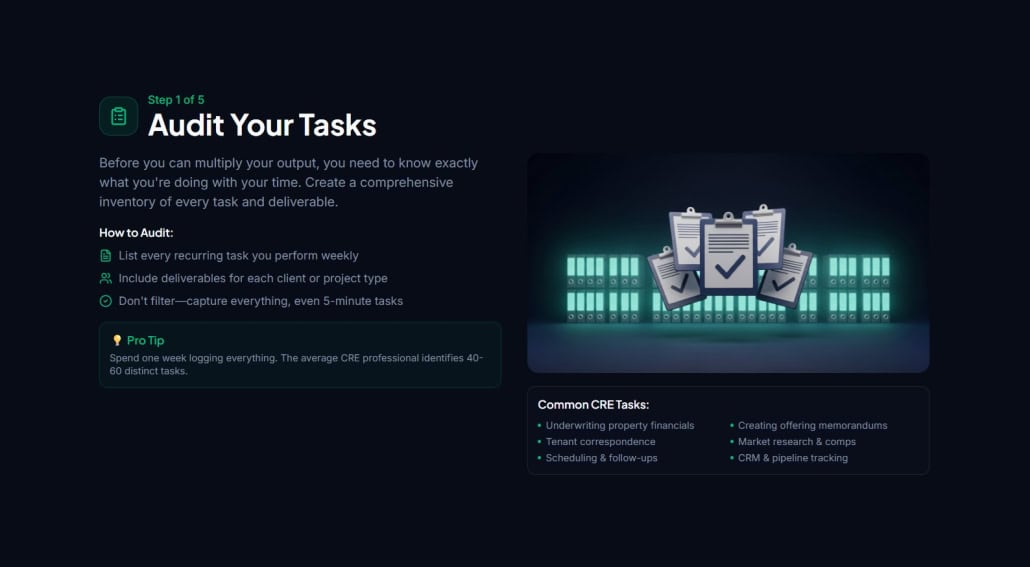
Step 1: Audit Your Work
Most of us think in deliverables, not tasks.
- Deliverables: “Quarterly report,” “acquisition model,” “IC memo,” “LOI”
- Tasks: “Download OM,” “pull rent roll,” “extract unit mix,” “update assumptions,” “paste charts into PowerPoint”
When you say, “I build a financial model,” that is a deliverable. The real work is the 20 to 50 micro tasks inside that deliverable.
What to do
- For the next 6 weeks, take a simple daily inventory:
- What deliverables did you work on today?
- For each, what tasks did you perform?
You can do this in a notebook, Excel, Notion, or directly inside the Multiplier Framework app. The goal is to see your job as a collection of repeatable tasks, not just big, amorphous outputs.
Step 2: Quantify the Impact
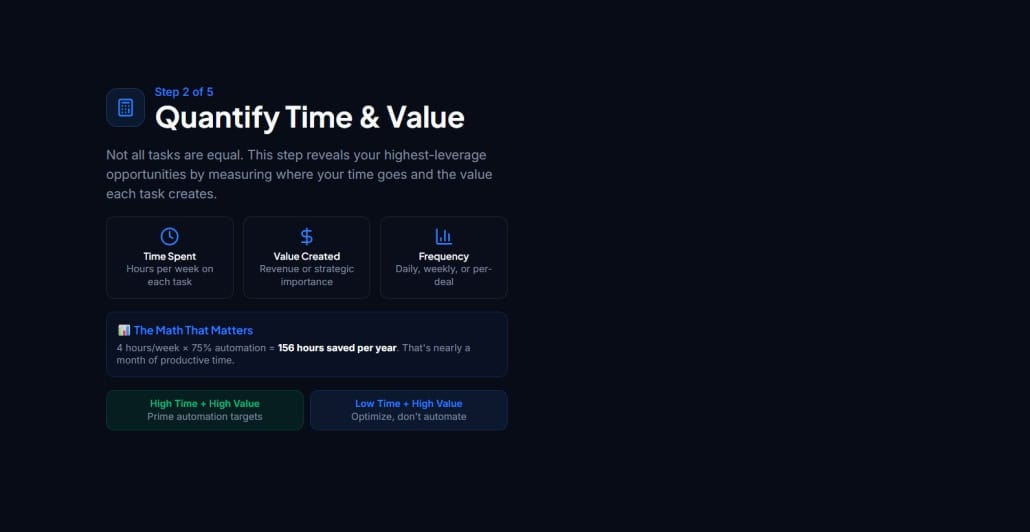
Next, you quantify the impact of automating or partially automating each task.
Think in three types of value:
- Hours saved
- Revenue impact (fees, promote, commissions)
- Expense reduction (salary, overhead, opportunity cost)
Examples:
- If an analyst earns 50 per hour and spends 50 hours per month on a recurring process, that is 2,500 per month. Cutting it in half saves 1,250 per month.
- If closing a deal generates 100,000 in fees, and a task meaningfully improves your hit rate or cycle time, you can allocate part of that value to the underlying work.
This step matters for everyone:
- Principals focus on revenue generation and cost reduction
- Employees and analysts improve bonuses, annual reviews, job security, and market value
- Students become far more competitive if they can show they know how to multiply output, not just complete work
Inside the app, you can assign a value and frequency to each deliverable, then let the math roll up to show where the biggest multipliers are.
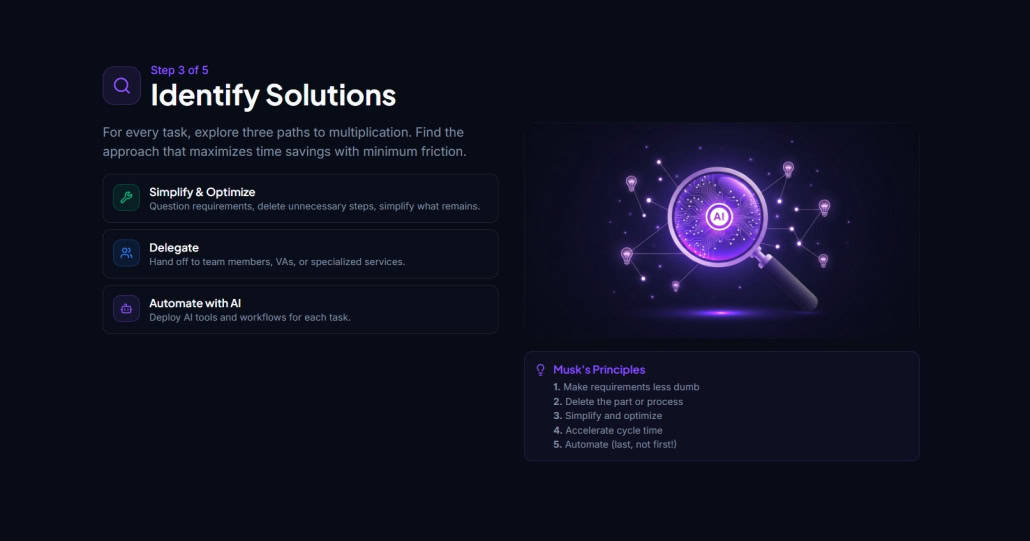
Step 3: Identify Solutions
Once you have a prioritized list of tasks, you brainstorm solutions.
Important point: Solutions are not always technology first.
In order:
- Make requirements less dumb
- Ask, “Do we actually need this?” or “Does it need to be this complex?”
- Delete
- Many recurring tasks exist because “we have always done it this way.”
- Delegate
- To teammates, offshore support, vendors, or specialized services.
- Automate
- Only after you have simplified and trimmed.
On tools, quality problems usually come from:
- Using the wrong tool for the job
- Not understanding what the tool needs from you to perform reliably
In the Multiplier Framework app, we built a database of third‑party AI tools, plus a growing catalog of potential CRE Agents skills and custom solution patterns, so you can browse ideas instead of starting with a blank page.
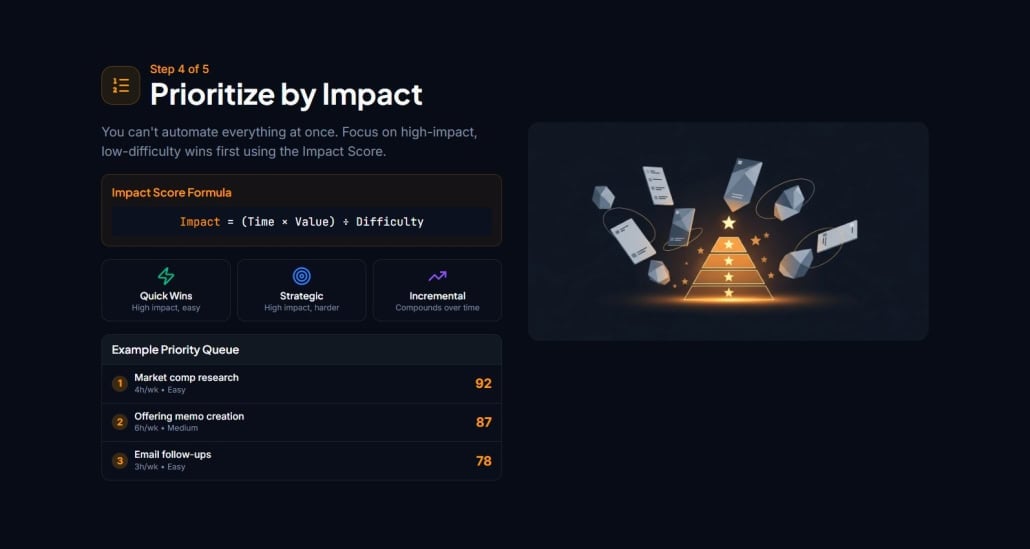
Step 4: Prioritize
Now you rank by two variables:
- Impact: How valuable would it be to improve or automate this task?
- Feasibility: How easy is it to implement?
You do not need a fancy scoring algorithm. A simple ranked list is fine:
- High impact, easy to implement
- High impact, harder to implement
- Lower impact, easy
- Lower impact, hard
Start with the highest impact, easiest to implement. That is how you avoid overwhelm and the “I do not know where to start” problem.
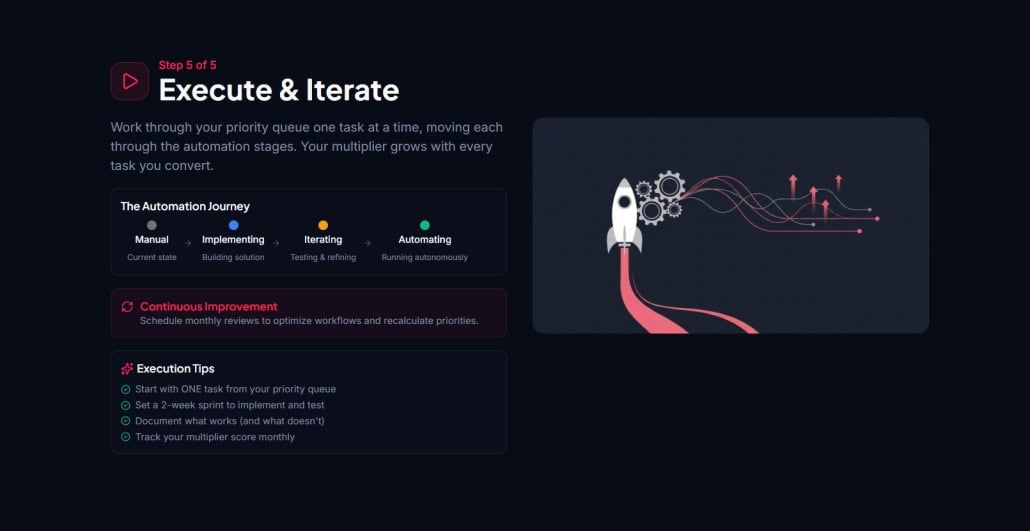
Step 5: Execute and Iterate
Finally, you pick one task and execute.
Think in three phases:
- Implement
- Sign up for the tool, wire up the integration, or set up the new process.
- Iterate
- Test, learn, refine. Expect bugs. Expect edge cases. This is normal.
- Automate
- Once it works reliably, treat it as “done” and move on.
A few mindset points:
- Do not let perfect be the enemy of good.
- What you want on day one is incremental help, then you layer on improvements.
- Once Task 1 is in the “iterate” phase, introduce Task 2. Over time you create an assembly line of improvements.
You climb a mountain one step at a time. You eat an elephant one bite at a time. This is no different.
The Framework in Action: A Real‑World Example
During the workshop, I walked through an example with Michael Belasco of Firm Ridge, an outdoor hospitality investment and development firm.
The problem
- They were missing deals by responding too slowly
- Michael estimated they lost four perfect deals last year because they were late
- Current process: about 2 hours per deal to run an initial fit check
- Roughly 25 deals reviewed to get 5 worth pursuing
- That is about 50 hours per month on initial screening
The solution path
- First priority: Build a notification engine
- Route all inbound leads to a single email
- Trigger a Slack notification the moment a new deal arrives
- Next iteration: Add basic pre‑screening
- Filter by property type, location radius, price range, simple rules
- Future state: A qualifying engine
- Automatically scores quality
- Surfaces top deals
- Eventually drafts simple LOIs or at least LOI skeletons
Five years ago, this would have required:
- A developer
- Custom code
- Ongoing maintenance
Today, a non‑technical principal can stand this up in half an hour between meetings using tools like Replit, n8n, Zapier, or even the agent‑builder tools inside ChatGPT.
That is the Multiplier Framework at work. Clear problem, quantified impact, simple solution, and a realistic first step.
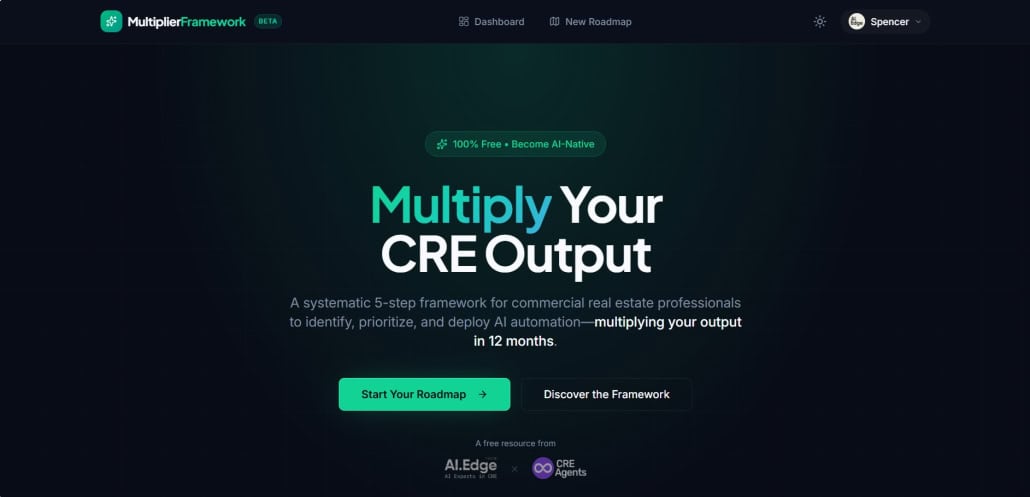
The Multiplier Framework App
To make this easier, we built a free app that walks you through the framework.
- You can access it here: https://multiplier.adventuresincre.ai/
A few important notes:
- It was built by non‑technical real estate people
- It has bugs
- Just like our early A.CRE models, it will improve through hundreds of small iterations over time
What the app does
It starts with a “Roadmap”, where you define what you are working on, for example: “Inbound Lead to LOI, Q1 2026.” Creating that roadmap involves the five steps of the framework:
- Audit
- Add your deliverables and tasks.
- Let AI suggest additional tasks you may be missing.
- Quantify
- Assign revenue or savings values and frequencies.
- See where the big multipliers sit in your work.
- Identify
- Browse a database of third‑party AI tools.
- See patterns for custom solutions and CRE Agents skills (more coming).
- Prioritize
- Rank tasks by impact score or drag them into your own order.
- Execute
- Use a simple Kanban view to move tasks from Manual → Implementing → Iterating → Automated.
- Dashboard
- Track your multiplier effect, hours saved, and time reduction over time.
My vision is that one day, in a job interview, the hiring manager asks:
“What is your multiplier effect, and how did you create it?”
This app is a starting point to help you answer that question.
Learn, Build, and Connect with AI.Edge and CRE Agents
During the workshop, we also asked about the biggest obstacles holding people back from using AI more effectively in CRE.
Top challenges:
- 46 percent: “I do not know where to start.”
- 43 percent: “I do not trust the output.”
- 42 percent: “I have a skill gap.”
AI.Edge exists to close that gap.
- AI training for CRE: Programs designed specifically for acquisitions, development, asset management, and brokerage
- Community: A place to share ideas, prompts, wins, and failures with peers
- Tools: Access to things like the Multiplier Framework app and future resources
- You can learn more here: https://aiedge.ac
If you are a firm that wants hands‑on help mapping processes, choosing where to start, and actually building solutions, our team at CRE Agents focuses on that work every day.
- Learn more at https://creagents.com
Your 2026 Challenge
My own output today is at least four times what it was before 2023. Given where the technology is, I believe doubling your output in 2026 is a reasonable goal for almost everyone reading this.
This is not rocket science. It is discipline plus a framework.
Here is your challenge:
- Map your process
- Use a notebook, a spreadsheet, or the Multiplier Framework app.
- Pick one task
- Highest impact, easiest to automate or improve.
- Do it
- Implement a simple solution. Expect it to be imperfect.
- Then do the second, and the third
- One task at a time. One small win at a time.
Do not let perfect be the enemy of good. The tech is there. No one is stopping you.
Let us make 2026 the year you multiply your output and start treating your time as your most valuable asset.
Frequently Asked Questions about this Double Your Output with AI in 2026: The Multiplier Framework for CRE
What is the “Multiplier Framework”?
The Multiplier Framework is a five-step system that helps commercial real estate (CRE) professionals audit their work, find high-impact opportunities, and use AI and automation to dramatically increase output, without working longer hours or hiring more staff.
Who is this framework for?
It’s for anyone in commercial real estate, acquisitions, asset management, brokerage, development, underwriting, or analysis, who wants to work more efficiently. No technical skills are required.
What are the 5 steps of the framework?
- Audit your work
- Quantify the impact
- Identify solutions
- Prioritize
- Execute and iterate
These steps help you isolate bottlenecks and apply automation where it makes the biggest difference.
What is the Multiplier Framework app?
It’s a free web app that guides you through the framework. You can map your workflows, assign value to tasks, browse AI tools, and track your automation progress.
Access it here: https://multiplier.adventuresincre.ai
What kind of results can I expect?
Many CRE professionals report 2x to 5x increases in productivity using this system. The framework has helped professionals save hours per week, improve margins, and move faster on deals.
Can I still watch the workshop replay?
Yes. You can watch the full 90-minute session and access the slides here: https://www.adventuresincre.com/double-your-output-with-ai-in-2026/
Do I need to be technical to use this?
No. The framework is designed for real estate professionals with no coding background. The focus is on identifying where AI tools can help, not building software from scratch.
What tools are recommended for automation?
Tools like ChatGPT, Zapier, Replit, n8n, and Notion are mentioned, but the key is to choose tools that match your task and skill level. The Multiplier app includes a database of tools to explore.
Where can I go to learn more about applying AI in CRE?
Explore AI.Edge for structured learning and community, or CRE Agents if you want hands-on help designing and implementing solutions inside your firm.
What’s the challenge to take action?
Start by mapping one workflow, pick one high-impact task, and implement a simple AI or automation solution. Then repeat. “One small win at a time” is how you multiply your output.
Version Notes
v1.41
- AI-powered weekly digest emails personalized to your progress, role, and company
- 6-day onboarding email series with tips for getting started
- In-app notification center with unread count badge
- Email preference management (toggle onboarding, weekly digest, tips)
- One-click unsubscribe links in all emails
- Improved email designs with solid colors for better compatibility
- Updated application icon
v1.0.0 Beta
- Initial release