

Total Facility Power
The full electrical capacity required to run a data center end-to-end, encompassing both IT Load and all supporting infrastructure (cooling, power distribution, lighting, security systems, etc.). This figure represents the facility’s true energy footprint and is the denominator used in efficiency calculations like PUE.
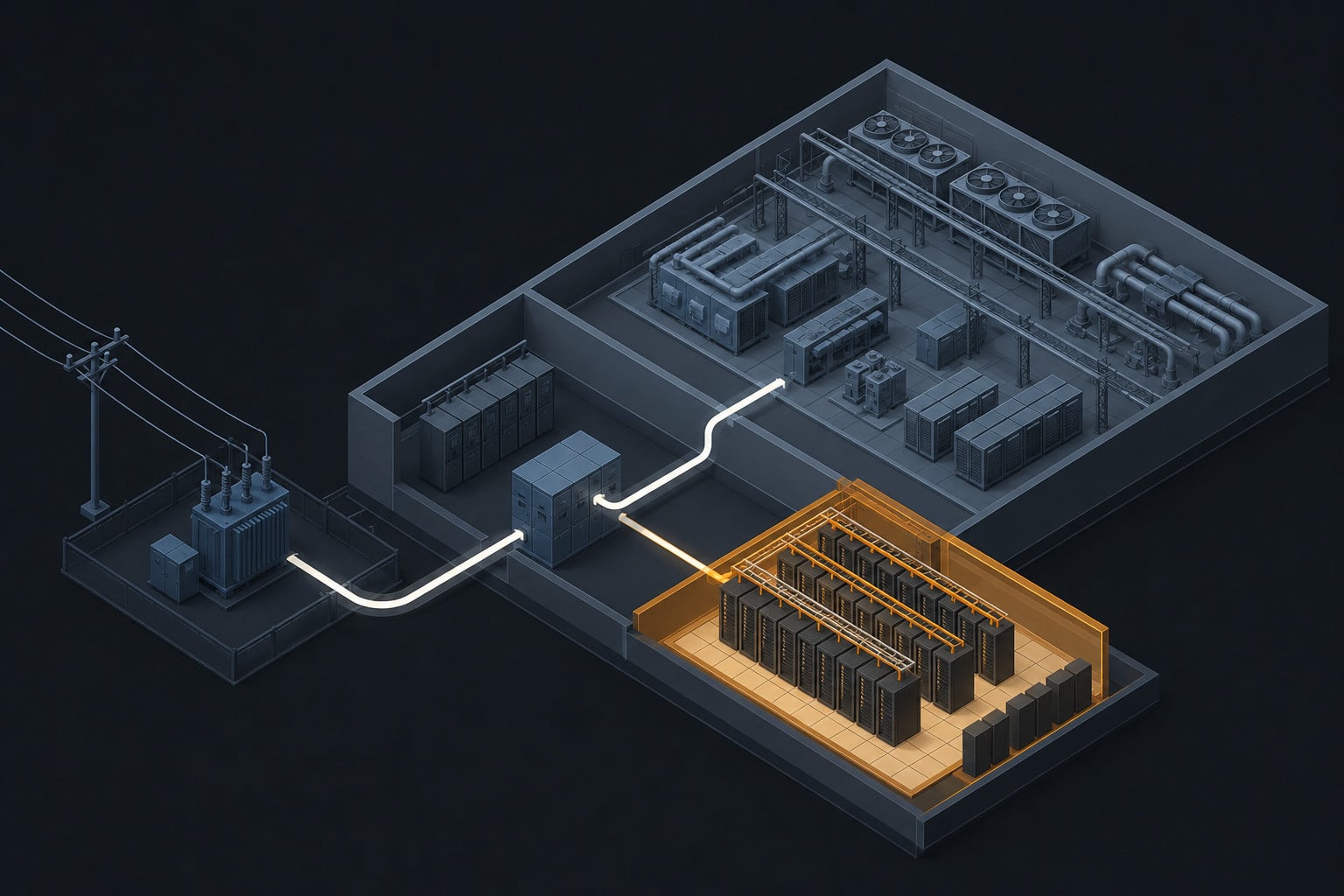
Putting Total Facility Power in Context
A developer planning a new 50 MW critical IT load data center uses total facility power projections to size the utility interconnection agreement and on-site generator capacity, because the utility commitment must cover not just the revenue-generating IT load but also the full overhead draw of cooling towers, power distribution losses, and life safety systems, which in an older facility design can add 60 to 80 percent above the critical load figure before a single server is powered on.
Frequently Asked Questions about Total Facility Power
How does total facility power relate to the critical IT load figure used in leasing and underwriting?
Critical IT load is the subset of total facility power that reaches revenue-generating equipment, while total facility power includes that load plus all overhead systems required to keep the facility operational. The relationship between the two is expressed as Power Usage Effectiveness, and a facility with a PUE of 1.4 is consuming 40 percent more total power than its critical IT load alone would require. In underwriting and development planning, both figures matter for different reasons: critical IT load drives revenue modeling, while total facility power determines the size of the utility interconnection, the generator and UPS sizing, and the facility’s operating cost structure and carbon footprint.
Why does total facility power matter when negotiating a utility interconnection agreement?
Utilities size interconnection agreements and allocate grid capacity based on the total load a facility will draw, not the IT load alone, so a developer who contracts for interconnection capacity based on critical IT load without accounting for overhead infrastructure will face a shortfall that requires a costly and time-consuming amendment or a second interconnection request. In grid-constrained markets where utility queue positions are scarce and interconnection timelines can stretch two to four years, undersizing the initial interconnection request is a significant development risk that can delay the facility’s ability to lease additional capacity even after construction is complete. Developers and their electrical engineers typically model total facility power at full build-out with a conservative PUE assumption to ensure the interconnection agreement supports the facility through multiple phases of tenant deployment.
How does the composition of total facility power differ between legacy and modern data center designs?
Older data center designs relied on computer room air conditioning units and chilled water systems that consumed a large share of total facility power relative to the IT load they supported, producing PUE figures of 1.6 to 2.0 or higher, meaning overhead infrastructure accounted for 60 to 100 percent of the critical IT load in additional power draw. Modern hyperscale and purpose-built colocation facilities use outside air economization, adiabatic cooling, and high-voltage power distribution to reduce overhead significantly, with leading facilities achieving PUE figures below 1.2. The gap between legacy and modern overhead profiles directly affects operating cost per kilowatt of IT load, which flows through to the competitiveness of the lease rates an operator can offer and the sustainability credentials increasingly required by hyperscale tenants.
What are the investment risks associated with a facility that carries a high total facility power relative to its IT load?
A facility with a structurally high overhead ratio faces two compounding risks: elevated operating costs that compress NOI margins relative to more efficient competitors, and increasing difficulty attracting and retaining tenants as corporate sustainability commitments and hyperscale procurement requirements push toward lower-PUE infrastructure. Energy costs are typically the largest operating expense line in a data center, and a facility consuming 60 percent more total power than its IT load warrants will carry a persistent cost disadvantage that cannot be fully passed through to tenants in a competitive market. Investors underwriting value-add data center opportunities should model the capital expenditure required to modernize mechanical and electrical infrastructure alongside the lease-up assumptions, since efficiency improvements often require wholesale replacement of cooling and power distribution systems rather than incremental upgrades.
How is total facility power used in development budgeting and cost estimation?
Development budgets for data centers are sized around total facility power because every major infrastructure system, including transformers, switchgear, UPS units, generators, cooling plants, and power distribution equipment, must be specified and procured based on the full load the facility will draw rather than the IT load alone. A developer targeting 20 MW of critical IT load at a target PUE of 1.3 must budget for 26 MW of total facility power capacity across all systems, and the cost of that additional 6 MW of overhead infrastructure is a real capital expenditure with no direct revenue offset. Construction cost per critical megawatt, which is one of the primary development benchmarks in the sector, implicitly captures total facility power efficiency because a more efficient design delivers more rentable critical load from the same total power infrastructure investment.
Click here to get this CRE Glossary in an eBook (PDF) format.