

White Space
The physical area within a data center dedicated to revenue-generating equipment — server racks, storage systems, networking gear, power distribution units (PDUs), and cooling distribution units (CDUs). White space is what tenants lease and pay for, making it the commercial core of the facility.
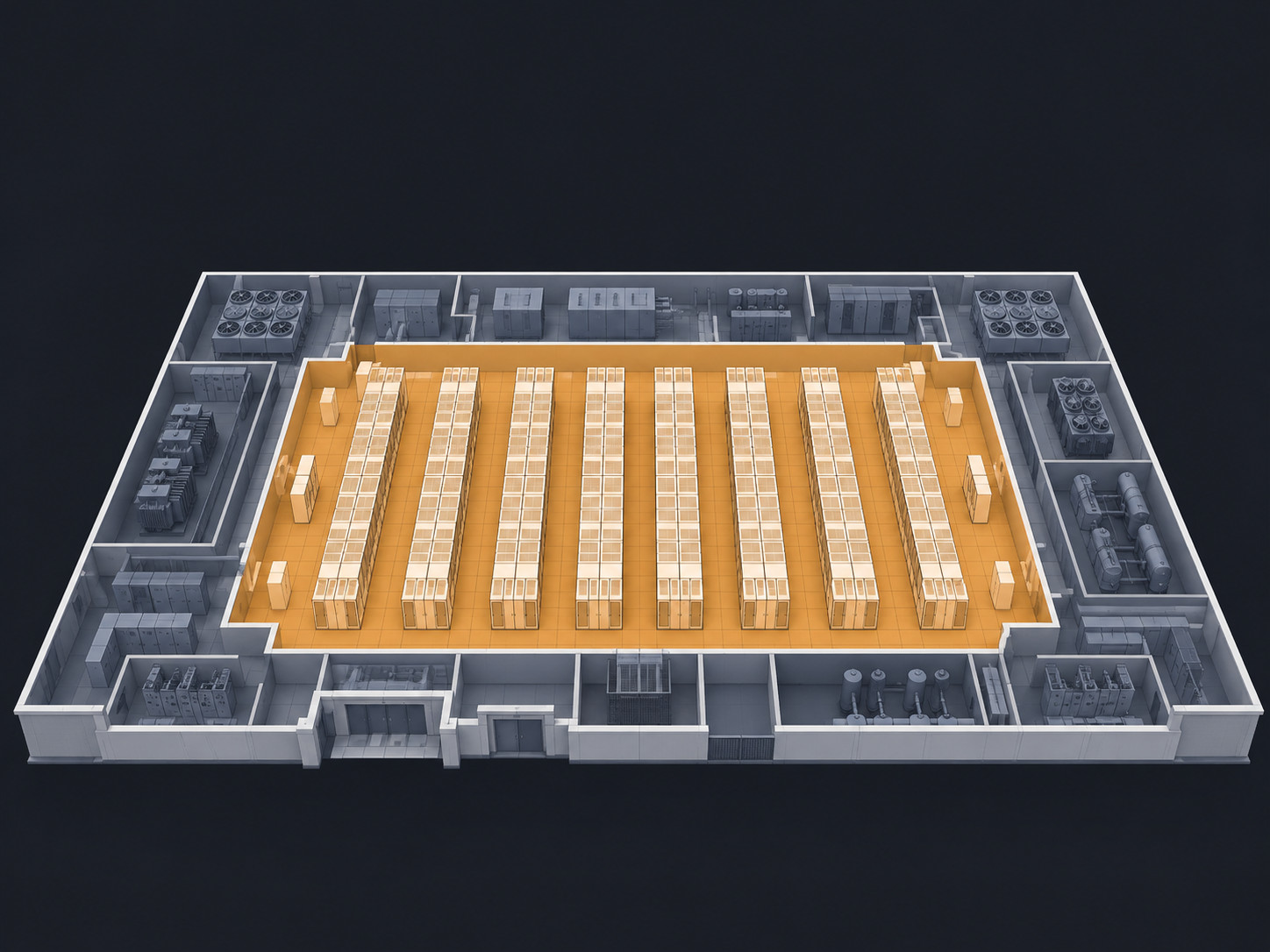
Putting White Space in Context
When evaluating a colocation facility acquisition, an analyst maps the building’s total square footage against its white space to understand how efficiently the facility converts gross area into leasable inventory, because the remaining footprint occupied by generators, cooling plants, electrical switchgear, and building support functions represents necessary overhead that generates no direct revenue and cannot be leased to tenants regardless of demand.
Frequently Asked Questions about White Space
How does white space function as the commercial equivalent of rentable area in a conventional building?
In a conventional office or industrial building, rentable area is the portion of the building a landlord can lease to tenants and collect rent against, with the remainder absorbed by structural elements, common areas, and building systems. White space serves the same function in a data center, defining the leasable inventory against which revenue is generated, while the surrounding mechanical and electrical infrastructure occupies the equivalent of back-of-house space that supports operations but cannot itself be leased. The key distinction is that white space is underwritten in kilowatts of critical IT load rather than in square feet, because what tenants are actually paying for is access to power capacity within that space rather than the floor area itself.
What is the difference between white space and gray space in a data center?
Gray space refers to the areas of a data center housing the mechanical and electrical infrastructure that supports the white space, including generators, UPS systems, cooling plants, switchgear, and fuel storage. Gray space is operationally essential but generates no direct revenue, and its size relative to white space is a key efficiency indicator for investors and operators. A facility with a high ratio of white space to total building area is converting more of its gross footprint into leasable, revenue-generating inventory, while a facility with a large gray space footprint relative to its white space may reflect older infrastructure design, higher redundancy specifications, or inefficient mechanical systems that consume more physical area than modern equivalents would require.
3
White space utilization is typically measured as the percentage of available critical IT load capacity that is under contract to tenants, rather than as a percentage of physical floor area occupied by equipment, because tenants pay for committed power allotments and may not have fully deployed hardware across their contracted footprint. A facility reporting 85 percent white space utilization means 85 percent of its total critical IT load capacity has been leased, with the remaining 15 percent available for new tenant commitments. Investors and operators track both contracted utilization and actual power draw to understand near-term revenue stability and the headroom available for incremental leasing without triggering additional capital expenditure for infrastructure expansion.
How does the shift to higher-density AI workloads affect the value and design of white space?
White space designed for conventional enterprise computing typically delivers 8 to 12 kilowatts per cabinet, which is insufficient for GPU-dense AI deployments requiring 50 to 100 kilowatts per cabinet or more. Operators serving AI workloads must redesign white space with reinforced power distribution, liquid cooling infrastructure integrated at the rack or row level, and higher structural floor load capacities, all of which affect both the capital cost of the space and the per-kilowatt lease rates it can command. Existing colocation facilities are increasingly segmented into AI-ready white space zones and standard-density zones, with the former commanding a meaningful premium and the latter facing competitive pressure from modern purpose-built supply entering major markets.
What should a CRE investor examine when evaluating the white space quality of an acquisition target?
Beyond the headline square footage and critical IT load figures, an investor should assess the white space’s power density ceiling per cabinet, the cooling architecture serving the floor, the age and remaining useful life of the power distribution infrastructure within the space, and whether the raised floor or overhead cable management system is compatible with current tenant deployment standards. The proportion of white space currently under long-term contract versus shorter commitments or month-to-month arrangements directly affects income stability, and the mix of tenant types occupying the floor, ranging from hyperscale cloud deployments to smaller enterprise colocations, determines the rollover risk profile. Physical separation and redundancy between white space zones also matters for operators serving tenants with strict uptime requirements, since a single mechanical failure in an undivided white space can affect multiple tenants simultaneously.
Click here to get this CRE Glossary in an eBook (PDF) format.