

Uptime Certification
Alongside scale, investors and tenants evaluate data centers based on their Uptime Institute Tier Certification, a widely adopted standard for assessing resiliency and redundancy that indicates, in practical terms, how reliably a facility can maintain uptime during maintenance, component failure, or unexpected outages. Tier I offers basic single-path infrastructure with roughly 28.8 hours of expected downtime per year and is not suitable for mission-critical workloads. Tier II adds some N+1 component redundancy but still relies on single-path delivery, with around 22 hours of expected annual downtime. Tier III is the institutional standard, offering full concurrent maintainability so maintenance can be performed without shutting down the facility, with redundant distribution paths and less than 2 hours of downtime per year. Tier IV is fully fault-tolerant, with 2N+1 redundancy ensuring operations continue uninterrupted even during active failure events, and is designed for workloads where downtime is not an option, including financial exchanges, defense systems, and mission-critical AI infrastructure.
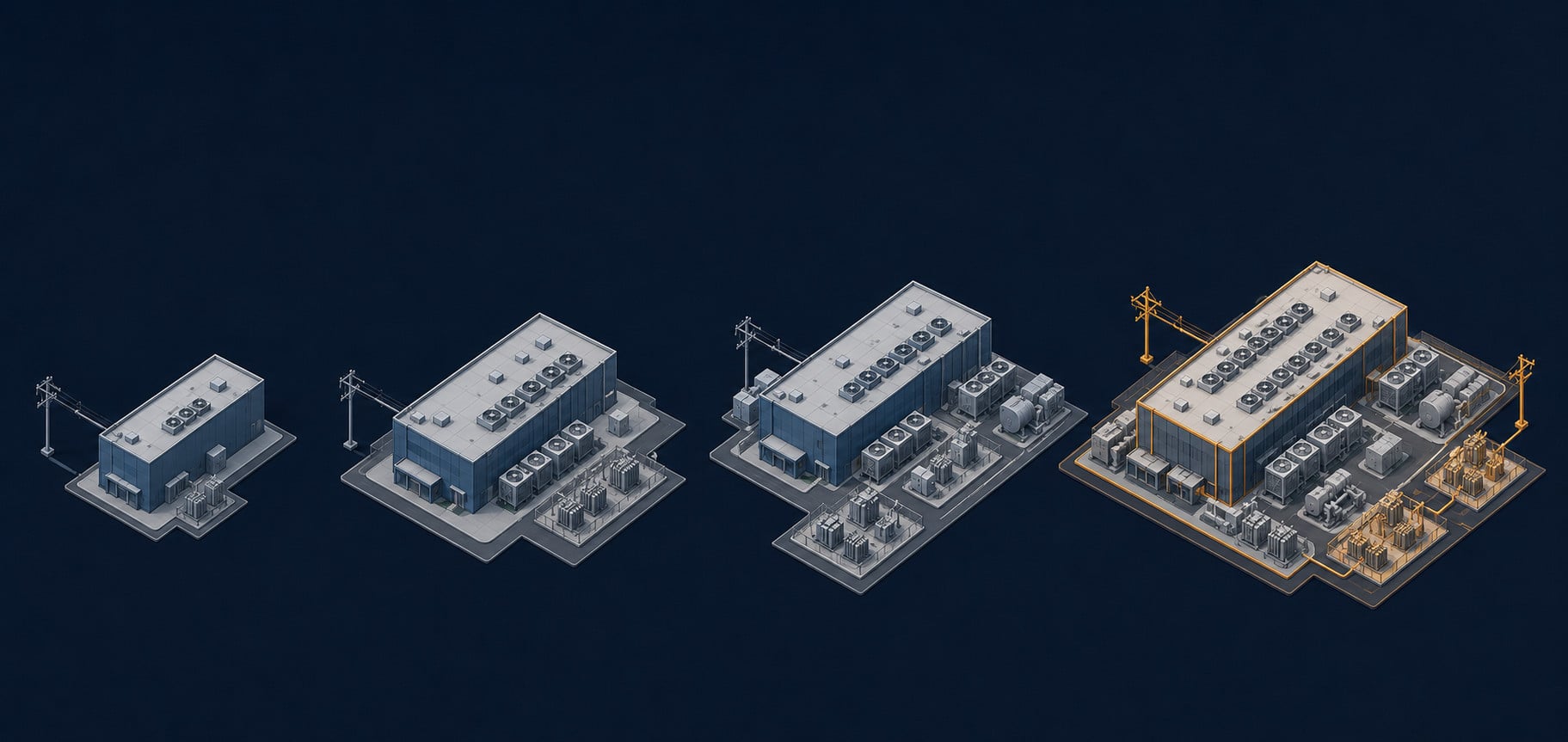
Putting Uptime Certification in Context
A pension fund evaluating a stabilized colocation acquisition uses the facility’s Tier III certification as a baseline screen before opening the financial model, because the institutional tenants occupying the white space floor signed leases contingent on concurrent maintainability and the ability to conduct infrastructure maintenance without planned outages, and re-tenanting a Tier I or Tier II facility to a comparable roster of enterprise and financial services occupants would require a capital program to upgrade the mechanical and electrical plant that the acquisition pricing does not reflect.
Frequently Asked Questions about Uptime Certification
Why is Tier III the most common certification target for institutional data center investment?
Tier III represents the inflection point where concurrent maintainability unlocks the broadest institutional tenant base, because enterprise, financial services, and cloud tenants deploying production workloads require the ability to service mechanical and electrical infrastructure without scheduling planned outages that interrupt operations. The capital premium to build or upgrade from Tier II to Tier III is meaningful but recoverable through higher lease rates and longer weighted average lease terms, whereas the incremental cost to reach Tier IV is substantially higher and the pool of tenants whose workloads genuinely require that level of fault tolerance is narrower. For investors, Tier III certification also signals that the grey space infrastructure has been designed and built to a documented and independently verified standard, reducing the diligence burden of evaluating redundancy specifications from first principles.
What is the practical difference between concurrent maintainability at Tier III and fault tolerance at Tier IV?
Concurrent maintainability means the facility can take any single component offline for maintenance or repair without interrupting power or cooling delivery to the white space floor, but a simultaneous unplanned failure during a maintenance window could still cause an outage because only one active path is carrying the load while the other is being serviced. Fault tolerance at Tier IV means the facility can sustain any single unplanned failure at any time, including during maintenance, without any interruption to operations, because 2N+1 redundancy ensures at least two fully independent active paths are available at all times rather than one active and one in standby. In investment terms, the distinction matters because Tier IV tenants, typically financial exchanges, defense contractors, and high-frequency trading infrastructure operators, sign leases with explicit uptime SLA requirements and liquidated damages provisions that make the underlying certification a contractual obligation rather than simply a marketing credential.
How should a CRE investor verify tier certification claims during due diligence?
The Uptime Institute issues distinct certifications at three stages: Tier Certification of Design Documents, which verifies that the engineering drawings meet the tier standard before construction begins; Tier Certification of Constructed Facility, which verifies that the as-built facility matches the certified design; and Tier Certification of Operational Sustainability, which verifies ongoing management and maintenance practices rather than just physical infrastructure. Investors should confirm which level of certification the facility holds, since a design certification does not guarantee that the facility was built or operated to that standard, and request the actual certification documents rather than relying on operator representations in marketing materials. Facilities that claim tier equivalency or compliance without a formal Uptime Institute certification should be underwritten conservatively, as self-assessed tier ratings carry no independent verification and may reflect design intent rather than tested operational performance.
What are the risks of acquiring a facility that was designed for a higher tier than it can operationally sustain?
A facility may hold a design-level Tier III or Tier IV certification but fail to maintain the operational practices, testing regimens, and maintenance staffing levels required to actually deliver on the redundancy the physical infrastructure was built to support, creating a gap between certified design and real-world performance that only becomes visible during an actual failure event. Tenants with contractual uptime SLA requirements may have audit rights and testing provisions written into their leases that surface this gap before lease expiration, creating disputes, rent abatement claims, or early termination triggers that directly impair the facility’s income stream. Investors should request historical maintenance logs, generator test records, and any incident reports alongside the certification documents, because the operational track record of the grey space infrastructure is as important to underwriting lease rollover risk as the physical certification itself.
How does uptime certification affect cap rate expectations and exit buyer demand for data center assets?
Tier certification functions as a proxy for income stability in data center valuation because it directly constrains which tenant types can occupy the facility and therefore what lease structures, term lengths, and credit profiles are achievable, with Tier III and IV assets commanding lower cap rates than Tier I and II facilities in the same market because their tenant bases are more captive and their lease terms are longer. Exit buyer demand is also more concentrated for higher-tier assets, since institutional acquirers including data center REITs, infrastructure funds, and sovereign wealth vehicles have minimum certification thresholds for acquisitions and will not underwrite a Tier I or Tier II facility into their core portfolio regardless of pricing. Sellers marketing a facility with a Tier III or IV certification to a broad institutional buyer pool can reasonably underwrite tighter cap rates and a shorter marketing period than sellers of lower-tier assets, which are more likely to trade to value-add buyers pricing in the cost of an upgrade program.
Click here to get this CRE Glossary in an eBook (PDF) format.