

Hyperscale Classification
A term describing the deployment of massive computing power, though what qualifies as “hyperscale” and the type of tenant behind it varies considerably by scale. Small-scale hyperscale, typically 5 to 10 MW, describes regional SaaS platforms or enterprise cloud deployments that may serve a single tenant but often rely on more standardized, less customized infrastructure. Core hyperscale, ranging from 10 to 40 MW, represents the institutional norm for large-scale cloud deployments by major platforms such as AWS, Google, or Microsoft, and typically features long-term leases, dedicated infrastructure, and layered redundancy. Mega hyperscale, at 50 to 200 MW and above, involves full campus builds developed in phases to support high-density AI workloads, GPU clusters, and sovereign cloud infrastructure, where capital expenditure per kilowatt is high but so is long-term value and exit demand.
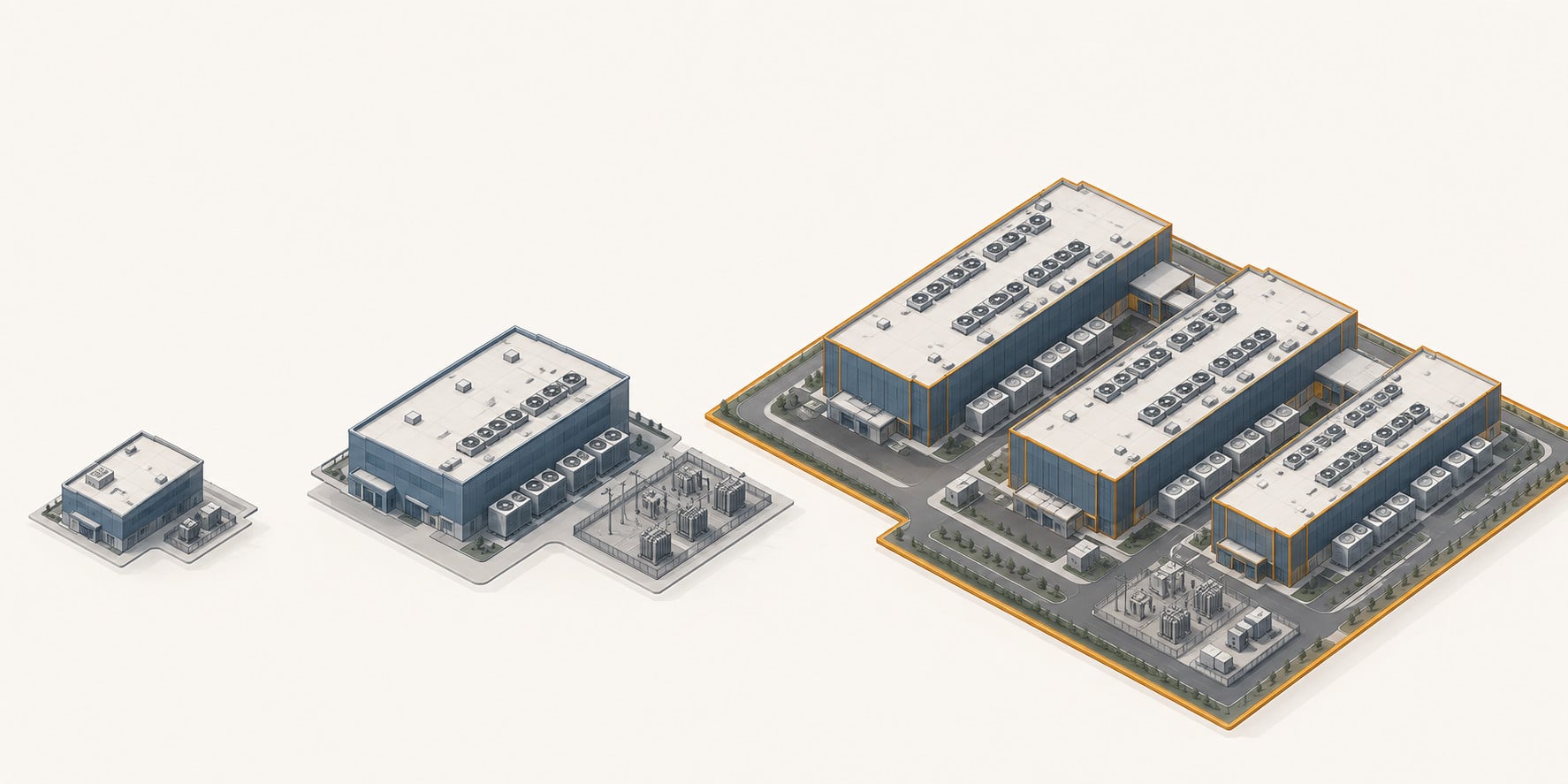
Putting Hyperscale Classification in Context
A data center developer evaluating two site opportunities uses hyperscale classification to frame the capital program and leasing strategy for each, structuring the smaller 8 MW build as a flexible colocation facility targeting regional enterprise tenants and sizing the 120 MW campus opportunity around phased delivery to a single hyperscale cloud provider, because the infrastructure specifications, lease structures, utility interconnection requirements, and exit buyer profiles for the two classifications are different enough to warrant entirely separate pro forma templates and investor narratives.
Frequently Asked Questions about Hyperscale Classification
How does hyperscale classification affect lease structure and tenant relationship dynamics?
Core and mega hyperscale deployments are almost universally structured as long-term, single-tenant or anchor-tenant leases spanning 10 to 20 years, with the hyperscale operator often involved in specifying the infrastructure before construction begins and sometimes contributing to the development timeline through pre-lease commitments. Small-scale hyperscale deployments, by contrast, are more likely to be structured as standard colocation agreements with shorter initial terms and options to expand, reflecting the less customized infrastructure and the tenant’s lower switching cost relative to a purpose-built campus. The classification therefore determines not just the physical scale of the facility but the degree of tenant dependency baked into the investment from day one, which has direct implications for lease rollover risk modeling and exit strategy.
How do underwriting assumptions differ across the three hyperscale classification tiers?
Small-scale hyperscale underwriting resembles standard colocation modeling, with revenue built around per-kilowatt lease rates across multiple tenants and vacancy assumptions drawn from local colocation market comps. Core hyperscale deals are typically underwritten on a build-to-suit basis with contracted revenue from a named tenant, making the credit quality and lease term of that tenant the primary valuation driver rather than market vacancy rates. Mega hyperscale campus underwriting is closer to a phased development model, where each building or pod is treated as a discrete income-producing asset delivered into a pre-committed lease, and the total return profile depends heavily on the developer’s ability to deliver phases on schedule and within budget against a fixed contracted lease rate negotiated before construction begins.
What distinguishes a mega hyperscale campus from a core hyperscale build beyond raw MW capacity?
Beyond the scale difference, mega hyperscale campuses are typically designed from the ground up to support GPU-dense AI workloads requiring 50 to 100 kilowatts per rack or more, which demands fundamentally different cooling infrastructure, structural floor load specifications, and power distribution architecture compared to a core hyperscale facility designed for conventional cloud computing at standard rack densities. Mega campuses are also generally developed on large land parcels with multiple buildings delivered in sequential phases over three to seven years, introducing development execution risk and phased capital deployment that is absent in a single-building core hyperscale deal. The sovereign cloud component increasingly found in mega hyperscale builds adds a layer of regulatory and geopolitical consideration, where government data residency requirements or national security designations affect which operators can participate and on what terms.
What are the investment risks specific to each hyperscale classification tier?
Small-scale hyperscale carries the highest re-leasing risk because the tenant base is less captive, the infrastructure is less customized, and competing supply can be built relatively quickly in most markets, making renewal negotiations more price-sensitive than in higher-classification facilities. Core hyperscale concentration risk is the primary concern, where a single tenant lease expiration or credit event can extinguish the entire income stream of a facility purpose-built to that tenant’s specifications, with limited alternative use options given the dedicated infrastructure. Mega hyperscale development risk is dominated by power delivery timelines and construction cost escalation, where utility interconnection delays or supply chain constraints on electrical switchgear and cooling equipment can push phased delivery schedules by years and erode the development spread between contracted lease rates and actual project costs.
How should a CRE investor use hyperscale classification when screening data center acquisition opportunities?
Hyperscale classification functions as a first-pass filter that determines which comparable transaction set, which lease structure assumptions, and which exit buyer universe are relevant for a given opportunity, so misclassifying a facility or applying the wrong underwriting template to it produces materially misleading return projections. A small-scale hyperscale facility that an investor underwrites using core hyperscale lease term and renewal assumptions will overstate income stability and exit cap rate compression, while a mega campus underwritten with colocation vacancy assumptions will misrepresent both the development timeline and the concentration risk embedded in the income stream. Investors should confirm classification not just from reported MW capacity but from the actual lease structure, tenant identity, infrastructure specification, and site size, since operators sometimes apply the hyperscale label loosely in marketing materials regardless of whether the facility meets institutional definitions of the classification.
Click here to get this CRE Glossary in an eBook (PDF) format.