
How to Implement AI Across a Commercial Real Estate Firm
Most commercial real estate firms are already using AI but the problem is that very few are using it systematically. Here’s how we it often goes.
Someone on the acquisitions team has figured out how to use Claude to summarize offering memoranda. An analyst is using ChatGPT to help with Excel. Someone in asset management has built a prompt that saves them an hour every month. Meanwhile, half the firm is still wondering what AI is useful for, IT is worried about where company data is going, and senior leadership is asking whether the subscriptions they approved are producing any measurable return.
As a company on the frontlines of helping CRE firms reskill and retool in the era of AI, we have now seen this play out across hundreds of commercial real estate firms.
We’ve also seen, firsthand, how the firms making meaningful progress approach AI implementation differently: They treat it as an operating problem rather than a software rollout.
The goal is not to get everyone using ChatGPT, Claude, Copilot, or whichever AI tool happens to be popular this quarter. The goal is to identify work that AI can perform well, give AI the tools and knowledge required to perform that work, teach employees how to supervise it, and create rules that allow the organization to scale what works.
That process is the foundation of effective AI adoption for commercial real estate firms.
If I you are the person responsible for AI implementation inside your CRE firm today, this is how we believe you should approach it.
Start Your AI Strategy With the Work
One of the first questions firms tend to ask is: “What can AI do for us?” It sounds reasonable. In practice, it sends the organization down a rabbit hole. You start watching vendor demos. One company has AI lease abstraction. Another has an underwriting tool. Another creates investment committee memos. Another promises AI-powered property management.
Before long, the firm has eight new experiments and no coherent AI strategy.
I would start somewhere else. Audit the work your people already do. Sit down with people across acquisitions, asset management, development, capital markets, accounting, property management, investor relations, research, and whatever other functions exist inside the firm.
Ask them what they repeatedly spend time doing. You are looking for tasks such as:
- Abstracting leases
- Reviewing offering memoranda
- Cleaning rent rolls
- Comparing a T12 to a budget
- Writing investment committee memos
- Drafting quarterly asset management reports
- Researching tenants
- Building market surveys
- Reviewing loan documents
- Preparing broker opinions of value
- Updating development budgets
- Comparing bids
- Preparing lender packages
- Drafting investor communications
- Pulling information from old files
- Formatting recurring Excel analyses
Then ask a second question: If AI could reliably take this task off your plate, how much would that matter? That gives you the beginning of an AI implementation roadmap.
Then rank AI opportunities by impact and feasibility
There are two dimensions I care about when evaluating an AI use case. The first is impact. How valuable would it be if AI could perform the task?
A task performed for four hours every week by 30 people is obviously interesting. But so is a task nobody currently does because there isn’t enough time.
An investment sales team we worked with approached the question that way. Rather than only looking for work they could automate, they asked what dollar-productive activities they would be doing if they had more time. They identified several prospecting activities that AI could perform and trained AI to handle them. Six months later, their BOV volume had doubled.
The second dimension is feasibility. Can AI reliably perform the task at the standard your firm requires?
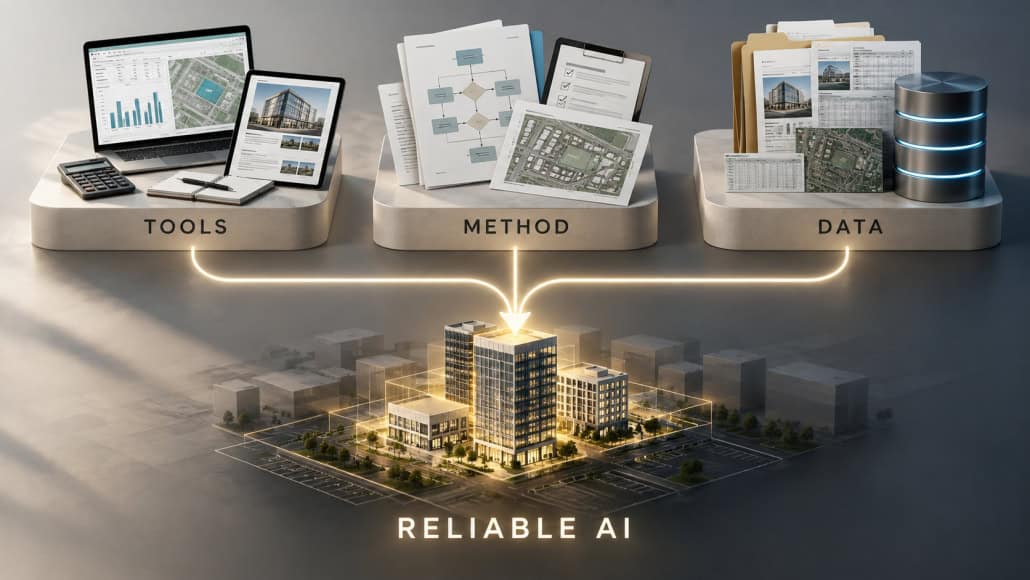
For CRE work, I think about feasibility as a function of three things:
TOOLS + METHOD + DATA
If you want AI to perform an Excel task, it needs a way to work inside Excel. If you want it to underwrite a deal the way your investment team underwrites deals, it needs your underwriting methodology. If you want it to build a rent comp set, it needs access to rent comp data.
Take away any of those pieces and reliability falls quickly.
Rank your opportunities by both impact and feasibility. Your first AI implementations should generally live in the upper-right corner: high-impact work that AI can already perform reliably with the right setup.
Choose an AI Harness Before You Buy a Collection of AI Apps
Once you know what work you want AI doing, tool selection becomes much easier. This is the first layer of what we refer to as the AI Tech Stack.
I would resist the temptation to buy a specialized AI application (i.e. AI point solution) every time you discover a use case. Those of us who do the actual work at CRE firms are tired of new tools/applications – we call that app fatigue! AI can make that problem considerably worse.
Instead, start with an AI harness capable of handling a broad range of work.
Today, that might be ChatGPT, Claude, Microsoft Copilot, or another enterprise AI environment. The exact answer will depend on your firm, security requirements, existing technology stack, and the type of work your people perform.
Then evaluate the harness against the work identified in your audit.
- Can it manipulate spreadsheets?
- Can it read PDFs?
- Can it search internal files?
- Can it connect securely to your cloud storage?
- Can it access your approved market data?
- Can it create reusable agent skills, projects, instructions, or workflows?
- Can administrators manage users and permissions?
- Can your people move between different types of work without opening five different applications?
The objective is to create a common AI working environment where possible. There will still be specialized applications worth buying. A narrow vertical application that performs an important task extraordinarily well may absolutely deserve a place in the technology stack.
Just make it earn that place.
Build Your Firm’s Proprietary Knowledge Into AI
This is where I believe the largest long-term advantage will come from. Every CRE firm has accumulated enormous amounts of institutional knowledge. Most of it is terribly organized.
You have old T12s sitting in email. Rent comps buried in spreadsheets. Leasing information scattered across shared drives. Investment memos sitting in folders. Market observations inside emails. Development lessons living in someone’s head. Senior professionals have spent 20 years developing judgment that has never been written down anywhere.
Historically, capturing all of this was difficult and expensive. AI changes the economics. The firms that systematically organize their proprietary information and make it available to AI will have something their competitors cannot reproduce by purchasing the same software subscription.
Think about your data in three tiers
I find it useful to divide CRE data into three categories.
Tier one is public data.
Property records, demographic data, government datasets, public filings, economic data, and other information generally available to everyone. Necessary, but rarely a competitive advantage.
Tier two is licensed data.
CoStar, MSCI, Green Street, CompStak, Placer.ai, RealPage, and whatever other commercial datasets your firm licenses. Useful, sometimes extraordinarily useful, but your competitors can generally buy access to the same information.
Tier three is proprietary data.
Your leases. Your rent comps. Your operating history. Your investment pipeline. Your tenant conversations. Your asset-level performance. Your relationships. Your investment committee decisions. Your firm’s accumulated judgment.
That is where the opportunity gets interesting.
Imagine a retail investor that has seen tens of thousands of leases over several decades. Those leases probably contain one of the best private rent comp datasets in the markets where that investor operates. Yet at many firms, those leases are PDFs sitting in folders.
AI can extract the economics, normalize them, store them in a structured database, and continuously add new leases as the firm encounters them. Now an acquisitions professional evaluating a shopping center can ask AI what the firm has historically seen for rent, TI, free rent, escalations, and other lease terms across comparable properties.
That is materially different from asking a general-purpose model, “What are retail rents in this market?”
Capture Methods, Not Just Data
Proprietary knowledge includes more than information. It also includes how your firm does things. Every good real estate organization has hundreds of unwritten methods.
- How does your acquisitions team normalize a rent roll?
- How does your investment committee think about replacement cost?
- How does your development team review a contractor bid?
- How does asset management prepare quarterly business plans?
- How does your debt team compare loan proposals?
Ask one of your best people to perform a task and there are probably dozens of small decisions being made along the way. Those decisions need to be captured.
In an AI environment, that method might become a detailed set of instructions, an agent skill, a workflow, a custom GPT, a Claude skill, or some other reusable configuration. The terminology will change constantly. The underlying idea will not.
Take the processes that distinguish your firm and encode them into a form AI can repeatedly use. A simple way to think about the output is:
KNOWLEDGE (DATA + METHOD) + INSTRUCTIONS + TOOLS = AI OUTPUTS YOU CAN USE
Give two competitors access to the same frontier model and their underlying AI capability is roughly the same. Give one of those firms ten years of proprietary transaction data, carefully documented internal methods, and tools connected to the systems where the work happens, and the outputs begin to diverge considerably.
That is an AI strategy for commercial real estate that can compound.

AI Training for Commercial Real Estate Firms Should Be Based on Real Work
Generic AI training is one of the easiest ways to spend money without changing behavior. Your employees attend a workshop. They learn what an LLM is. Someone explains prompting. There are a few impressive demonstrations.
Everyone leaves interested. Three weeks later, very little has changed. The training failed because it never crossed the gap between understanding AI and turning over actual work to AI. Effective AI training for commercial real estate firms should be built around the work sitting on employees’ desks.
If an acquisitions associate is learning AI, have her use a live offering memorandum. If an asset manager is learning AI, give him a real monthly reporting task. If an investment sales team is participating, use actual prospecting work. If someone spends six hours per month performing a recurring Excel process, the objective of the training should be to teach AI that process.
Run AI training over several weeks
I would also avoid the one-day AI bootcamp.
We have found that a multi-week structure works much better. One approach is four sessions over four weeks. Employees learn something, leave the session, use it on actual work, discover where it fails, come back, improve it, and repeat.
Learning how to work with AI is closer to learning Excel than attending a software demonstration. You develop the skill by using it repeatedly. We have also found that team-based learning works well. Mix junior, mid-level, and senior employees. Give them real work to solve. Have them compare what they built.
CRE professionals tend to be competitive. Use that. Let teams nominate their best AI workflow or agent skill. Have their peers judge the submissions based on impact, usability, output quality, and compliance with the firm’s AI governance standards.
Now AI reskilling for commercial real estate becomes connected directly to productivity.
Reskill Employees to Become AI Managers
There is a broader workforce shift happening underneath all of this. As AI becomes capable of completing more knowledge work, the valuable employee increasingly becomes the person who knows what should be done, can teach AI how to do it, and can judge whether the output is correct.
That requires domain expertise.
A junior acquisitions professional still needs to understand real estate finance. In fact, I would argue that expertise becomes more important as AI does more of the mechanical work. If AI builds an acquisition model in five minutes, someone still has to know whether the model makes sense. If AI abstracts 50 leases, someone must understand lease economics well enough to recognize when the abstraction is wrong. If AI drafts the IC memo, someone still owns the recommendation.
Your AI reskilling program should therefore teach three capabilities:
- Identify work that can be delegated to AI.
- Teach AI the firm’s method for performing that work.
- Review AI output with enough subject matter expertise to accept, reject, or improve it.
That is a considerably more durable skill set than memorizing prompting tricks.
Create Practical AI Governance Before Scaling Adoption
Firms sometimes treat governance as the brakes on AI adoption. I think good governance should do the opposite. Employees are already using AI. If the firm’s policy is unclear, highly restrictive, or disconnected from how people work, some percentage of employees will quietly open personal accounts and use AI anyway.
Now company information is entering systems nobody at the firm administers, successful workflows remain hidden, output quality varies by employee, and management has no idea what is happening.
That is a terrible outcome.
Practical AI governance creates enough clarity that employees know exactly where and how they are allowed to use AI. At a minimum, every meaningful AI workflow should answer five questions:
- What task is AI performing?
- What data is AI permitted to access?
- What quality standard must the output meet?
- Who is responsible for the output?
- Where is human review required?
I would also adopt three firm-wide principles.
AI-generated work must meet the same quality standard
Turning something over to AI does not lower the firm’s standard. If an analyst would be expected to produce an accurate rent roll analysis, the AI-generated version should meet or exceed that standard.
People remain accountable for the work
Someone should own every production AI workflow. AI can perform the task. It cannot become the excuse when the task is performed poorly.
Reward productive adoption
Do not measure success by the number of prompts employees send. Measure whether AI is taking over useful work.
An employee who sends 500 prompts per month and saves no meaningful time is less valuable to your AI initiative than someone who builds one reliable workflow that eliminates 15 hours of recurring work every month.
Measure Firm-Wide AI Adoption by Work Completed
This brings us to measurement. Software companies will happily show you logins, messages, tokens consumed, active users, and other usage statistics. Those metrics can tell you whether employees opened the software.
They tell you very little about ROI. For firm-wide AI adoption, I would track metrics such as:
Tasks moved to AI. How many recurring tasks have been successfully taught to AI?
Hours saved. How much human time did those tasks previously require?
Adoption by function. Are acquisitions, development, asset management, accounting, investor relations, and other groups finding productive applications?
Output quality. How often does AI-generated work meet the firm’s required standard?
Repeat usage. Did the workflow become part of the employee’s normal operating process?
Knowledge captured. How many proprietary methods, datasets, and processes have been made available to AI?
Economic impact. What does the recovered capacity allow the firm to do?
That last question is this.
If 25 employees each save 15 hours per month, the firm has recovered 375 hours of capacity every month, or 4,500 hours per year. At an assumed loaded labor cost of $100 per hour, that represents $450,000 of annual capacity. The example is illustrative, but it shows why measuring tasks and hours becomes useful very quickly.
And time savings are only one form of ROI. AI might allow an investment sales team to make more calls, an acquisitions group to review more deals, or an asset manager to analyze opportunities that previously went unexplored. Measure the business outcome whenever possible.
A Simple 90-Day AI Implementation Plan for a CRE Firm
If I were starting from scratch, I would use the first 90 days to create a repeatable implementation process.
Days 1 to 30: Audit and prioritize
- Identify recurring work across the firm.
- Rank the tasks by impact and feasibility.
- Select a small number of high-value workflows for your first implementation cohort.
- Choose the primary AI environment employees will use.
- Draft practical governance rules before asking employees to experiment.
Days 31 to 60: Build and train
- Run a multi-week training cohort around actual firm work.
- Each participant should select at least one recurring task to turn over to AI.
- Document the method.
- Connect whatever tools and approved data AI needs.
- Test the outputs repeatedly.
- Require a clearly defined human review process.
Days 61 to 90: Measure and institutionalize
- Identify which workflows produced measurable value.
- Calculate time saved, quality improvement, additional activity, or revenue impact.
- Turn successful workflows into reusable firm resources.
- Begin capturing the proprietary data and methods required to make those workflows better.
- Promote the best implementations internally.
- Then run the next cohort.
That creates a flywheel. Each group produces more people who understand how to delegate work to AI, more institutional knowledge encoded for AI to use, more reusable workflows, and more examples showing the rest of the organization what productive adoption looks like.
How to Implement AI in Commercial Real Estate Without Getting Lost in the Technology
AI is moving extraordinarily fast. Models will improve. Today’s best AI harness may eventually be replaced. Agent architectures will change. New tools will appear every month.Your implementation framework should survive all of that.
- Start with the work. Identify the tasks where AI can create the greatest economic value.
- Give AI the tools, methods, and data required to perform those tasks well.
- Capture the knowledge your firm has accumulated so AI can work from your information rather than the same generic information available to everyone else.
- Train employees on their actual jobs.
- Govern AI closely enough that people know how to move quickly and safely.
- Then measure work completed and value created.
That is the framework we have developed through our work with CRE firms, and the underlying AI implementation framework we use with commercial real estate teams goes deeper into the three core actions: identifying the work, building a proprietary knowledge edge, and governing AI for productive adoption.
If you are the person inside your organization who has been told to “figure out AI,” start small. Pick five recurring tasks. Identify the three with the best combination of impact and feasibility. Choose one. Teach AI to do it extraordinarily well. Then do it again.