

AI Harness
A software application that wraps around an artificial intelligence model and gives people a practical way to interact with and use that model. An AI harness may provide the user interface, instructions, tools, context, memory, permissions, and execution environment that turn the underlying AI model into a useful application.
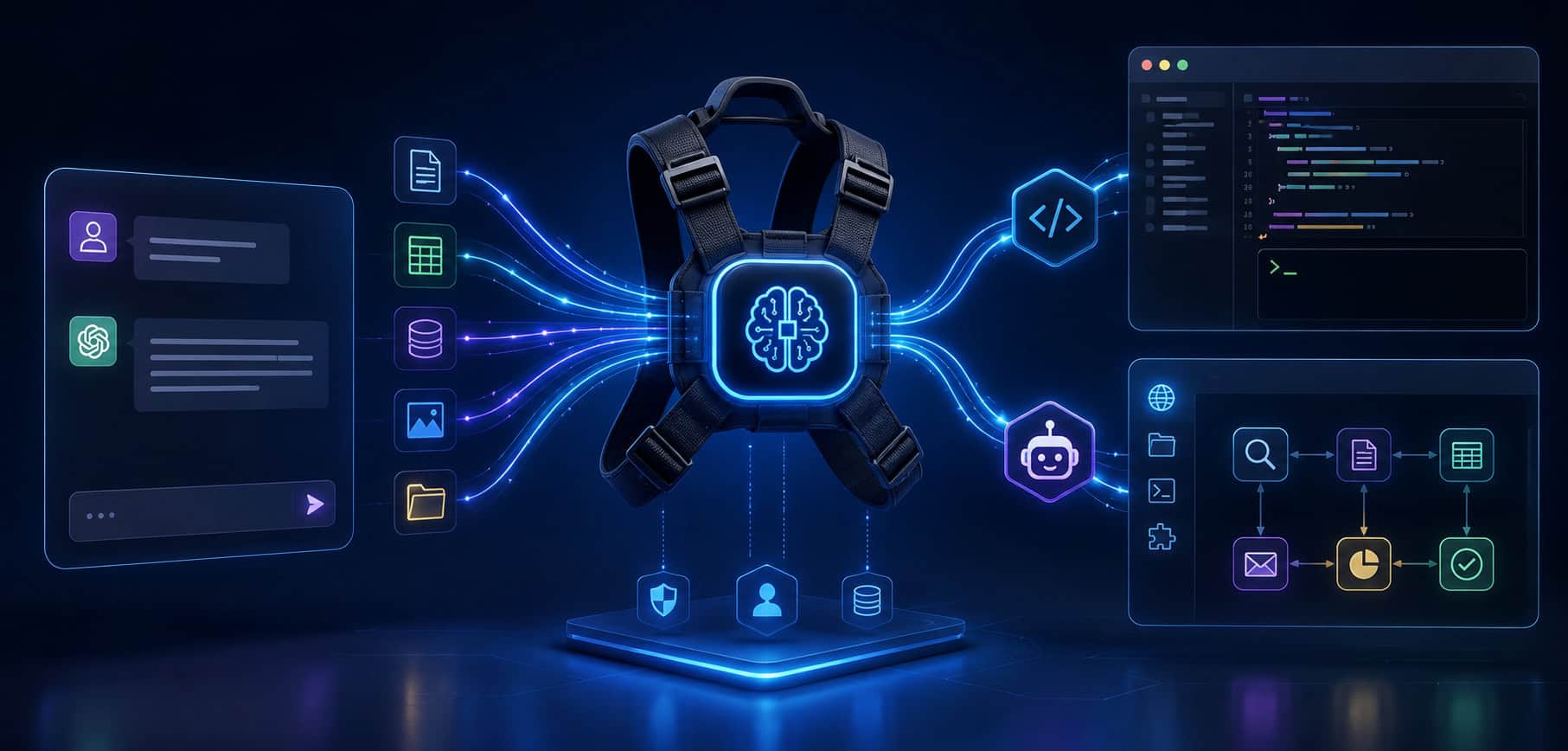
Putting AI Harness in Context
ChatGPT is perhaps the easiest way to understand the concept.
When OpenAI introduced ChatGPT in November 2022, the underlying technology was a large language model. But most people weren’t going to interact with an LLM through an API or write software to access it.
ChatGPT wrapped that intelligence in something almost anyone could understand:
A chat box.
Type a question. Get an answer. Ask a follow-up question. Continue the conversation.
That sounds obvious today, but it was enormously important.
ChatGPT effectively became the first mass-market AI harness, giving non-technical users an intuitive way to access the capabilities of an LLM. The harness abstracted away much of the technical complexity underneath.
Since then, AI harnesses have become considerably more sophisticated.
Today’s harnesses don’t simply allow us to talk to AI. They can give AI access to tools, files, browsers, terminals, software applications, persistent memory, external data, and entire computing environments.
Two interesting examples are Claude Code and Grok Bot.
AI Harness Example: Claude Code
Claude Code is Anthropic’s agentic coding environment and an excellent example of a specialized AI harness.
The underlying Claude model provides the intelligence.
Claude Code provides the environment around the model that allows that intelligence to work effectively on software development.
Through Claude Code, Claude can work inside a developer’s terminal and codebase, read files, understand a repository, use tools, edit code, execute commands, maintain context, and complete multistep programming assignments.
Anthropic itself describes Claude Code as a “flexible agent harness.”
The important point is that Claude Code isn’t simply a smarter model.
It’s a specialized environment that harnesses the capabilities of Claude for a particular type of work: software development.
AI Harness Example: Grok Bot
Grok Bot is also an AI harness, but it is designed for a very different purpose.
Rather than primarily wrapping AI around a software development environment, Grok Bot wraps AI in an environment designed around persistent, general-purpose digital coworkers.
A Grok Bot can operate on a persistent cloud computer with access to a browser, filesystem, terminal, plugins, and other tools. The user gives the Bot work much like they would give work to a colleague, and the Bot can continue working across multiple steps and return when it needs input or approval.
The underlying AI provides intelligence.
Grok Bot provides the environment in which that intelligence can interact with software and perform work.
So Claude Code and Grok Bot are both AI harnesses, even though their purposes are quite different.
Claude Code harnesses AI for coding.
Grok Bot harnesses AI for persistent, general-purpose work.
Both demonstrate how the AI industry is moving beyond simply building smarter models and toward building better environments around those models.
Model vs. Harness vs. Context
This distinction becomes especially useful as the AI ecosystem evolves.
The model provides the underlying intelligence.
The harness provides the environment through which that intelligence interacts with people, tools, and systems.
The context provides the information, methodologies, data, and domain knowledge the AI needs to perform a particular task well. See: Context-as-a-service.
For example, Claude may be the model. Claude Code may be the harness. A company’s coding standards, repository documentation, and development methodologies may provide the context.
Or Grok may provide the underlying intelligence. Grok Bot may provide the harness. The files, applications, instructions, routines, and organizational knowledge available to the Bot provide context.
These layers work together but solve different problems.
The model provides intelligence. The harness makes that intelligence usable. Context makes that intelligence relevant.
Frequently Asked Questions about AI Harnesses
What is an AI harness?
An AI harness is the software environment wrapped around an AI model that gives users a practical way to interact with and use that model. Depending on its purpose, a harness may include a user interface, instructions, tools, memory, context management, permissions, integrations, and an execution environment.
What is the difference between an AI model and an AI harness?
An AI model provides the underlying intelligence, while an AI harness provides the environment through which that intelligence is used. The same or similar underlying model can therefore behave quite differently depending on the harness, tools, instructions, and context surrounding it.
Is ChatGPT an AI harness?
Yes, using the broader definition of AI harness. ChatGPT wraps OpenAI’s underlying AI models in a conversational interface and increasingly provides those models with tools such as web search, file analysis, memory, data analysis, and other capabilities. Its original conversational interface helped make LLM technology accessible to a mass audience without requiring users to interact directly with an API.
Is Claude Code an AI harness?
Yes. Anthropic explicitly describes Claude Code as a flexible agent harness. It wraps Claude in a coding environment where the AI can access a codebase, use tools, execute commands, edit files, manage context, and perform multistep software development work.
Is Grok Bot an AI harness?
Yes. Grok Bot provides an environment around AI that includes persistent agents, a cloud computer, browser, filesystem, terminal, plugins, routines, and other capabilities. While Claude Code is primarily oriented toward coding, Grok Bot is designed around persistent AI teammates that can perform more general-purpose work.
Can two AI harnesses serve completely different purposes?
Yes. An AI harness is defined by the environment it creates around AI, not by a single use case. Claude Code is a harness optimized for software development, while Grok Bot is a harness optimized for persistent, general-purpose digital work. ChatGPT began primarily as a conversational harness designed to make interacting with an LLM intuitive for everyday users.
What is the difference between an AI harness and Context as a Service?
An AI harness provides the environment through which a person uses an AI model, while Context as a Service provides specialized knowledge, methodologies, tools, and data to that AI. A context service can therefore plug into an AI harness and make the underlying AI more useful for a specific domain or organization.
Click here to get this CRE Glossary in an eBook (PDF) format.