

Context-as-a-service
A service that provides artificial intelligence with the specialized data, methodologies, tools, and domain knowledge it needs to perform work within a specific industry or organization. Context as a Service, or CaaS, often to connect to an AI Harness through a Connector or app via Model Context Protocol (MCP), bringing domain-specific context to the AI where the user already works.
Putting Context as a Service in Context
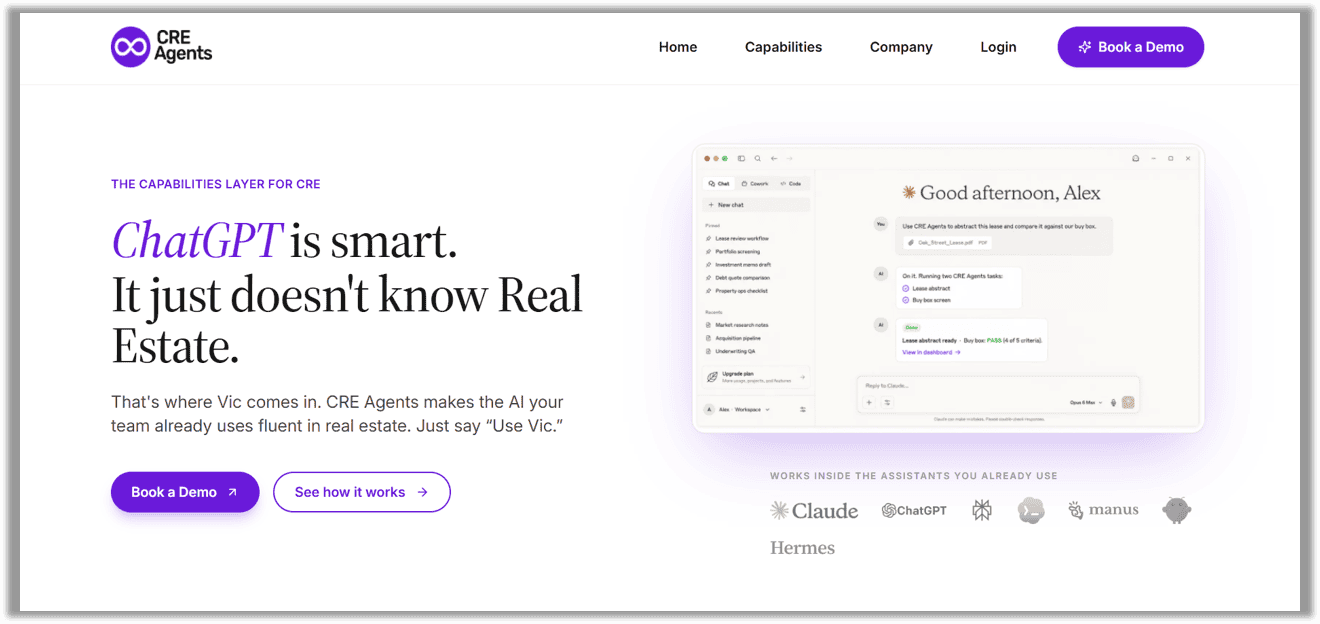
CRE Agents is an example of Context as a Service built specifically for commercial real estate.
Rather than attempting to replace general-purpose AI tools, CRE Agents connects to the AI a CRE professional already uses (e.g. Claude, Grok Bot, ChatGPT, Hermes, etc) and supplies the commercial real estate context that AI is missing.
CRE Agents’ Vic provides hundreds of CRE-specific tasks and methodologies, together with live commercial real estate data. These capabilities can be used inside Claude, ChatGPT, and virtually any AI that supports the necessary connection.
Through MCP, an AI Harness can connect to CRE Agents and access the CRE-specific data and methodology Vic makes available. This creates a separation between the underlying intelligence, the environment where the user works, and the specialized CRE context.
For example, a user might tell their AI to “Use Vic to map this retail T12 to our chart of accounts.” CRE Agents provides the AI with the methodology and retail-specific supporting context needed to approach the assignment as a CRE-specific task rather than as a generic spreadsheet exercise.
The same concept extends to processes such as lease abstraction, buy-box screening, investment committee memos, development pro formas, property and ownership research, broker opinions of value, and investor reporting.
CRE Agents also adapts its methodologies to the 12 most common commercial real estate property types, with more being added regularly. A multifamily T12 and an industrial NNN rent roll, for instance, require different methodologies and should not be analyzed using the same generic process. CRE Agents supplies that property-type-specific context to the AI.
The result illustrates the basic Context as a Service model: The AI provides the intelligence. CRE Agents provides the CRE context. The professional provides the judgment.
Frequently Asked Questions about Context as a Service
What is Context as a Service?
Context as a Service, or CaaS, provides an AI with specialized data, methodologies, tools, and domain knowledge it can use to perform work within a particular industry or organization.
Why does AI need context?
General-purpose AI models are highly capable, but they do not automatically know an organization’s processes, proprietary methodologies, current data, or industry-specific workflows. Providing that context helps the AI produce more relevant and useful results.
What is the difference between prompt engineering and context engineering?
Prompt engineering focuses primarily on how a user asks an AI to perform a task. Context engineering is broader and focuses on assembling the instructions, data, tools, documents, methodologies, and other information the AI needs to complete the task effectively.
What types of information can be delivered through Context as a Service?
Context may include specialized methodologies, company standards, task instructions, live data, reference documents, analytical frameworks, examples, and software tools available to the AI.
How is Context as a Service used in commercial real estate?
In CRE, Context as a Service can give an AI access to real estate-specific methodologies and data needed for tasks such as underwriting, lease abstraction, market research, buy-box screening, investment committee memos, development analysis, brokerage deliverables, and investor reporting.
How is CRE Agents an example of Context as a Service?
CRE Agents supplies Claude, ChatGPT, and other AI assistants with CRE-specific tasks, methodologies, skills, and live data. Rather than replacing the underlying AI, CRE Agents gives that AI specialized commercial real estate context so it can better perform CRE workflows. CRE Agents currently offers hundreds of capabilities, including 325+ ready-to-run tasks, 150+ CRE methodologies, and 27 live data sources.
Does Context as a Service replace professional judgment?
No. Context as a Service can improve the information and methodologies available to an AI, but AI-generated outputs should still be reviewed by the professional responsible for the work. In commercial real estate, professional judgment remains especially important for underwriting, investment decisions, legal interpretation, and other consequential decisions.
What role does Model Context Protocol (MCP) play in Context as a Service?
Model Context Protocol, or MCP, is one method for connecting AI applications with external tools, data, and specialized context. Gartner has specifically discussed MCP servers as infrastructure capable of gathering, aggregating, interpreting, and making enterprise context actionable for AI agents.
Click here to get this CRE Glossary in an eBook (PDF) format.