

Understanding the AI Tech Stack: Model, Harness, Tools, Knowledge, and Human Judgment
For the past few years, we’ve spent a ton of time testing dozens of AI models. Starting at gpt-3 in 2022, to most recently Grok 4.6. From closed source models like Anthropic’s Opus to open weight models like Kimi or Nemotron.
As part of that testing, we give each model a series of consistent tasks, like asking them to build a 3-tier, European-style equity waterfall model and then track the results. And for the first few years, the intelligence of the model itself mattered a lot. But over the past 9-12 months, that has changed.
Sure, the models continue to get better. But increasingly, the limit of their potential comes down to the components surrounding the model. The “AI Stack”, if you will.
And those components now matter more than the model itself.
Recently, a member of our AI training program for real estate messaged asking what is in my AI stack. And so I thought now would be a good time to share a bit more about what the AI tech stack actually consists of (at least in 2026!).
What is the AI Tech Stack?
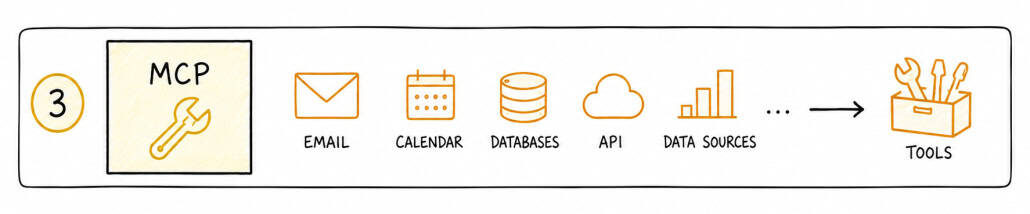
The AI tech stack consists of five-layers:
- AI Model = Intelligence
- AI Harness = Environment
- MCP = Tools
- Agent Skills + Data (Knowledge) = Domain Context
- Human = Judgment
Let me explain what I mean.
It Starts With Intelligence
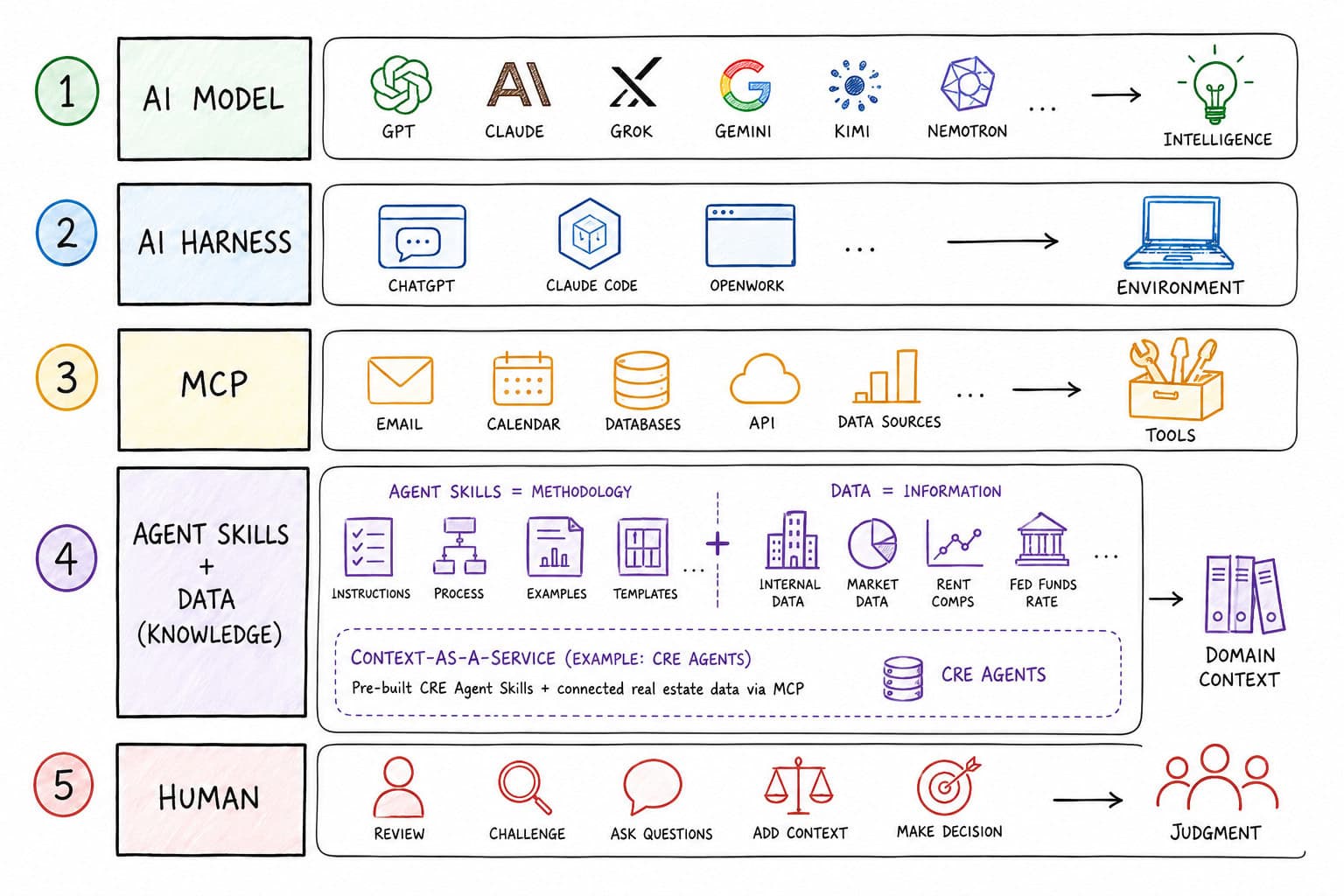
The first layer is the artificial intelligence model itself.
This is GPT, Claude, Grok, Gemini, Kimi, Nemotron, and the hundreds of other models now available. Openrouter has a fairly comprehensive list of models available.
The model provides the underlying intelligence. It reasons, writes, codes, analyzes, and increasingly works through complicated, multi-step problems.
In the early days of generative AI, this layer mattered enormously.
A better model could be the difference between successfully completing a task and failing miserably. And even today, there are meaningful differences between models. Some are better at coding. Others at writing. Others at working with spreadsheets, reasoning through complex problems, or using tools.
But the gap between the leading models has narrowed considerably, to the point where other components of the stack can make up for a less intelligent model.
The AI Harness is the Environment
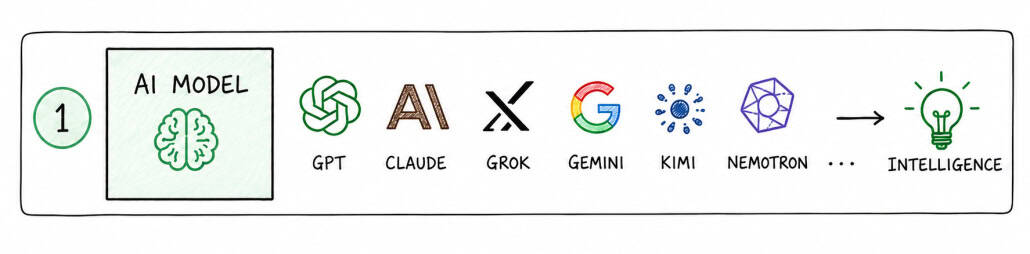
The second layer is the AI Harness.
The harness is the environment (i.e. application) where the model works.
ChatGPT is probably the most familiar example. OpenAI took an incredible technology that could only be accessed via API and wrapped it in a simple interface where anyone could type a question and get a response.
But modern AI harnesses go well beyond chat.
They can give the model access to files, a browser, memory, code execution, spreadsheets, documents, and other capabilities needed to actually perform work.
Claude Code is a good example. It is the harness, whereas Fable, Opus, Sonnet, and Haiku are models available in Claude. And at least for now, Anthropic’s harnesses (e.g. Claude Chat, Claude Cowork, Claude in Excel, etc) are restricted to Anthropic’s own models.
But that’s not the case for all harnesses.
Take OpenWork. It is an open-source harness alternative to ChatGPT Work or Claude Cowork. You can download and install it on your own server or computer and use virtually any model you want, including models you build yourself and/or host on your own server.
My intuition is that eventually harnesses will largely decouple from the models themselves. Check back in a few years to see if I’m right!
MCP Gives the AI “Tools”
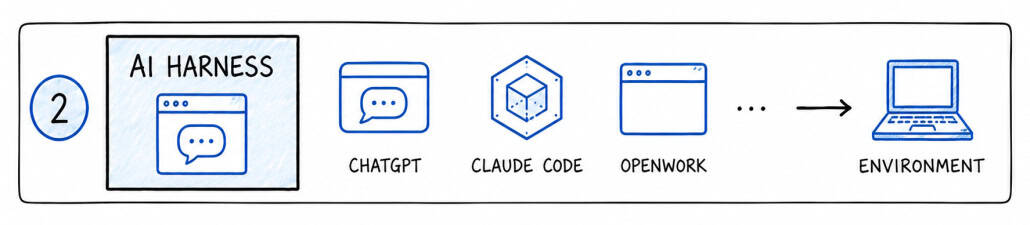
The next layer is tools. An AI model can reason, write, code, and analyze. But on its own, it has limited ability to interact with the systems and information you use every day.
Tools extend what the AI can actually do.
For example, you might give an AI access to your email so it can search messages, draft responses, or summarize a thread. You might connect it to your calendar so it can review your schedule, find availability, or help coordinate meetings. Or you might give it access to real estate data sources via tools like our A.CRE Intelligence Hub.
In commercial real estate, that could mean pulling the current Fed Funds Rate, retrieving property records, accessing demographic data, sourcing rent comps, or searching an internal database.
One increasingly common way to make those connections is through Model Context Protocol, or MCP.
MCP is an open standard that allows an AI harness to connect with outside tools and data sources. In just over a year, MCP has quickly become the primary standard for connecting AI applications to external systems.
Agent Skills + Data (Knowledge) Give the AI Domain Context
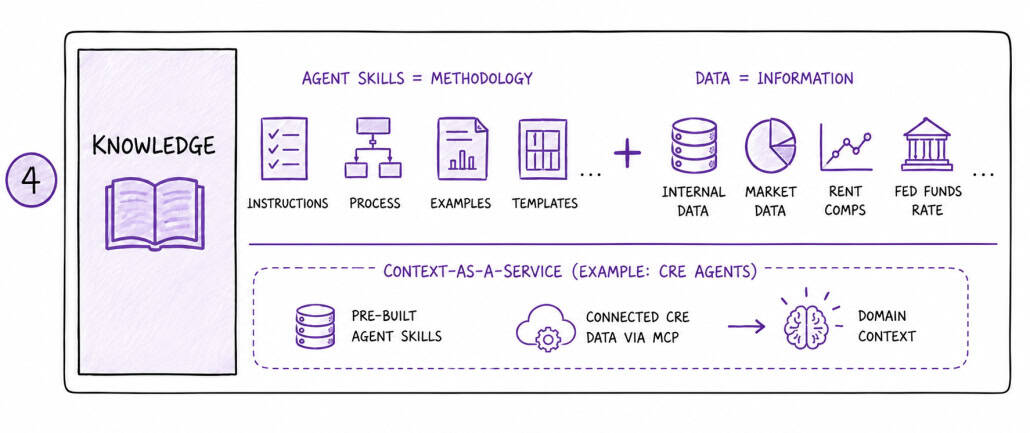
The fourth layer is what I think of as Knowledge.
This is the layer that gives a general-purpose AI the context needed to perform specialized work.
And that context primarily comes from two places: Agent Skills and data.
Agent Skills = Methodology
Agent Skills for real estate tell the AI how to perform a task in real estate. A Skill is essentially a packaged methodology. It contains the instructions, process, examples, reference materials, templates, and other resources needed to follow a specific technique for doing something.
For instance, we might build an Agent Skill that teaches an AI exactly how to analyze a T12, screen an acquisition against our buy box, or to model a 3-tier, European-style equity waterfall using our Excel template.
While the model brings the raw intelligence, the Skill brings the expertise.
Data = Information
But methodology alone is not enough. The AI also needs the information required to perform the task.
Take rent comp analysis.
You can give an AI the world’s best methodology for analyzing apartment rents. But without current rent comps, it can only get so far.
Or take interest rates.
The AI may understand exactly how SOFR or the Fed Funds Rate impacts a real estate investment. But if the task requires today’s rate, it needs access to current data.
That’s why I group Agent Skills and data together into the Knowledge layer. Knowledge is the domain context needed to perform specialized work.
Build vs. Buy and Context-as-a-service
There is an obvious challenge with this Knowledge layer: it either needs to be built or bought!
For real estate organizations, building it internally increasingly means hiring or training subject matter AI engineers to turn institutional knowledge into Agent Skills, and then build the connectors that give the AI access to the right data – both internal and external.
But building and maintaining that Knowledge layer isn’t trivial.
You need the AI engineering talent that actually understands the work. You need to turn methodologies into reliable Agent Skills. You need to build and maintain data connections. And then you need enough usage and productivity gains to justify that investment.
This is the ROI challenge facing CRE firms implementing AI right now.
And so, not surprisingly, an alternative to building the Knowledge layer internally has started to emerge: “Context-as-a-Service.”
Rather than every organization independently building the Agent Skills, methodologies, and data connections required for a particular domain, a third party builds and maintains that context and makes it available to the AI.
One example in commercial real estate is CRE Agents.
CRE Agents has built hundreds CRE-specific Agent Skills and aggregated billions of real estate data points that can be made available to virtually any AI harness via MCP. So rather than every CRE firm having to build that domain context entirely from scratch, they can access an existing Knowledge layer and then supplement it with their own proprietary context.
The Human Provides Judgment
Which brings us to the final layer: Us!
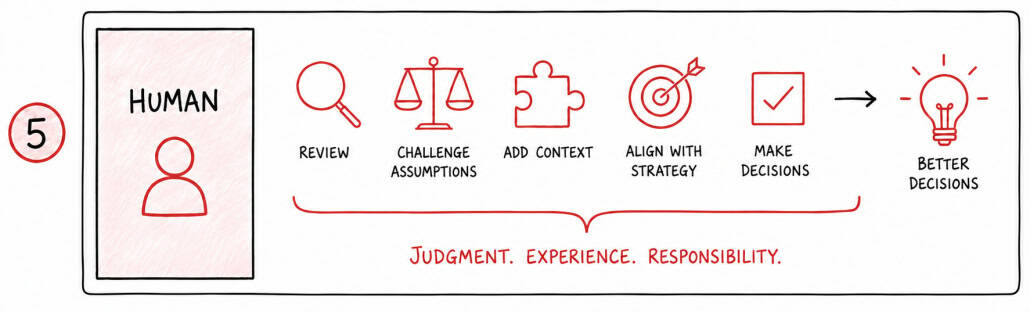
Even with a great model, a capable harness, access to tools, strong methodologies, and good data, someone still has to decide whether the output makes sense.
Imagine an AI underwrites an apartment acquisition and concludes that the deal generates a 17% levered IRR. That is an output – just like typing 2 + 2 into a calculator will return 4. But that is NOT a decision.
- Do you believe the rent assumptions?
- Is the exit cap reasonable?
- How worried are you about new supply?
- Is the basis attractive?
- Does the investment fit your strategy?
- And what happens if you’re wrong?
Those are judgment questions. And judgment is still very much a human responsibility. This is why I don’t think the end state of AI is simply automating the commercial real estate professional away.
AI is a tool to accelerate and improve human judgement, not replace it.
Why the AI Tech Stack Matters
For the first few years of this AI wave, I spent a lot of time asking which model was best. And at the time, that was probably the right question. But the models have crossed an important threshold. They’re now capable enough that what surrounds the model increasingly determines how useful it is.
A great model inside a weak harness, with no tools, no methodology, and no access to useful data is limited. Meanwhile, a strong stack can take that same general-purpose intelligence and turn it into something capable of doing highly specialized work.
That’s why I increasingly care less about which model happens to sit at the top of a leaderboard this month and more about the harness, the tools, and the knowledge the AI model sits on top of.
So when that AI.Edge member asked what was in my AI stack, that’s really what prompted this post.