

Redundancy
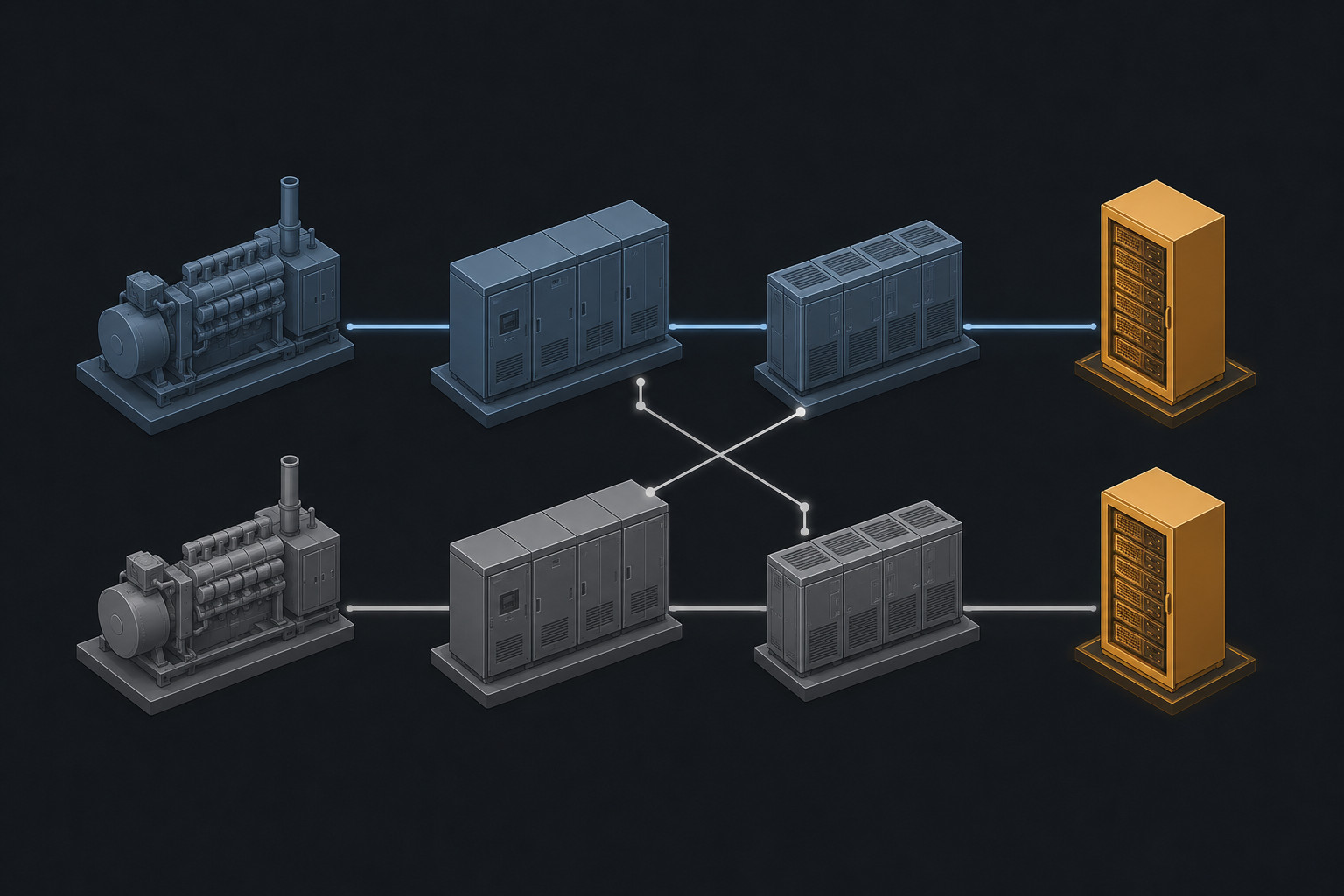
The design principle of maintaining backup systems — for power, cooling, and connectivity — that can seamlessly take over if a primary system fails, ensuring continuous uptime. Redundancy is typically expressed using tier classifications (e.g., N, N+1, 2N) that describe the level of backup capacity built into the facility.
Putting Redundancy in Context
A net lease investor evaluating a single-tenant data center leased to a financial services firm reviews the facility’s redundancy specifications as a core underwriting input, because a tenant whose trading infrastructure requires contractual 99.999 percent uptime will only renew into a facility with 2N power and cooling redundancy, and a building that cannot meet that specification faces meaningful rollover risk regardless of its location or critical IT load capacity.
Frequently Asked Questions about Redundancy
What do the N, N+1, and 2N redundancy classifications mean in practical terms?
N represents the minimum capacity required to support the facility’s full IT load with no backup, meaning any single system failure results in an outage. N+1 adds one additional unit of capacity beyond what is required, so if a facility needs four UPS modules to support its IT load, an N+1 configuration installs five, allowing one to fail or be taken offline for maintenance without interrupting power to the white space floor. 2N doubles every component in the system, creating two fully independent and parallel paths for power and cooling that can each independently carry the full load, which is the configuration required for the highest uptime commitments and is standard in mission-critical financial, healthcare, and government deployments.
How does redundancy level affect the capital cost and grey space footprint of a data center?
Each step up in redundancy classification requires materially more grey space infrastructure and capital expenditure, because additional generators, UPS strings, switchgear, cooling plant capacity, and the physical room to house and maintain all of it must be built into the facility design from the ground up. A 2N facility can cost 40 to 60 percent more to build per critical megawatt than an N+1 equivalent serving the same IT load, with much of that premium attributable to the doubled mechanical and electrical plant occupying a larger grey space footprint. For investors, this means that higher-redundancy facilities carry higher replacement cost and stronger barriers to competing supply, but also require larger upfront capital commitments and ongoing maintenance budgets to keep parallel systems in tested, operational condition.
How does redundancy specification affect tenant mix and lease term expectations?
Tenants with the most stringent uptime requirements, including financial exchanges, healthcare systems, government agencies, and payment processors, will only deploy mission-critical workloads in facilities that meet or exceed their redundancy specifications, and they typically sign long-term leases with significant tenant improvement investment that creates high switching costs and supports lease renewal. Tenants running less sensitive workloads, such as development environments, backup storage, or content delivery, are generally willing to accept N+1 or even N configurations at lower lease rates, producing a more price-competitive but also more commoditized tenancy profile. Understanding the redundancy requirements of a facility’s existing tenant roster and prospective demand in its market is therefore an important input to lease rollover risk assessment and re-leasing assumption underwriting.
What are the risks of overpaying for redundancy capacity that the tenant base does not require?
A facility built to 2N redundancy specifications in a market where the dominant tenant demand is for cost-sensitive colocation at N+1 standards will carry higher construction costs, higher maintenance and testing expenses, and a larger grey space footprint than competing supply targeting the same tenants, without being able to charge meaningfully higher lease rates to recover those additional costs. The parallel systems in a 2N configuration also require continuous testing and maintenance to remain operational, and the labor and parts cost of maintaining dormant redundant capacity represents a recurring operating expense with no direct revenue offset. Investors acquiring existing facilities should assess whether the redundancy level was designed to serve an achievable tenant profile in that specific market or whether it reflects an aspirational specification that has not translated into the premium lease rates needed to justify the capital deployed.
How does redundancy relate to the Uptime Institute Tier classification system?
The Uptime Institute Tier system is the industry’s primary framework for certifying and communicating redundancy levels to tenants and investors, with Tier I representing a basic N configuration with no redundant capacity and Tier IV representing fully fault-tolerant 2N infrastructure with no single point of failure across any system. Tier III, which requires N+1 redundancy across power and cooling with concurrent maintainability, is the de facto standard for enterprise colocation and is the minimum specification most institutional tenants require for production workloads. A Tier certification from the Uptime Institute provides third-party verification of redundancy claims rather than relying solely on operator self-reporting, which is particularly important in acquisition due diligence where the physical infrastructure specifications directly affect the supportable tenant base and the defensibility of underwritten lease rates.
Click here to get this CRE Glossary in an eBook (PDF) format.