

PUE (Power Usage Effectiveness)
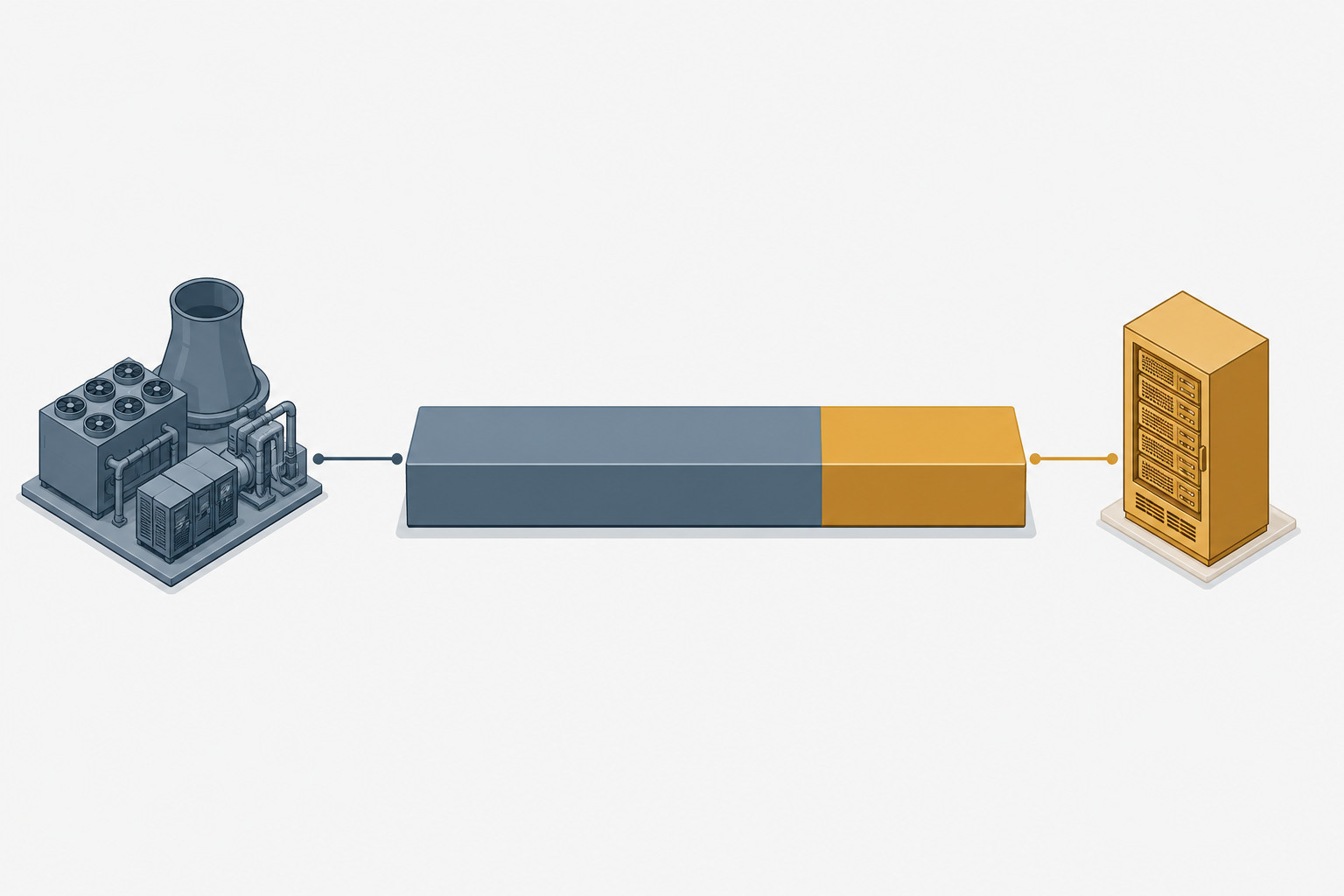
A standard efficiency metric calculated as: PUE = Total Facility Power / IT Load. A PUE closer to 1.0 indicates a more efficient facility, where a greater share of total power reaches IT equipment rather than being consumed by overhead (cooling, power conversion losses, etc.). PUE is widely used to benchmark data center efficiency and sustainability.
Putting PUE (Power Usage Effectiveness) in Context
An asset manager comparing two stabilized colocation acquisitions with identical critical IT load capacity uses PUE as a direct proxy for operating cost competitiveness, because the facility running at 1.8 PUE is consuming 80 percent more total power than its IT load requires and will carry structurally higher utility costs per leased kilowatt than the competing facility running at 1.3 PUE, a gap that compresses NOI margin and limits the operator’s ability to offer market-rate lease pricing against newer, more efficient supply.
Frequently Asked Questions about PUE (Power Usage Effectiveness)
How is PUE calculated and what does the resulting number actually represent?
PUE is calculated by dividing total facility power by the critical IT load, so a facility consuming 13 MW of total power to support 10 MW of IT load has a PUE of 1.3, meaning 30 percent of its total energy draw is consumed by overhead systems rather than by revenue-generating equipment. The theoretical minimum is 1.0, which would mean every watt of power entering the facility reaches IT equipment with no overhead loss at all, an impossible standard in practice but a useful conceptual anchor. Most industry benchmarks treat a PUE below 1.5 as acceptable for older facilities, below 1.3 as good for modern colocation design, and below 1.2 as characteristic of purpose-built hyperscale infrastructure with advanced cooling and power distribution systems.
2
Energy cost is typically the largest single operating expense in a data center, and PUE determines how much of that cost is productive versus overhead, so a facility with a high PUE is paying to run cooling and power conversion systems at a scale disproportionate to the revenue it generates from IT load. In competitive leasing markets, operators with lower PUE can offer tenants more attractive all-in power pricing while maintaining equivalent NOI margins, or they can hold pricing steady and capture higher margins relative to less efficient competitors. As enterprise and hyperscale tenants face increasing pressure to report and reduce the carbon footprint of their infrastructure, PUE has also become a procurement criterion, with some large cloud providers publishing maximum PUE thresholds that a colocation facility must meet to be considered for a lease.
What are the main drivers of high PUE in older or less efficient facilities?
Cooling systems are the dominant driver of overhead power consumption in most facilities, and older designs relying on perimeter computer room air conditioning units or inefficient chilled water plants operating at conservative setpoints consume far more energy per kilowatt of IT load cooled than modern economizer-based or liquid cooling systems. Power conversion losses across multiple transformation stages, from utility medium voltage down through UPS systems to rack-level PDUs, add cumulative inefficiency that compounds in facilities with older or over-specified electrical infrastructure. Facilities also tend to operate at higher PUE during periods of low IT load utilization, because cooling and power overhead systems are often sized for peak capacity and continue drawing significant power even when the white space floor is partially empty, which makes PUE a function of both design efficiency and occupancy level.
What are the limitations of PUE as an investment or benchmarking metric?
PUE measures energy efficiency but says nothing about the carbon intensity of the power being consumed, so a facility with a PUE of 1.15 running entirely on coal-generated grid power may have a significantly larger carbon footprint than a facility with a PUE of 1.4 powered by renewable energy, a distinction that matters increasingly to tenants with net-zero commitments. PUE also varies with climate, IT load utilization, and the time of year at which it is measured, meaning a single reported PUE figure can be misleading if it was captured during optimal operating conditions rather than averaged across a full annual cycle. Investors should request annualized PUE data and understand the measurement methodology used, since facilities sometimes report design PUE targets rather than actual measured performance, and the gap between the two can be substantial in facilities with cooling systems that underperform their specifications.
How should a CRE investor factor PUE into underwriting a data center acquisition?
PUE feeds directly into the operating expense model through its effect on utility costs, so an investor should translate the facility’s measured PUE into a total power draw figure, apply the local utility rate, and stress-test that cost against scenarios where IT load utilization is lower than underwritten, since overhead power consumption does not scale down proportionally with tenant deployment levels. The gap between the subject facility’s PUE and that of new competing supply entering the market should be modeled as a pricing headwind, particularly for lease renewals occurring five or more years out when efficiency expectations will have continued to tighten. Capital expenditure scenarios for PUE improvement, whether through cooling plant upgrades, power distribution modernization, or the addition of outside air economization, should be evaluated alongside the lease-up assumptions to assess whether the investment required to close the efficiency gap is accretive relative to the alternative of accepting higher operating costs and lower competitive positioning.
Click here to get this CRE Glossary in an eBook (PDF) format.