

There Has Never Been an Easier Time to Stand Out in CRE
A student reached out to me a couple weeks ago with a question I get some version of almost every week.
He is a rising junior, interning at a firm any of you would recognize, attends a good school, and has already done the work to become a capable real estate financial modeler.
His question was simple: How do I stand out?
He looked around at the proverbial stack of competitive resumes and saw a lot of people who looked like him. They attended top real estate schools, hadgreat grades, and had completed real estate financial modeling training. They were leaders in their respective real estate clubs and had certifications for tools like ARGUS.
So, we talked through the usual things. Then the conversation turned to AI.
He told me he was already using AI and felt pretty good about it. I asked him a few specific questions about what he was doing with it, what he had built, and how he was applying it to his work.
It became clear pretty quickly that he had a ChatGPT account, not an AI skill set.
There is a BIG difference.
And that led me to tell him something I increasingly believe: There has never been an easier time to differentiate yourself in commercial real estate than today.
The opportunity is sitting right in front of us. How long this window of opportunity stays open, only time will tell. But it is WIDE open right now.
I talked through this whole conversation with Michael and Sam in Episode 15 of the Multipliers Podcast, and shared some data that makes the point even stronger.

The Market Is Now Paying for This
On August 3, 2026, PwC published its 2026 Financial Services Workforce AI Survey.
The survey included 1,004 executives, all director level or above, at U.S. financial services firms with at least $500 million in revenue. Respondents were split evenly across asset and wealth management, banking and capital markets, insurance, and private equity.
In other words, these aren’t Silicon Valley startups we’re talking about. These are large, regulated financial institutions.
And the numbers point to a generational opportunity:
- 91% of executives said their firms are increasing compensation for employees with AI skills.
- 86% said AI skills training is more valuable than an MBA for many new hires.
- 62% plan to hire employees with AI-specific skills in the coming year, while 61% plan to upskill or reskill existing employees.
Think about that for a minute!
We’re not talking about a prediction of what employers might value five years from now. Employers are telling us what they value TODAY, and with astonishing conviction.
But there is another side to the survey that makes this more urgent.
Nearly eight in ten executives expect their workforce to shrink by at least 20% over the next five years. And when asked which layer of the organization is most vulnerable to AI disruption, the most common answer was entry-level roles, at 30%.
The same PwC survey that says the premium for AI skills is real also says effectively that “AI won’t take your job, but the people who know how to use it will.”
That should get your attention.
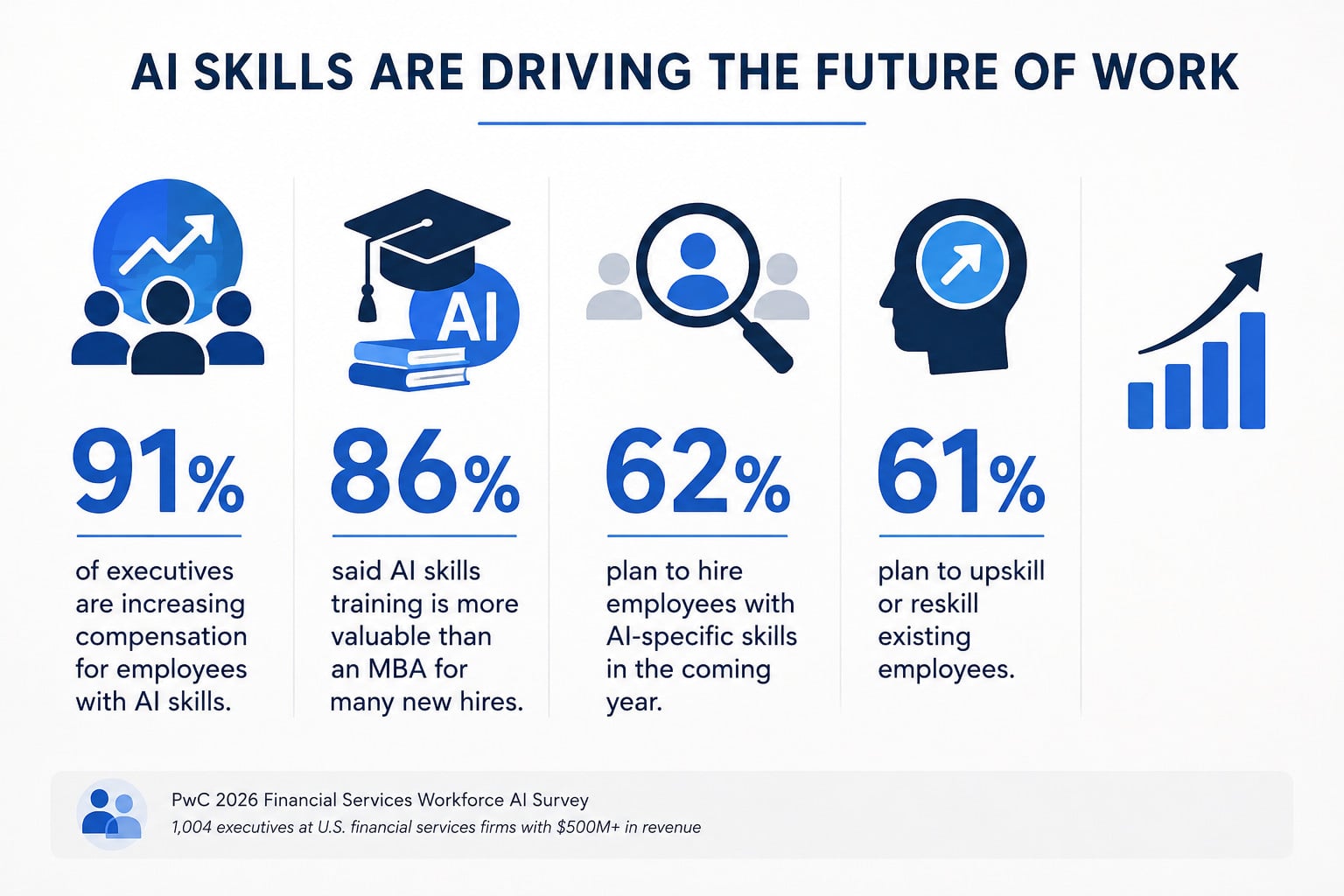
As your AI competence grows, the quicker you’ll spot AI-obvious graphics like this one created with GPT Image 2!
They Are Not Paying for Your ChatGPT Skills
There is an important distinction here.
Companies aren’t paying more because you know how to open ChatGPT or Claude and type a question into a box.
They’re paying for the ability to use AI to produce measurable output inside a professional context.
That’s a much narrower skill than it sounds. And that’s exactly why it remains scarce.
I’ve seen this firsthand in the work we’re doing training CRE firms in AI and implementing AI for CRE firms. Most firms have already purchased enterprise Claude or Copilot licenses.
The technology is sitting there and the employees have access. And yet, only a small group of people are actually getting meaningful ROI from those licenses.
In fact, PwC found that 77% of financial services executives say most AI investments are not delivering measurable ROI.
But why?
Because the hard part is knowing how to fold AI into an existing process.
To get ROI from AI, you need to understand the process well enough to break it into its component tasks, understand how AI works well enough to know where it fits, and then be able to “teach” the AI to participate in that process.
Purchasing a Claude license is not the hard part – getting value from it is.
And right now, the gap between having access to AI and knowing how to use it professionally is an enormous opportunity.
Technical Skills Plus AI Skills
This is especially important in commercial real estate. An AI expert who doesn’t understand real estate can’t reliably tell when the output is wrong.
A real estate professional who doesn’t know how to use AI, meanwhile, is increasingly competing on volume against professionals who do.
The person who has both is still relatively rare. They won’t be rare ten years from now, but today they are RARE.
I’ve used the analogy before that financial modeling in the era of AI is a bit like long division and the calculator.
We still teach 4th graders long division even though every phone has a calculator. Why? Because understanding the mechanics gives you the ability to recognize when the calculator is wrong.
The same is true here.
Learning real estate financial modeling isn’t becoming obsolete because AI can increasingly help build models. The modeling foundation is what allows you to direct the AI, challenge its assumptions, catch its mistakes, and ultimately trust the work product.
That is why we continue to invest heavily in the A.CRE Real Estate Financial Modeling Accelerator. It is the real estate financial modeling foundation upon which your AI skills rely.
And it’s why we built AI.Edge. It develops the other half of the skill set, learning how to apply AI to the actual work CRE professionals do.
The combination is where I believe the real career leverage sits.
Build Something, Then Tell People About It
So what do you actually do with this?
Get trained and then build something. The training certificate is an important credential, but something you’ve built makes that credential real.
And the “build” doesn’t need to be a six-month project.
Give yourself a weekend. Build a set of AI agent skills around tasks you perform regularly and that require some specific public data. Then, build a small proprietary dataset using that public data (e.g. property tax records, zoning data, permits, foreclosures, etc). Finish by giving your AI access to the agent skills and dataset and iterate until it produces an acceptable output consistently.
Michael did a version of this long before AI existed.
When A.CRE was brand new and getting something like five visitors a month, Michael put the website on his resume. He had built and shared a mixed-use development model on the site.
Someone at Hines downloaded the model, looked through his work, and eventually hired him. The “build”, coupled with the credential (i.e. his graduate degree), was the differentiator he needed.
I think the 2026 equivalent is increasingly going to be a link to something you’ve built for AI that a hiring manager can actually poke at.
So build it, and then make it visible.
Post what you built to LinkedIn (or join AI.Edge for free and post it to our build showcase). Explain the problem you were trying to solve and how you solved it.
Ideally, you also add your Accelerator and AI.Edge certificates to your profile and tag us so we can endorse you for the skills you’ve developed!
You Might Also Like
If you want to go one level deeper into how we think about using AI in commercial real estate, Michael and I unpack the different layers that make AI useful in Episode 14 of the Multipliers Podcast.