
• Link to Facebook
  • Link to Youtube
  • Link to LinkedIn
  • Link to X
  • Link to Tiktok
  • Link to Instagram
  • EN ESPAÑOL
    • Inicio
    • Glosario de Términos
    • Modelos Financieros
    • Tutoriales Cortos
  • A.CRE HELP
    • Support Section
    • Contact Us
  • LOGIN/REGISTER
  • Shopping Cart Shopping Cart
    0Shopping Cart
Adventures in CRE
  • A.CRE
    • A.CRE Home
    • A.CRE Help
    • Accelerator
      • Learn More
      • Login
    • AI.Edge
      • Learn More
      • Login
    • Artificial Intelligence
    • Careers
    • CRE Event Calendar
    • CRE Job Board
    • Education
    • Library of Excel Models
    • Meet the A.CRE Team
  • RE Modeling
    • 1031 Exchange
    • Audio Series
    • All-in-One (Ai1) Model
      • Download
      • Guides and Tutorials
      • Support
    • Ask Me Anything (Live)
    • Beginner’s Guide to Excel
    • Excel Models
      • Excel Add-ins
      • Library of Excel Models
      • All-in-One (Ai1) Model
      • Apartment
      • Condo
      • Debt
      • Development
      • Equity Waterfall
      • Hotel
      • Industrial
      • Office
      • Portfolio
      • Retail
      • Single Family
      • Tutorial
    • Excel Tips
    • Practice Library of Case Studies
    • Stochastic Modeling
    • Argus
    • My Downloads / My Account
  • Careers
    • About Careers in Real Estate
    • Ask Me Anything (Live)
    • Audio Series
    • Compensation in Real Estate
    • CRE Job Board
      • Find a Job
        • Browse Jobs
        • Post a Resume
        • Register
        • Login
      • Post a Job
    • CRE Event Calendar
    • CRE Interviews
    • Day in the Life Series
    • Real Estate Legal Content
    • What CRE Pros Do
  • Education
    • Accelerator
    • AI.Edge
    • A.CRE 101
    • Ask Me Anything (Live)
    • A.CRE Audio Series
    • Audio Series
    • Book Reviews
    • CRE Event Calendar
    • Deep Dive Series
    • Glossary of CRE Terms
    • Real Estate Legal Content
    • Real Estate Clubs
    • University Profiles
    • Watch Me Build
  • AI
    • AI Skills
    • AI Use Cases in CRE
    • AI for CRE Training
    • AI Tools for CRE
    • AI.Edge Membership
      • Learn More
      • Login
  • Accelerator
    • Accelerator Reviews
    • Accelerator Story
    • Enroll Now
    • Learn More
    • See What’s New
    • Enterprise Members Only
      • General Enterprise Login
      • ICSC Login
      • M&M Login
    • Members Only
      • Extend/Renew Membership
      • Login
      • Manage Membership
  • My Downloads
    • View My Downloads
    • Find an Excel Model
    • Register
    • Login
  • Click to open the search input field Click to open the search input field Search
  • Menu Menu
You are here: Home1 / Real Estate Financial Modeling2 / Excel Tips3 / Tutorial on How to Model Irregular Growth Rates in Real Estate
Spencer Burton
Real Estate Financial Modeling, Excel Tips, Excel Models, Tutorial

Tutorial on How to Model Irregular Growth Rates in Real Estate

When building a real estate financial model, managing income and expense growth is rarely as simple as applying a fixed growth rate year over year. In real estate investment analysis, growth assumptions need to be flexible, dynamic, and reflective of real-world realities. One common challenge is modeling irregular growth rates, where:

  • Growth occurs annually but not necessarily at the start of the year.
  • A line item doesn’t begin immediately, meaning growth should only apply after its start date.
  • Different years require different growth rates, with later years transitioning to a stabilized rate.

To address these nuances, I created a step-by-step video tutorial demonstrating how to model irregular growth rates in Excel. This post walks through why you’d need to model growth this way and provides a structured video guide with source file to help you implement it.

  • Are you an Accelerator member? Check out other Excel tutorials like this one in our Mastering MS Excel for Real Estate Endorsement. Not yet an Accelerator member? Consider joining our A.CRE Accelerator, the industry’s preeminent real estate financial modeling training program.
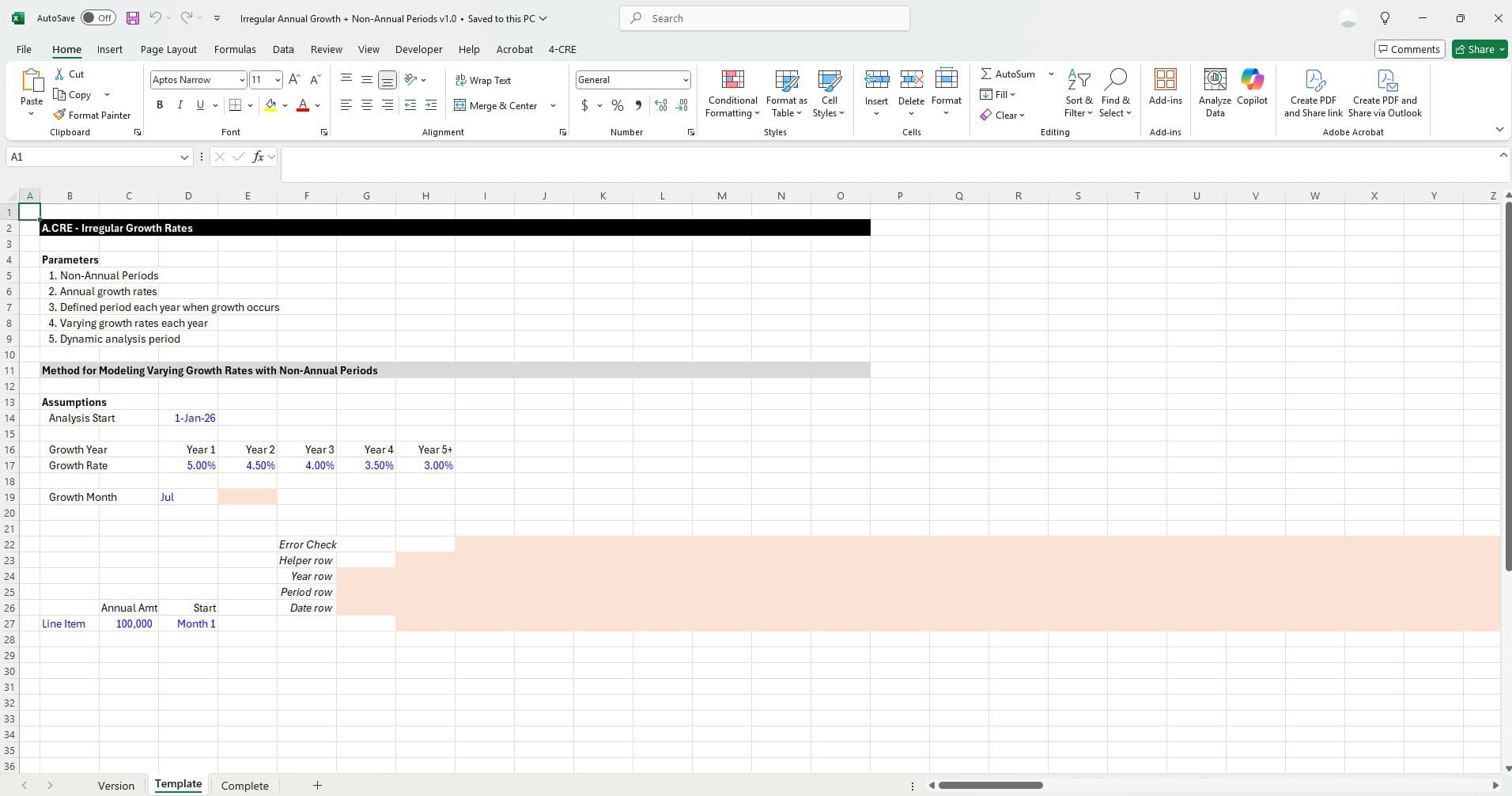
In this step-by-step tutorial, I show you a method for modeling irregular growth rates in Excel.

When Modeling Irregular Growth Rates Comes into Play

In most real estate financial models, growth rates are assumed to be applied on a fixed, annual basis, starting from the first period. But real-world scenarios often require a more sophisticated approach. Here are a few conditions where this methodology becomes necessary:

1. Growth Occurs Annually, But Not on January 1st

  • Your analysis is based on monthly or quarterly periods rather than annual ones.
  • You want growth to happen once per year, but that could be in July, October, or any other month rather than January.

2. The Line Item Starts Mid-Analysis

  • Not all cash flows begin in Period 1—some expenses, revenues, or investments kick in later in the timeline.
  • The model needs to ignore growth until the line item officially starts.

3. Growth Rates Vary by Year

  • Instead of assuming a constant growth rate, different rates apply for different years.
  • The model needs to dynamically pull in the correct growth rate based on the analysis year.

4. Dynamic Analysis Period

  • The start date and total analysis duration may change, requiring growth logic that adjusts automatically.

6. Handling of Partial Years

  • If the analysis begins in a partial year, the model should ensure that growth only applies when the next full year starts.

Many real estate and investment professionals struggle with applying growth accurately in models with non-standard periods. The methodology I demonstrate in the tutorial below ensures:

  • Flexibility for shifting growth to any month.
  • Scalability so it works for multiple line items.
  • Accuracy in applying the correct growth only when necessary.
  • Automation so adjustments happen dynamically.

Now, let’s dive into the step-by-step tutorial where I walk you through exactly how to build this in Excel.

Step-by-Step Video Tutorial – How to Model Irregular Growth Rates in Excel

To help you master this technique, I created a detailed video tutorial that walks through. In the video, I also include a downloadable Excel template, so you can follow along and apply this method in your own models. Find a link to download that file further below.

Building a flexible growth model is a critical skill in real estate, private equity, and investment analysis. Whether you’re modeling rent, other income, operating expenses, or capital expenditures, or any other cash flow line that grows over time, ensuring that growth occurs at the right time and in the right increments makes your model more accurate.

Happy modeling!

Download the Source File for the Tutorial on Modeling Irregular Growth Rates

To make this tutorial accessible to everyone, it is offered on a “Pay What You’re Able” basis with no minimum (enter $0 if you’d like) or maximum (your support helps keep the content coming – typical tutorials sell for $25- $100+ per license). Just enter a price together with an email address to send the download link to, and then click ‘Continue’. If you have any questions about our “Pay What You’re Able” program or why we offer our models on this basis, please reach out to either Mike or Spencer.

We occasionally update the tutorial (see version notes). Paid contributors to the tutorial receive a new download link via email each time it is updated.

Proceed to Download Page

Frequently Asked Questions about Modeling Irregular Growth Rates in Real Estate

What is meant by “irregular growth rates” in real estate modeling?

Irregular growth rates refer to scenarios where cash flow line items do not grow at a fixed, annual rate starting on January 1. Instead, growth may start mid-year, vary by year, or begin only after a certain period. “Growth occurs annually but not necessarily at the start of the year… The model needs to ignore growth until the line item officially starts.”

Why is it important to model irregular growth rates accurately?

Accurate modeling of irregular growth ensures that financial projections reflect real-world timing and assumptions. It provides “flexibility for shifting growth to any month,” ensures “accuracy in applying the correct growth only when necessary,” and makes the model more reliable for decision-making.

What are some scenarios where irregular growth modeling is needed?

Scenarios include:

Growth starting in months other than January

Line items that begin mid-analysis

Different growth rates by year

Partial first-year analysis

Changing analysis start dates and durations
“These nuances…require a more sophisticated approach.”

What does the step-by-step video tutorial include?

The video tutorial walks through how to model irregular growth in Excel. It demonstrates dynamic logic that adapts to various start dates, variable growth rates, and mid-period item starts. “I created a step-by-step video tutorial… with a downloadable Excel template.”

How does the model handle growth for line items that start later?

The model is designed to ignore growth until the line item officially begins. “The model needs to ignore growth until the line item officially starts,” ensuring growth doesn’t apply prematurely.

Is the model compatible with dynamic timelines or partial years?

Yes. The methodology supports timelines that start mid-year or change in duration. It ensures growth applies only when appropriate and adjusts to “dynamic analysis periods” and “handling of partial years.”

Who should use this modeling technique?

Professionals in real estate, private equity, and investment analysis who need to model rents, expenses, or capex that grow in non-standard ways. “Building a flexible growth model is a critical skill… ensuring that growth occurs at the right time and in the right increments.”

How do I access the Excel file and tutorial?

The tutorial is available on a “Pay What You’re Able” basis. Enter any amount (including $0), provide your email, and receive a download link to the Excel file. Contributors receive updates via email. “Typical tutorials sell for $25–$100+ per license.”


Version Notes

v1.0

  • Initial release

About the Author: Spencer Burton is Co-Founder and CEO of CRE Agents, an AI-powered platform training digital coworkers for commercial real estate. He has 20+ years of CRE experience and has underwritten over $30 billion in real estate across top institutional firms.

Spencer also co-founded Adventures in CRE, served as President at Stablewood, and holds a BS in International Affairs from Florida State University and a Masters in Real Estate Finance from Cornell University.

Contact Spencer
by Spencer Burton
Share this entry
  • Share on X
  • Share on LinkedIn
  • Share by Mail
  • Link to Instagram
  • Link to Youtube
https://www.adventuresincre.com/wp-content/uploads/2025/03/irregular-growth-rates.jpg 768 1024 Spencer Burton https://adventuresincre.com/wp-content/uploads/2022/04/logo-transparent-black-e1649023554691.png Spencer Burton2025-03-17 09:26:542025-06-26 14:39:32Tutorial on How to Model Irregular Growth Rates in Real Estate
You might also like
Using OpenAI’s ChatGPT to Create Complex Excel Logic
The Definitive Guide to Microsoft Excel for Real Estate (Updated Oct 2025)
Using Boolean Logic to Model Multiple Generations of Tenant Improvements
IRR and XIRR are different Why Your IRR and XIRR are Different (Updated June 2024)
Watch Me Build a Dynamic Mortgage Amortization Table in Excel (Updated September 2024)
Convert Monthly Cash Flows to Quarterly and Annual Cash Flows (Updated Mar 2022)
Accelerator - Learn More

Featured Content

  • RE Financial Modeling Training
  • Library of Excel Models
  • Post a Job – It’s Free
  • Master Financial Modeling
  • Technical Interview Guide
  • Definitive Guide to Excel
A.CRE Library of Excel Models

Recent Posts

  • A.CRE Real Estate Financial Models Download Guide (Updated Jun 2026)
  • Episodio 3 de Multiplicadores: La Brecha de la IA Ya Está Aquí
  • Nuevo Contenido en Español (Actualizado Junio 2026)
  • An AI Skill for the A.CRE Short-Term Rental Acquisition Model
  • Short-Term Rental Acquisition Model (Updated June 2026)

Note About Models

Models downloaded from A.CRE may contain errors. Verify formulas/methodology before basing investment decisions on any model here. Read our Terms and Conditions of Use and Disclaimer.

★★★★★

Accelerator Reviews

Search Adventures in CRE

Search Search

Have a Question or Need Help?

Visit our Help Section

Contact Adventures in CRE

  • Visit A.CRE Help
  • Via Email
  • Via LinkedIn

You Might Also Like

  • Real Estate Modeling Courses
  • Real Estate Financial Modeling
  • A.CRE Job Board
  • Careers in Commercial Real Estate
  • Real Estate Education

A.CRE Library of Excel Models

  • Browse Excel Models
  • Login/Register
  • View My Downloads
  • Edit Account Details

Terms, Policies, and Disclaimer

  • Privacy Policy
  • Cookie Policy
  • AI Usage Policy
  • Terms of Use
  • Disclaimer
© 2014 - Present - Copyright - www.AdventuresinCRE.com, LLC | Adventures in CRE | A.CRE
  • Link to Facebook
  • Link to Youtube
  • Link to LinkedIn
  • Link to X
  • Link to Tiktok
  • Link to Instagram
Link to: El arrendamiento financiero en América Latina Link to: El arrendamiento financiero en América Latina El arrendamiento financiero en América Latina Link to: Caso de Estudio #1 – El Hotel Costa Azul (Caso Solamente) – (Actualizado Marzo 2025) Link to: Caso de Estudio #1 – El Hotel Costa Azul (Caso Solamente) – (Actualizado Marzo 2025) Caso de Estudio #1 – El Hotel Costa Azul (Caso Solamente) – (Actualizado...
Scroll to top Scroll to top Scroll to top