

Data Center
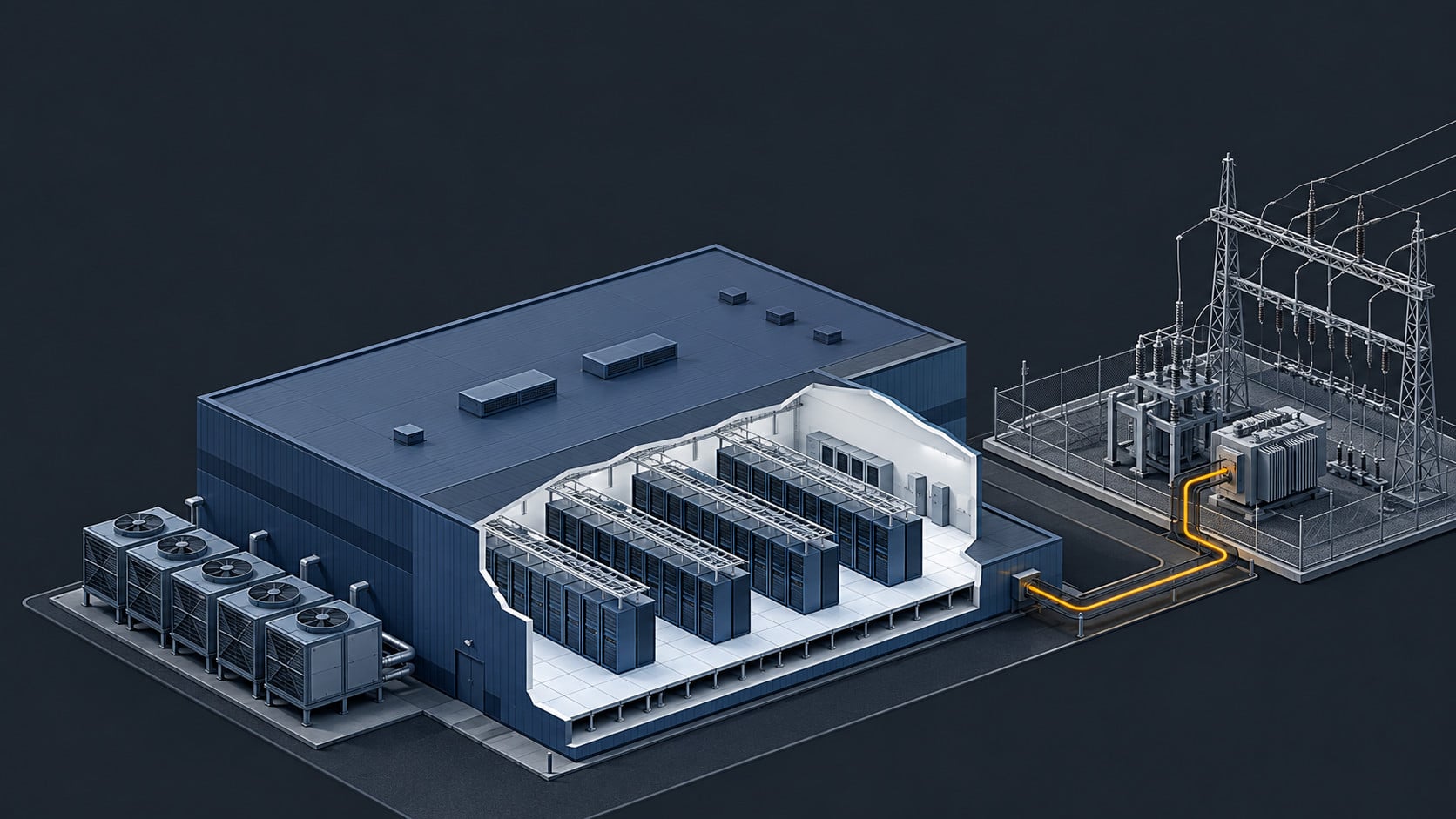
A facility purpose-built to house computing infrastructure — servers, storage systems, and networking equipment — along with the power, cooling, and connectivity systems required to keep that equipment running continuously. As a real estate asset class, data centers are valued and underwritten based on power capacity (measured in MW) rather than square footage alone, since power availability — not space — is typically the binding constraint on how much revenue-generating equipment a facility can support.
Putting Data Center in Context
An acquisitions analyst underwriting a stabilized colocation data center in northern Virginia builds the pro forma around contracted kilowatt capacity rather than rentable square footage, modeling revenue as a function of the facility’s total critical IT load, current utilization rate, and per-kilowatt lease rates across its anchor hyperscale tenant and smaller enterprise colocation customers, because the binding constraint on NOI growth is available power, not vacant floor space.
Frequently Asked Questions about Data Center
How is a data center underwritten differently from a traditional commercial property?
Where office and industrial underwriting centers on rentable square footage and per-square-foot lease rates, data center underwriting is built around power capacity expressed in megawatts and the revenue generated per kilowatt of critical IT load. Vacancy in a data center is measured as unused power capacity rather than empty floor area, and capital expenditure planning must account for power infrastructure, cooling systems, and generator redundancy rather than standard tenant improvement budgets. Lenders and investors also place significant weight on the facility’s Tier classification, which signals redundancy levels and uptime commitments, and on the credit quality of tenants given the long-term, capital-intensive nature of data center leases.
What are the main data center subtypes a CRE professional is likely to encounter?
The primary subtypes are hyperscale, colocation, and enterprise. Hyperscale facilities are massive campuses leased entirely or in large blocks to a single cloud provider such as Amazon, Microsoft, or Google, and are valued similarly to single-tenant net lease assets given their long lease terms and high-credit counterparties. Colocation facilities, or colos, lease space and power to multiple tenants in smaller increments, creating a more diversified income stream closer in structure to a multi-tenant office or industrial building. Enterprise data centers are owner-occupied facilities built and operated by a single company for its own use and are generally not investment assets in the traditional sense, though they do appear in sale-leaseback transactions.
Why is location so critical to data center investment, and what factors drive site selection?
Data center site selection is driven by power availability and cost, network connectivity, proximity to end users, and regulatory and tax environment rather than by population density or retail traffic patterns. Access to abundant, low-cost power from a utility grid with spare capacity is often the single most important factor, which is why markets like northern Virginia, Phoenix, and the outskirts of major metros with favorable utility infrastructure have attracted disproportionate development. Latency requirements for certain workloads also constrain geography, since financial services and gaming applications require the facility to sit within a specific distance of end users, while archival storage workloads are far less location-sensitive.
What are the primary risks specific to data center investments that differ from other asset classes?
Technological obsolescence is a risk unique to data centers, since the power density requirements of computing equipment evolve rapidly and a facility built to support a certain hardware generation may require significant capital investment to accommodate next-generation servers without a corresponding increase in rentable area. Power supply constraints and utility interconnection timelines have become a significant development risk in major markets, where grid capacity limitations can delay projects by years regardless of entitlement status. Tenant concentration risk is also acute in hyperscale facilities, where a single lease expiration or tenant credit event can eliminate the entire revenue stream of a campus-scale asset.
How has the growth of AI infrastructure affected data center demand and underwriting assumptions?
AI model training and inference workloads require significantly higher power density per rack than traditional enterprise computing, with GPU-dense configurations demanding 50 to 100 kilowatts per rack compared to 5 to 10 kilowatts in conventional deployments, which has driven both demand for new purpose-built AI data centers and a revaluation of existing facilities based on their ability to support high-density power configurations. Underwriters are now stress-testing cooling infrastructure and power delivery architecture more rigorously, and the per-kilowatt lease rates commanded by AI-ready facilities have risen substantially relative to standard colocation product. The pace of AI infrastructure buildout has also tightened power availability in major markets to the point where access to utility capacity has become a competitive moat for established operators and a significant barrier to entry for new development.
Click here to get this CRE Glossary in an eBook (PDF) format.