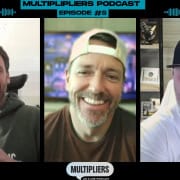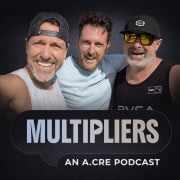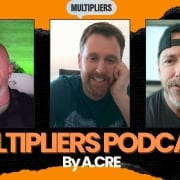

Episode 16 of Multipliers: Grok Bot and Coffee Enemas
This episode starts with discussing shoulder injury recovery, takes a detour through the Panama Canal, spends twenty minutes on why you are not typing anymore, and lands on one of the clearest explanations of the AI tech stack the podcast has produced. There is also a coffee enema backstory that earns its place more than it has any right to.
The through line is not the topics. It is the posture: three people who are genuinely using AI every day, comparing notes on what is working, what is getting cheaper, and what is becoming so accessible that there is no longer a good reason not to try it.
Spencer built a chief of staff agent in Grok Bot that reads his email, manages his task manager, and updates his calendar without being prompted. Michael’s autonomous agents are handling inventory management, document search, and fixed asset tracking. Sam is building sales pages in Manus like a, as he puts it, “gangster”.
And one free alternative mentioned on the pod is an open source tool called Goose that Jack Dorsey’s team developed and anyone can connect to a free model this weekend.
In this episode of the Multipliers podcast, Spencer Burton, Michael Belasco, and Sam Carlson cover the AI tech stack that is finally hardening, why most enterprises are paying millions for AI tokens and getting almost no ROI, how Grok Bot changes the autonomous agent game for non-technical users, and what skills are actually worth learning right now versus what will be abstracted away in twelve months.
- You might also enjoy: The prior episode on how to stand out in a stack of 300 resumes with AI skills: Episode 15 of Multipliers: How to Stand Out in a Stack of 300 Resumes
- Related: Build the technical foundation this episode references: The A.CRE Accelerator
Episode 16 of Multipliers: Grok Bot and Coffee Enemas
All three co-founders are back. Michael just returned from Panama City, partly a family trip, partly a half-serious exploration of a potential second base of operations for the A.CRE crew. Sam is fighting off a cold, which opens the episode with the health-as-foundation conversation that the podcast keeps returning to in different forms. Spencer has an injured shoulder that has forced him into tempo training, low weights, four seconds down, one second hold, three seconds up, which he hates.
The episode was recorded in early September and there is a looseness to it that comes from three people who have been working together long enough to talk about peptide stacks, dictation tools, coffee enemas, and billion-dollar AI acquisitions in the same breath without it feeling like a gear shift.
The conversation connects back to Episode 15, where the group covered the PwC survey finding that 91% of financial services executives are raising compensation for AI-skilled employees. This episode is the more practical follow-on: what does that actually look like in daily operations, and what is Spencer running right now that he thinks represents the next wave.
Listen on: Apple Podcasts | Spotify
Why This Episode, Why Now
The AI tech stack is hardening. That is Spencer’s central observation going into this episode, and it matters because it changes the nature of the bet. A year ago, building on any particular layer of the AI stack felt like building on sand: whatever you built today might be obsolete by the model release next month. The clarity that is emerging now is that certain layers are stabilizing, the harness, the model, the tools, and the knowledge layer, and the people who understand what those layers are and how they interact are the ones who will be able to take real advantage of the next twelve months.
The NVIDIA quarter is the data point Spencer uses to anchor this. NVIDIA produced more revenue than any corporation in history in their most recent quarter, with year-over-year growth above 100%, and they are projecting 70% growth from 2026 to 2027. The acquisitions that followed, NVIDIA acquiring Hugging Face for roughly twelve and a half billion, Stripe acquiring OpenRouter, reflect a market that is consolidating around the infrastructure that makes the tech stack work at scale.
The model cost data is the other anchor. Spencer ran a standard rent roll parsing task across multiple models. With an Opus-quality model, the task costs about 70 cents. With GPT-5.6 Soul, about 60 cents. With Grok 4.6, about 25 cents. With GLM 5.3 Flash, six cents. The same task that a year ago cost fifty to sixty cents even with significant engineering, and that almost no model could reliably complete, now runs correctly for six cents. That cost compression is not marginal. It is structural, and it will continue.
The personal tool conversation, Whisperflow, dictation, Grok Bot, Goose, is the practical layer on top of all of this. These are not future technologies. Spencer and Michael are using them daily. Sam is downloading Grok Bot during the recording. The gap between what is theoretically possible and what is practically accessible has narrowed to the point where a non-technical person can spin up a chief of staff agent on a Sunday afternoon.
Episode Highlights
Here are the themes that stood out.
1. The Panama Canal and the Leadership Lesson Inside It
Michael came back from Panama genuinely captivated by the canal, and Spencer gave him the space to talk about it because the story is worth telling. Michael watched the documentary twice. Spencer, who lived in Panama for years and fished the canal roughly once a month, knows it well enough to add details most people do not realize: Panama runs east to west, not north to south, the canal runs north to south through it, and the canal itself is a lake, one that was at the time of construction the largest man-made lake in the world.
What struck Michael most was not the engineering but the strategy. The French tried to blast straight through the mountain and failed. The US came in and solved problems that were not engineering problems at all: disease, yellow fever, cultural barriers to getting workers to relocate. The locks concept, treating the canal as an elevator system that lifts boats up to the lake level and back down, was borrowed and refined by engineers who had the intellectual humility to look at what had already been tried and find a different angle.
Spencer’s fishing stories are the bonus: every cast on the canal produces a bass, which eventually leads to just lowering a line and pulling fish up by hand, taking bags of filleted fish home for ten cents a fish. The point is not the fish. It is the abundance that comes when you find yourself in the right position at the right time with the right tools.
2. Stop Typing: The Whisperflow Revelation
The dictation conversation is one of the more practically useful sections of the episode for anyone who has not yet made the switch from typing to speaking.
Spencer wears a Rode Wireless Micro lapel mic all day. It is a hundred dollars, wireless, and produces a quality output that his laptop’s internal mic cannot match. Michael uses Whisperflow on the A.CRE company subscription. Both of them have largely stopped typing. The evidence: Michael sent Spencer a message mentioning pari-passu, a legal term, and it came through spelled phonetically because he was dictating and did not bother to correct it. Spencer knew immediately from the spelling that Michael was in dictation mode.
Spencer described how Whisperflow works for the non-technical listener: it is not a direct transcription tool. It runs what you say through a large language model that interprets and cleans the output. So if you say “open sesame, no, actually open Geronimo,” it produces “open Geronimo” rather than a verbatim transcript of the correction. It delivers the cleaned text to wherever your cursor is on any app on your computer. If you are nowhere, it saves to your clipboard.
For privacy-conscious users, Spencer noted he runs open-source Whisper locally on a separate laptop. That version never leaves the device. For most use cases, the standard Whisperflow is sufficient and significantly faster to set up.
The practical benefit is real: the speed of communication with AI tools, with colleagues, and with clients increases substantially when you are speaking rather than typing. Michael’s anecdote about his team on video calls hearing him talk to his computer, and his wife walking in wondering who he is speaking to, captures how normal this has already become for the people who have made the switch.
3. The AI Tech Stack Is Hardening: What That Means for CRE
Spencer’s framework for the AI tech stack is the most useful part of this episode for anyone trying to understand where to focus. He has described it across several episodes, and it is worth restating clearly because the clarity around it has increased meaningfully in the last few months.
The harness is the interface: Claude, ChatGPT, Grok Bot, Manus. The intelligence layer is the underlying model: Opus, GPT-5, Grok, GLM. The tools are the external integrations that give the agent the ability to act on the world: email, calendar, accounting software, task managers, anything accessible through MCP. The knowledge layer is the encoded methodology and data that make the agent actually useful for a specific domain: agent skills, proprietary databases, the CRE-specific methodology that turns a general-purpose model into something a commercial real estate professional can trust.
The key shift that is hardening: the harness and the intelligence layer are increasingly decoupling. You are starting to see harnesses that are model-agnostic, where you choose the underlying intelligence based on your cost and capability requirements rather than being locked into whatever model the harness provider offers. GLM 5.3 Flash at six cents for a complex task, versus Opus at seventy cents for the same task, is the kind of cost differential that will drive enterprise adoption of model-agnostic harnesses over the next twelve months.
Why most enterprises are not getting ROI from their AI investment is the related point Spencer makes explicitly: they have a harness and a model but they are missing the tools and the knowledge layer. The tool layer gives the agent the ability to do things. The knowledge layer tells it how to do them in a way that is specific to the firm’s domain. Without both, you have an expensive chat interface that produces generic outputs that no one trusts enough to act on. That is the state of most enterprise AI right now, and it explains both the frustration and the opportunity.
4. Grok Bot: The Chief of Staff Spencer Finally Built
Spencer has wanted a chief of staff agent for a long time. The technical barriers to building one from scratch are real: every integration, calendar, email, task manager, bank account, requires its own API connection, often involving service accounts, JSON keys, and ongoing maintenance when things break. For a developer, this is manageable but time-consuming. For everyone else, it is a wall.
Grok Bot, developed by SpaceX AI (XAI), removes the wall. The integrations are pre-built and one-click. Connect to Google Calendar, a window pops up, you authenticate, it is done. Connect to Gmail, same process. Connect to the task manager, same. The integrations Spencer has turned on: Gmail, Google Calendar, the ACRE Plane task management system (an open-source tool he and Kyle have been using), and the folder where all Google Meet transcriptions are saved.
What the agent does with those integrations is the interesting part. Every time a new meeting transcription lands in the folder, the agent reads it, identifies action items, and surfaces them in Slack with proposed updates to the task manager. Every fifteen minutes, it scans new email for tasks that need to be flagged or calendar events that need to be created. Urgent items get a Slack notification immediately. Calendar invites can be circulated with a single confirmation.
The model underneath Grok Bot matters too: Grok 4.6 is one of the most cost-effective models relative to intelligence on the current leaderboard, and it is what powers the integrations. Spencer gets Grok Bot through his Cursor subscription, which makes the marginal cost effectively zero. For someone who does not already have Cursor, the standalone cost is approximately one hundred dollars per month, though it includes Cursor access.
For people who want to experiment without spending a hundred dollars, Spencer closed the episode with the free alternative: Goose, an open-source autonomous agent tool developed by Jack Dorsey. Connect a free model to it and you have a fully functional autonomous agent environment for zero dollars. The poor man’s Grok Bot, as Spencer put it, but genuinely functional.
5. What Michael Is Running at Olympic and ACRE
Michael’s live examples are the grounding that keeps the technical conversation from floating too far into the abstract.
At Olympic RV Park, the cashierless store continues to operate with an agent managing inventory, tracking what is in stock, what has sold, and what needs to be ordered. The agent is working toward being connected to the ordering systems at Amazon, Walmart, and Costco directly, at which point it will be able to pre-fill shopping carts based on what the inventory data shows. Michael noted the company they use for the store management, Willcore, may or may not have an API that supports this, which is the kind of practical constraint that matters in real operations.
For ACRE Consulting, Michael and Spencer needed to search through massive amounts of documents to find specific information. Kyle connected it to a shared drive and let an autonomous agent run for roughly ninety minutes. It searched through everything, organized the findings, and put documents in chronological order. That is not a task that would have been practical to delegate to a human for the same cost.
The fixed asset chart for Olympic is the accounting example. A cost segregation study produces different amortization schedules for different asset categories. Building the chart manually from the study outputs is tedious work. Michael gave the AI the cost segregation study and all the relevant reports. It built the entire fixed asset schedule. Spencer’s own bookkeeping agent at CRE Agents is the daily version of this: expenses come in, revenue comes in, the agent reconciles against the bank account, updates the accounting ledger, and can export to Excel on demand, including a P&L, a balance sheet, and a tax-ready format for the accountant.
6. What Skills Are Actually Worth Learning Right Now
Michael’s question near the end of the episode is the one that most professionals should be asking: as AI tools become more accessible and the technical barriers drop, what is worth learning and what will be abstracted away?
Spencer’s answer is specific. Agent skills are long-term high value: understanding what they are, how to encode your knowledge into one, and how that encoding transfers across harnesses. An agent skill you build today works in Claude, in ChatGPT, in Grok Bot, in Manus. That portability is what makes it worth investing in.
Understanding the AI tech stack is the second durable skill. You are the manager of these agents. You need to understand their capabilities and limitations well enough to direct them and catch their errors. That requires knowing what the tools layer enables, what the knowledge layer provides, and where the gaps are. You do not need to be able to build the integrations from scratch, especially as harnesses like Grok Bot remove that requirement. But you need to understand what is connected to what and why it matters.
Tinkering is the third. Spencer is direct about this: most of what he knows about the idiosyncrasies of these tools comes from spending Friday afternoons and weekend time building things that may or may not work. The flash workshop idea he floated for AI.Edge is the formalized version of this: Spencer tinkering in real time, building a new Grok Bot-style agent on screen, anyone who wants to watch is welcome. Two hours of boring for the people who find it interesting, and immensely valuable for the ones who do.
The Bigger Idea
The coffee enema story is the funniest four minutes the podcast has produced. It is also, in its way, the episode in miniature: Sam experimented with something unusual because a credible person told him it might work, stuck with it long enough to form a view, and came out with a nuanced assessment that is neither evangelical nor dismissive. That is exactly the posture the podcast is trying to model for AI.
The AI tech stack is hardening. The cost of intelligence is collapsing. A task that cost sixty cents a year ago costs six cents today. The integrations that used to require thirty minutes of engineering per connection are now one click. The autonomous agent that Spencer spent months building in a custom environment can now be approximated in an afternoon using Grok Bot or for free using Goose. The barriers are coming down faster than most people realize, which means the window for building a real advantage by moving early is also narrowing.
The knowledge layer is the piece that is not commoditizing. The methodology you have developed over a career in commercial real estate, the specific way your firm underwrites, manages assets, or serves clients, that is not available in any model’s training data. Encoding it into agent skills is the work that produces durable advantages. And that work requires understanding what an agent skill is and how to build one, which is exactly what AI.Edge and the A.CRE Accelerator exist to teach.
Sam’s closing is the right note: there is nothing scary about AI. The only scary thing is what you do not know about it. Chatting with ChatGPT is kindergarten tinkering. Download Grok Bot, or download Goose if you want the free version, connect it to something you actually use, and build something. You will be surprised how quickly the fear gives way to the much more productive feeling of being unleashed. That is what Sam feels when he builds a sales page in Manus. That is what Michael feels when his agent surfaces a deal in Slack without being asked. That is what Spencer felt the first time his bookkeeping agent exported a clean P&L without a single prompt. The tools are there. Platforms like CRE Agents exist to bring the knowledge layer to go with them.
Frequently Asked Questions about Episode 16 of Multipliers: Grok Bot and Coffee Enemas
What is Grok Bot and how is it different from other autonomous agent tools?
Grok Bot is an autonomous agent harness developed by XAI, the AI company behind the Grok models. What sets it apart from custom-built autonomous agents is that the external integrations, calendar, email, task managers, banking, and others, are pre-built and one-click to connect. Custom-built agents require setting up each integration individually, which can take thirty minutes or more per connection and requires ongoing maintenance when integrations break. Grok Bot removes that barrier, making it possible for a non-technical user to spin up a functioning chief of staff agent in an afternoon. It runs on the Grok model, which Spencer described as one of the most cost-effective models relative to intelligence on the current leaderboard.
What is Goose and how can someone use it to tinker with autonomous agents for free?
Goose is an open-source autonomous agent tool developed by Jack Dorsey. It is free, and you can connect a free model to it to get a fully functional autonomous agent environment at zero cost. Spencer described it as the accessible starting point for anyone who wants to experiment with autonomous agents without committing to a paid subscription. The trade-off relative to something like Grok Bot is that the integrations are not pre-built, so there is more setup involved. But for someone who wants to understand how autonomous agents actually work before spending money on a managed solution, Goose is the right starting point.
What is Whisperflow and why has it replaced typing for Spencer and Michael?
Whisperflow is a dictation tool that runs speech through a large language model before delivering the text output. Unlike direct transcription, it interprets what you say and produces a cleaned version, catching corrections and awkward phrasings automatically. It delivers text to wherever your cursor is on any app on your computer, or saves to your clipboard if no cursor is active. Spencer pairs it with a Rode Wireless Micro lapel mic for clean audio pickup. Michael uses it on the A.CRE company subscription. Both have largely stopped typing as a result. For privacy-sensitive dictation, Spencer runs open-source Whisper locally on a separate laptop, so no audio ever leaves the device.
Why are most enterprises failing to get ROI from their AI investment?
Spencer argued that most enterprises have a harness and a model but are missing the tools layer and the knowledge layer. The tools layer is what gives an agent the ability to act on the world: access to email, calendar, accounting software, task managers. Without it, the agent can think but cannot do. The knowledge layer is the encoded domain methodology that makes the agent useful for a specific type of work. Without it, the agent produces generic outputs that professionals cannot trust enough to act on. The result is an expensive chat interface with limited practical utility, which leads firms to conclude that AI does not work when the real issue is that the two layers that actually create value have not been built.
What is the knowledge layer and why is it the part that does not commoditize?
The knowledge layer is the encoded methodology and data that make a general-purpose AI useful for a specific domain. For a CRE firm, this means the specific way the firm underwrites deals, manages assets, or evaluates risk, encoded into agent skills that the AI can reference when performing those tasks. Unlike the harness or the model, which are increasingly commoditized, the knowledge layer is proprietary. No model has your firm’s underwriting methodology in its training data. Building it into agent skills creates a capability that compounds over time and cannot be easily replicated by a competitor who has not done the same work.
What is the cost difference between AI models right now and why does it matter?
Spencer ran a standard rent roll parsing task across multiple models to illustrate the cost compression happening in the market. An Opus-quality model costs about 70 cents per task. GPT-5.6 Soul costs about 60 cents. Grok 4.6 costs about 25 cents. GLM 5.3 Flash costs six cents and completes the task correctly. A year ago, the same task cost 50 to 60 cents even with significant engineering, and most models could not complete it reliably. The implication is that model-agnostic harnesses that let users choose the underlying intelligence based on cost and capability requirements will have a structural advantage over platforms locked to a single expensive model.
What did Spencer build with Grok Bot and what does it actually do?
Spencer connected Grok Bot to Gmail, Google Calendar, the A.CRE Plane task management system, and the folder where all Google Meet transcriptions are saved. The agent reads new meeting transcriptions as they arrive, identifies action items, and surfaces proposed task updates in Slack. Every fifteen minutes, it scans new email for tasks and calendar events that need to be created. Urgent items get immediate Slack notifications. Calendar invites can be circulated with a single confirmation. The result is a chief of staff that handles the administrative layer of tracking and coordinating without requiring Spencer to log into multiple apps throughout the day.
What AI skills are worth learning now versus what will be abstracted away?
Spencer identified three durable skills. First, agent skills: understanding what they are, how to encode domain knowledge into them, and how that encoding transfers across harnesses. An agent skill built today works in Claude, ChatGPT, Grok Bot, and Manus. Second, understanding the AI tech stack: knowing what the tools layer enables and what the knowledge layer provides, so you can direct your agents effectively and catch their errors. Third, tinkering: spending Friday afternoons and weekends experimenting with new tools to develop intuition about what works and what does not. The technical setup work, building API integrations, managing JSON keys, will increasingly be abstracted away by harnesses like Grok Bot. The judgment about what to build and whether it is working will not.
What autonomous agents is Michael running at Olympic RV Park right now?
Michael has several agents running at Olympic. The cashierless store agent tracks inventory, identifies low stock, and is working toward connecting directly to ordering systems at Amazon, Walmart, and Costco to pre-fill orders automatically. A document search agent ran through a large shared drive in roughly ninety minutes and organized everything chronologically. A fixed asset agent built the entire amortization schedule from a cost segregation study and supporting reports. Spencer also runs a bookkeeping agent at CRE Agents that reconciles the bank account nightly, updates the accounting ledger, and can export a P&L, balance sheet, or tax-ready format on demand without any manual input.
What is the main takeaway from this episode for CRE professionals who feel behind on AI?
Sam put it cleanly: there is nothing scary about AI. The only scary thing is what you do not know about it. Chatting with ChatGPT is kindergarten tinkering. The move is to download a tool, connect it to something you actually use, and build something. Grok Bot is one option. Goose is the free alternative. Manus, Claude Code, and Base44 are others. The barriers to getting started have never been lower. The A.CRE Accelerator builds the foundational skills. AI.Edge keeps you current on the tools. And platforms like CRE Agents bring the knowledge layer that makes the whole stack useful for commercial real estate.