

How the Bets Outgrew the Market: 2008 Crisis, Part 4
Part 4 of my series working through the 2008 financial crisis from a real estate perspective, and the part where credit default swaps enter the story. If you’re new to the series, in Part 1 I looked at why the mortgage was trusted, in Part 2 I followed a single mortgage payment down the chain and watched the risk detach from everyone who touched it, and in Part 3 I opened up the tower: the tranches, the CDOs, and the correlation assumption that let the rating agencies bless all of it. Here I want to follow what happened when the machine ran out of mortgages to feed on and the market started manufacturing the exposure instead. That is the story of the credit default swap, of the synthetic CDO, and of the one insurer that ended up on the other side of an extraordinary share of it.
Part 3 ended with an appetite problem. By the middle of the decade the CDO machine needed more triple-B tranches than the mortgage market could physically originate, even with underwriting standards already on the floor. I left that gap open on purpose, because the way Wall Street closed it is the most consequential piece of engineering in the whole story.
If the loans do not exist in sufficient quantity, you stop waiting for loans. You build an instrument whose economics are identical to owning the loan, without any loan involved. And once you can do that, the size of the bet stops being limited by the size of the thing you are betting on.
The Guarantee You Already Understand
Start with something familiar from commercial real estate, because the core idea here is not exotic.
There are two ways to be exposed to a building. You can buy it, which takes capital, shows up on your balance sheet, and makes you the owner of the upside and the downside both. Or you can sign a guarantee on somebody else’s building. That second position takes no money up front. It generates fee income. It barely registers on your financials. And it makes you economically responsible for a loss you will not see coming until it arrives.
A credit default swap is that second position, formalized and traded. And as with a guarantee, the question that matters is never whether the document is well drafted. It is whether the party who signed it can actually pay when the day comes.

What a Credit Default Swap Actually Is
Michael Lewis makes the point bluntly: it was not really a swap at all. It was an insurance policy, usually written on a corporate bond, with periodic premium payments and a fixed term.
The mechanics are a bilateral contract between two parties. One of them, the protection buyer, pays a premium every period. The other, the protection seller, owes a contingent payment if a defined credit event happens to a referenced bond. If nothing happens, the seller keeps the premiums and the buyer bought nothing but time.
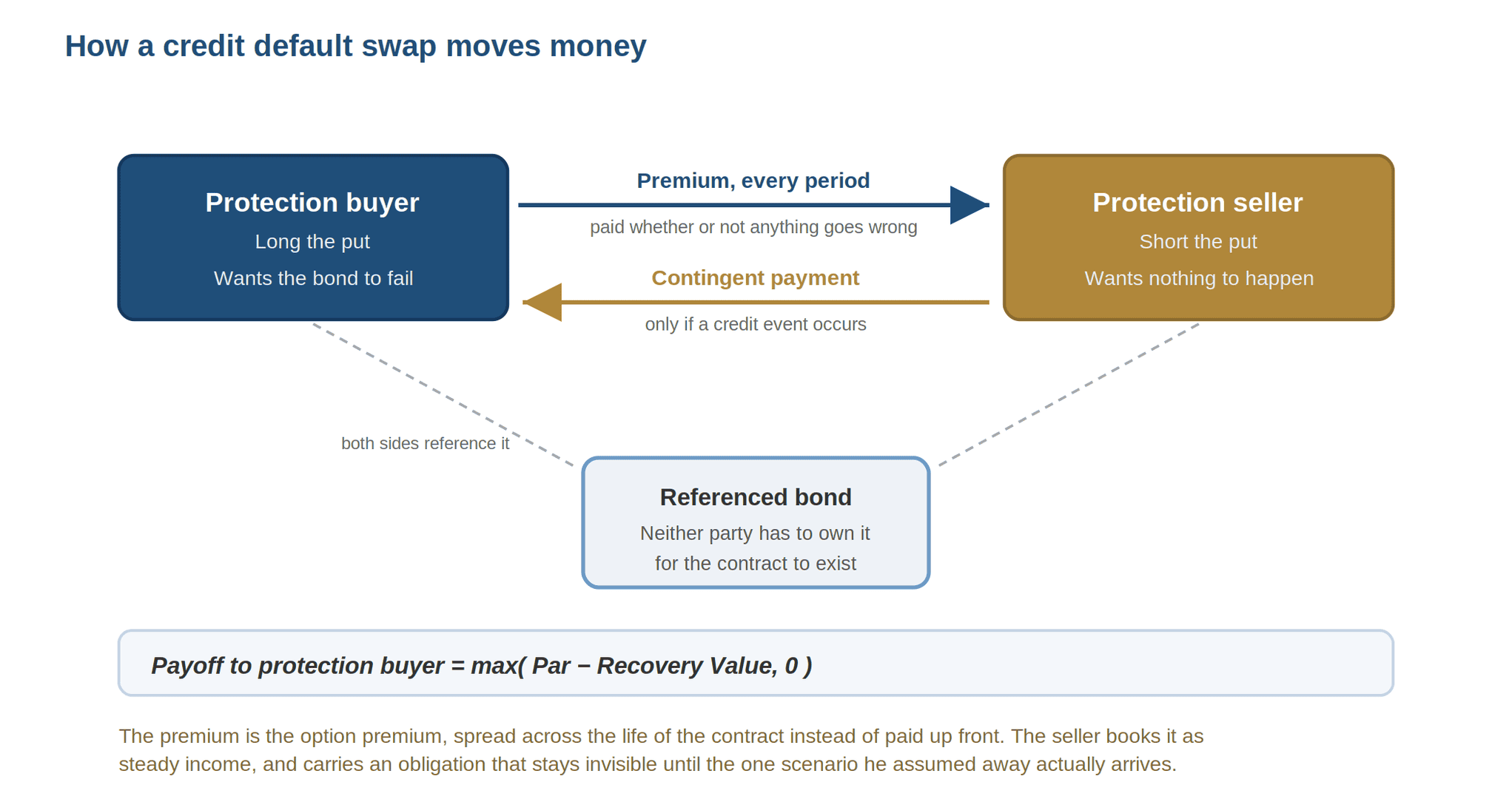
That description is accurate, but it undersells what the instrument is. Insurance is a useful first analogy because it is familiar. The precise analogy, and the one that tells you how the thing behaves under stress, is an option.
A put option is a contract that gives its holder the right to sell something at a price agreed in advance. Suppose you own a building and somebody signs an agreement letting you sell it to them for ten million dollars at any point in the next three years. You are holding a put, and you paid something for that right. If the building is worth twelve million when the time comes, you let the agreement expire and you are out only what you paid for it. If the market falls apart and the building is worth six million, you exercise, you sell at ten, and the person on the other side absorbs the four million difference. Holding that right is called being long a put: your loss is capped at what you paid, and the position pays off when things go badly. Having sold that right is being short a put: you collect the payment up front, and you are the one buying a six-million-dollar building for ten.
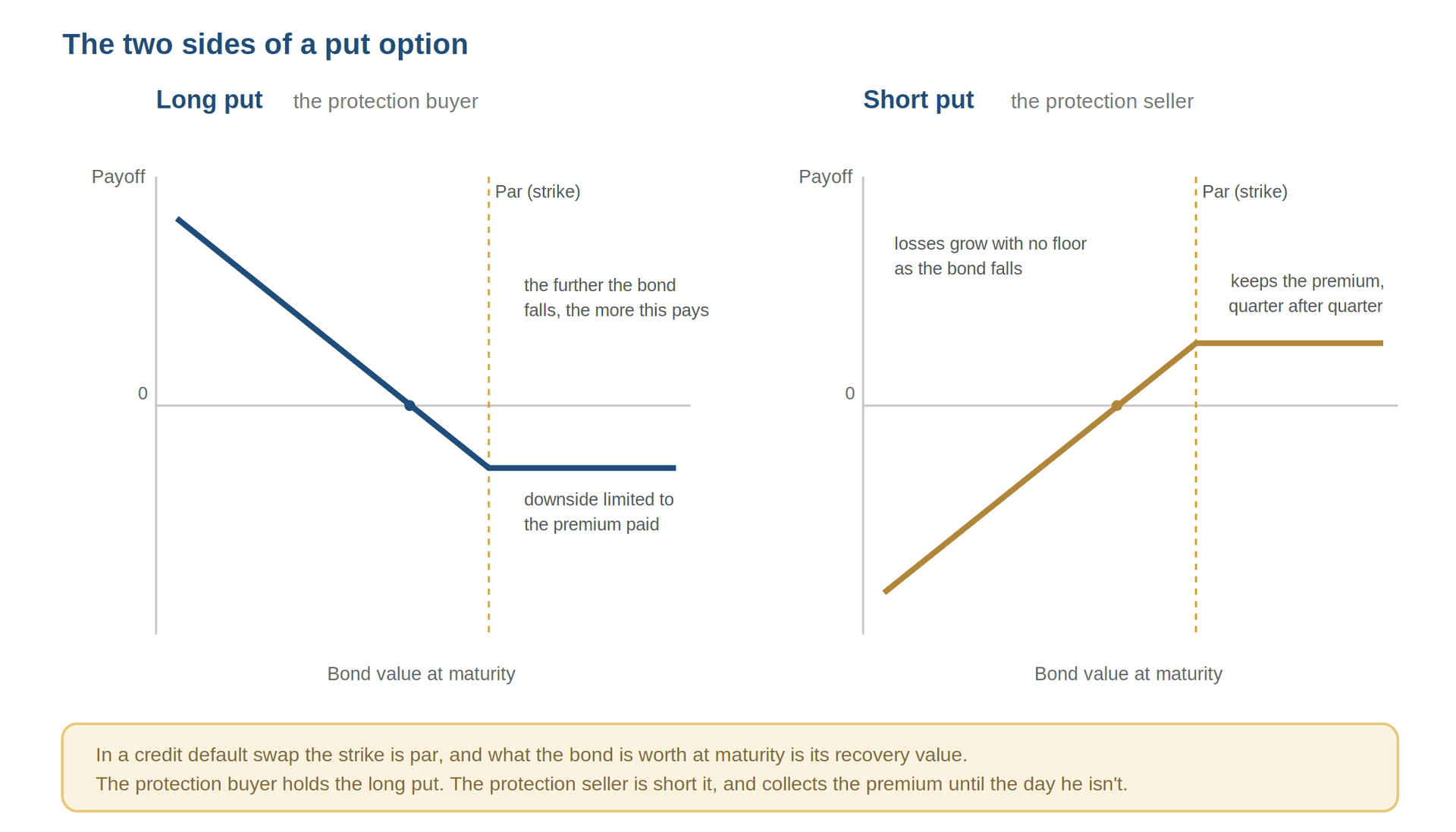
Now look at what a protection buyer receives when a credit event occurs. In a physically settled contract, he hands over the defaulted bond and receives its full face value in cash. He is selling that bond back at par to somebody who agreed in advance to buy it at par. That is a put, exercised. The payoff looks like this:
Payoff to protection buyer = max( Par – Recovery Value, 0 )
If the bond pays in full, the recovery value is par, the difference is zero, and the option expires worthless. If the bond defaults and recovers forty cents on the dollar, the payoff is sixty cents for every dollar of notional. The premium is the option premium, just spread across the life of the contract instead of paid up front.
So the positions sort cleanly. The protection buyer is long a put on the referenced bond, struck at par: known cost, contingent payoff. The protection seller is short that same put: steady premium income, and an obligation that stays invisible right up until it is not.
Once you see it that way, the behavior of everyone in this story gets easier to predict, because we already know how short put positions behave. They look like free money for long stretches. They produce smooth, positive earnings quarter after quarter. And they carry a tail that shows up all at once, in the one scenario the seller has been assuming away.
Lewis gives a concrete example worth sitting with. You might pay $200,000 a year for a ten-year credit default swap on $100 million of General Electric bonds. Your maximum loss over the full term is $2 million, the sum of every premium. Your maximum gain is the notional, $100 million.
Maximum payoff ratio = notional ÷ total premiums paid
For that trade, $100 million divided by $2 million is 50 to 1.
To me, that ratio explains most of who ended up on each side of these contracts. Fifty to one attracts people looking for a cheap way to be right about something rare. The other side of fifty to one attracts people who need to show earnings this quarter and will sell a lottery ticket to do it.
What the Credit Default Swap Premium Was Really Saying
This is where I found the engineering most revealing, because the premium on a credit default swap is not an arbitrary price. It is a probability statement, and you can read it backwards.
Think about what the protection seller is doing when she sets a price. She is going to collect a premium every year. In exchange, she owes a payment if there is a default. To break even, what she collects has to equal what she expects to pay out.
Two things determine what she expects to pay out. The first is how likely default is, call that p. The second is how much she loses when it happens, and that is not the whole notional, because defaulted bonds are rarely worth nothing. Bondholders usually recover something in bankruptcy. If the recovery rate is R, her loss given default is (1 – R) per dollar of notional.
So her expected annual payout, per dollar of notional, is the probability multiplied by the loss:
Expected annual payout = p x (1 – R)
Set that equal to the annual spread s she charges, and solve for the probability:
Implied default probability = p ≈ s ÷ (1 – R)
That is the relation credit traders use constantly, and it is worth internalizing because it turns a price into a forecast. Whatever the market charges to insure something, divide by the loss given default and you have the market’s implied annual probability that the thing fails.
Run the General Electric numbers through it. A premium of $200,000 on $100 million of notional is a spread of 20 basis points, or 0.20 percent a year. Corporate credit conventionally assumes recovery near 40 cents on the dollar, so the loss given default is 0.60. Divide 0.0020 by 0.60 and the implied annual default probability is about 0.33 percent. For General Electric in 2005, that was defensible. A third of one percent a year is the market saying this company fails about once every three centuries.
Now keep the formula exactly as it is and change only what the swap references. Instead of General Electric, the referenced bond is a triple-B-minus subprime tranche, the same one from Part 3 that goes to zero once cumulative losses in the underlying pool reach roughly 7 percent.
The formula has no way of knowing anything changed. It takes whatever spread you feed it and hands back an implied probability with the same confidence. But both inputs have stopped being reliable, and the recovery rate is the one that really breaks.
The recovery rate was borrowed from corporate bankruptcy, where it describes an orderly process: a company fails, creditors line up, and there are assets to divide among them. A wiped-out tranche does not work that way. A tranche is not a claim on assets. It is a position in a payment waterfall, and once losses have eaten through its attachment point there is nothing left to claim. The recovery is not forty cents. It is closer to zero.
Which means the loss given default was not 0.60. It was nearly 1.00. Put the honest number into the same equation and the same spread implies a far lower default probability than the seller believed she was being paid to accept. The mispricing did not come from bad arithmetic. It came from carrying a parameter across a border where it had stopped meaning anything.
What stands out to me is that this is the Part 3 failure wearing new clothes. There the unobservable input was correlation. Here it is recovery. Both times, a clean equation did honest work on a number nobody had grounds to believe.
The Contract Itself Had to Be Built First
None of this was sitting on a shelf waiting to be used. Lewis describes Michael Burry arriving at the idea from an unlikely direction: reading a technical book on credit derivatives, and a passage about the creation of the first corporate credit default swaps at J.P. Morgan in the mid-1990s.
Burry’s problem was that he could not short houses. He could short homebuilder stocks, but that was indirect, expensive, and badly timed, since a stock can stay irrational longer than a fund can stay solvent. The credit default swap solved the timing problem, because it let him hold a position with a known annual carrying cost and simply wait.
But credit default swaps on mortgage bonds did not exist in standard form. The International Swaps and Derivatives Association already had terms for corporate credit default swaps, and a corporate bond is a comparatively simple object: it pays, or it defaults. A mortgage bond amortizes, pays down over time, and does not fail in one binary event so much as bleed. The contract itself had to be redesigned before the trade could exist at all.
I find that detail clarifying. The instrument that eventually multiplied the crisis was not a loophole somebody stumbled into. It was purpose-built, negotiated, and documented by people on both sides who understood exactly what they were constructing.
The Synthetic CDO: When the Bets Outgrew the Market
Now the two threads meet, and this is the center of Part 4.
Lewis lays out the arithmetic without decoration. To generate one billion dollars of triple-B subprime exposure, Goldman Sachs did not need to originate fifty billion dollars in home loans. It needed to find a pessimist willing to pick a hundred different triple-B bonds and buy ten million dollars of credit default swaps on each one. Assemble that package and you have a synthetic CDO, a CDO built out of nothing but credit default swaps.
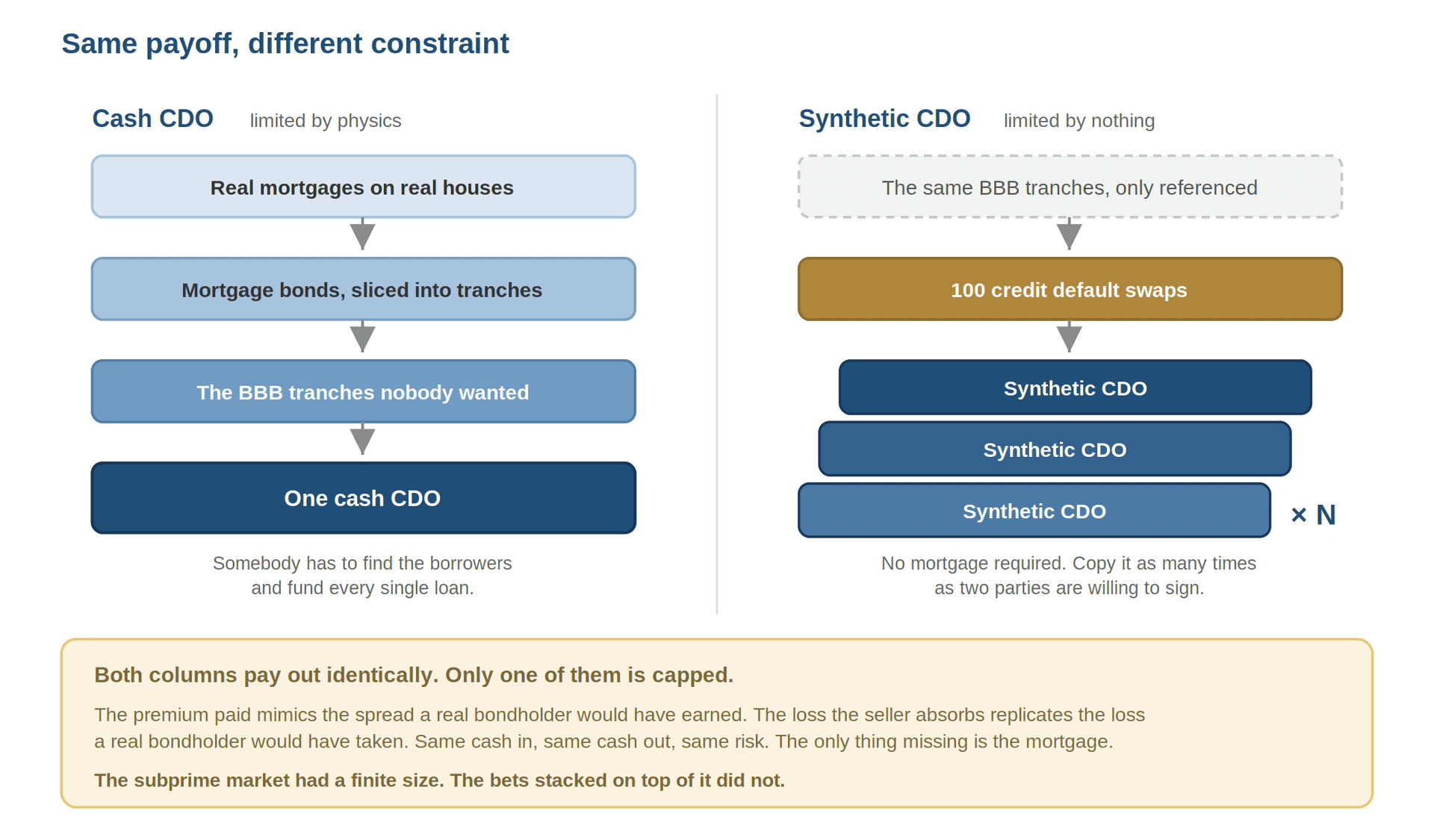
The reason this works is that the swap is an economic clone. The premium the protection buyer pays mimics the spread a real bondholder would have earned. The loss the protection seller absorbs if the bonds go bad replicates the loss a real bondholder would have taken. Same cash in, same cash out, same risk. The only thing missing is the mortgage.
The pessimist who buys protection is long a put. Somebody has to be short that put, and in a synthetic CDO that somebody is the investor who buys the CDO’s notes. He is selling protection on the referenced bonds, collecting the premium as his coupon, and absorbing the losses if those bonds fail. He is short the put, and that is exactly why his position replicates owning a cash CDO. A cash CDO holder also earns a spread while things are calm and eats the losses when they are not. Short a put and long a risky bond have the same shape.
That leaves the arranger in the middle. The bank structuring and selling the synthetic CDO sits on the long-put side of that particular leg, since it is buying protection from the vehicle it created. But in the ordinary case it is not taking a view on housing at all. It sold protection to the pessimist and bought protection from the CDO investors. The two legs point in opposite directions and cancel, and the bank keeps the difference between what it collects on one side and pays on the other. Traders call this running a matched book. It is intermediation rather than speculation, and it is a genuinely useful function: the pessimist gets his hedge, the yield-hungry investor gets his coupon, and the intermediary gets paid for connecting two people who would never have found each other.
But notice what a matched book does to incentives. If you earn a spread on every contract you arrange and carry no directional risk, the rational move is to arrange as many contracts as possible. Volume is the whole business. Nothing in that arrangement asks whether the world needs another hundred million dollars of exposure to the same hundred bonds.
Notice the second thing too, which is that staying matched was a choice. The arranger could keep the long put instead of passing it along, which is another way of saying it could take the pessimist’s side of the trade while selling its clients the opposite side. Lewis reports Goldman traders booking profits of somewhere between 1.5 and 3 billion dollars. That is not intermediation revenue.
There is one more property of a matched book worth planting here. A matched book is only matched if both counterparties pay. The bank is short a put to the pessimist and long a put from the CDO investors, and on paper those cancel perfectly. If the party on the long side fails to deliver, the cancellation stops working and the bank is suddenly holding a naked short put it never intended to own. Every institution in this market was running books that looked flat, and every one of them was flat only on the assumption that everybody else was solvent.
Which brings us to the consequence that makes this part of the story different from everything before it. A cash CDO is constrained by physics: somebody has to find borrowers, write loans, and fund them, and there are only so many borrowers in America. A synthetic CDO is constrained by nothing except the willingness of two parties to sign. The same hundred triple-B bonds could be referenced by ten synthetic CDOs, or by fifty. The underlying subprime market had a finite size. The bets stacked on top of it did not.
Lewis compares the resulting market to fantasy football, a harmless imitation of the real thing, and then points at where the analogy breaks. In fantasy football the imaginary league does not bankrupt anybody. Here, every synthetic contract created a real obligation between two real institutions. The risk was not transferred. It was copied, and every copy landed on somebody’s books.
Who Was on the Other Side
Burry reasoned that only a triple-A rated entity could be writing this protection with no money down and no questions asked. He was right. It was AIG, and specifically a unit called AIG Financial Products, which Lewis describes as founded in 1987 by people who had come out of Michael Milken’s operation at Drexel Burnham.
Under Joe Cassano the unit was reliably profitable. Lewis puts its earnings on the order of $300 million a year, roughly 15 percent of AIG’s total profits. To my reading, that number explains much of the institutional silence around the unit. A quiet business printing 15 percent of group earnings does not get asked hard questions.
Lewis describes what happened next as a bait and switch in two stages. Stage one took a model built for corporate credit risk and pointed it at consumer credit risk: student loans, auto loans, aircraft leases, credit card receivables. The justification was diversification. Different borrowers, different circumstances, different places, unlikely to all deteriorate at once.
Stage two, beginning around the end of 2004, replaced those mixed consumer pools with pools consisting of nothing but United States subprime mortgages.
Read those two stages in order and the problem is unmistakable. The entire intellectual license for the model was diversification. Stage two deleted the diversification and kept the model. It is the correlation assumption from Part 3 again, migrating from a rating agency spreadsheet into an insurer’s book, and getting more wrong along the way.
To AIG’s credit, and this complicates the easy version of the story, Andrew Ross Sorkin records that by late 2005 AIG stopped insuring securities containing subprime tranches. They saw something and they stopped writing new business. The timing is worth pausing on. On the FHFA national house price index, prices rose about 11 percent in 2005 and about 4.5 percent in 2006. AIG stepped back almost exactly as national appreciation was about to fall by more than half. Whoever made that call was reading the market well. It did not matter, because the book already written could not be unwound, and it was enormous.
Why Credit Default Swaps Were Not Insurance
An insurance company, properly speaking, does three things. It holds reserves against expected claims. It diversifies across risks that do not move together. And it answers to a regulator on capital adequacy, so somebody independent checks whether it can actually pay.
AIG Financial Products was doing none of the three, and there are three structural reasons the protection it sold was weaker than it looked.
The first is that no capital was set aside. Burry’s own inference was that only a triple-A entity could take this risk with no money down. The rating was functioning as a substitute for reserves.
The second is counterparty risk. Credit default swaps are privately negotiated bilateral contracts. They are illiquid, with a very thin secondary market, and the documentation often restricts transferring the position. Protection is a promise, and a promise is worth exactly the solvency of whoever made it. Every buyer who believed they had eliminated their mortgage risk had in fact exchanged it for AIG risk.
The third is invisibility. Because these exposures sit off the balance sheet, a firm can accumulate an enormous position without it appearing in the accounts, to the point where the firm itself may not have a reliable picture of what it is carrying. Cassano himself, on a 2007 investor call recounted by Sorkin, referred to collateral call disputes with counterparties and to the opacity of the market he was operating in.
But the collateral mechanism is where the real risk lived, and it is the piece I had not properly understood before working through it.
These contracts did not say AIG would pay when a bond defaulted. They said AIG would post collateral, meaning hand over cash or securities, as the market value of the protection it had sold moved against it. Roughly:
Collateral owed = (current spread – contract spread) x duration x notional
Take the terms one at a time. The contract spread is what AIG agreed to be paid when it wrote the protection, fixed for the life of the deal. The current spread is what that same protection costs in the market today. If insuring those bonds cost 50 basis points when AIG signed and costs 500 today, AIG is short protection at a price that is now badly off market, and the gap is a live loss on paper. Duration turns that annual gap into a present value, because the mispricing repeats every year until the contract matures. Notional is the face amount referenced, the multiplier that turns a spread measured in hundredths of a percent into a number measured in billions.
Now look at what is missing from that expression. There is no term for default. Nothing here requires a single homeowner to miss a single payment. Spreads widening is enough, and spreads widen on fear, on forced selling, on a bad headline. AIG could be made to hand over billions in cash on a portfolio where every underlying loan was still current.
There is a second feature that makes it worse. What AIG owed was also tied to AIG’s own credit rating, so the structure contains a loop that eats itself. A downgrade forces you to post cash. Posting cash drains your liquidity. Draining your liquidity invites the next downgrade.
The numbers Sorkin reports make it concrete. A single one-notch downgrade of AIG could trigger a collateral call of about $10.5 billion. If the second agency followed, which everyone expected, the figure went to roughly $13.3 billion.
That is the sentence I would underline in this whole part. A company can be destroyed by an insurance book long before any of the insured events happen.
Where the Story Goes Next
Two threads run out of here.
The first goes to Part 5. Every structure described so far, the tranches, the CDOs, the synthetic CDOs, and the protection AIG wrote against all of them, rests on the same assumption: that losses would stay modest and would not arrive together. Part 5 is where origination standards give way completely and that assumption meets a falling national housing market.
The second goes to Part 6. Because credit default swaps were private bilateral contracts, there was no central record of who owed what to whom. Every institution knew its own positions and could only guess at everybody else’s. When one large node finally failed, the question that froze the system was not how much money had been lost. It was that nobody could work out who was standing behind whom.
For now, what I’m taking away from this part is the shift it describes. Up to Part 3, the risk in the system was tied to actual mortgages on actual houses, and it was therefore finite. With the credit default swap, the exposure came loose from the collateral entirely. The bets could be copied as many times as two parties were willing to sign, and every copy was real.
Sources and Further Reading
This series draws on two works that, read together, tell the human story of the 2008 crisis. If you want the full account, go to the originals:
Lewis, Michael. The Big Short: Inside the Doomsday Machine. W. W. Norton, 2010.
Sorkin, Andrew Ross. Too Big to Fail. Viking, 2009.
Frequently Asked Questions about Credit Default Swaps, Synthetic CDOs, and the 2008 Financial Crisis
What is a credit default swap?
A credit default swap is a bilateral contract where one party pays a periodic premium and the other pays out if a defined credit event, typically a default, occurs on a referenced bond. The protection buyer gains a payoff when things go badly. The protection seller collects steady premiums and owes a contingent payment. A useful analogy from commercial real estate is a guarantee: the protection seller is economically responsible for a loss they will not see coming until it arrives, and the key question is always whether they can actually pay when the day comes.
What is the difference between a cash CDO and a synthetic CDO?
A cash CDO pools actual loans or bonds and issues securities backed by their cash flows. A synthetic CDO achieves the same economic exposure using credit default swaps rather than actual loans. The protection buyers provide the premium stream that mimics bond interest. The CDO investors sell protection and absorb losses if the referenced bonds fail. Because no actual loan needs to be originated, the same bonds can be referenced by multiple synthetic CDOs simultaneously, meaning the total exposure stacked on the market can exceed the size of the underlying mortgage market by a large multiple.
What does it mean to be long or short a put?
A put option gives its holder the right to sell something at a pre-agreed price. Being long a put means you hold that right: your loss is capped at what you paid for the option, and you profit when the underlying falls. Being short a put means you sold that right: you collect the premium upfront and are obligated to buy at the agreed price if the option is exercised. In the credit default swap context, the protection buyer is long a put (known cost, contingent payoff), while the protection seller is short a put (steady income, obligation that surfaces only when things go wrong).
How did the credit default swap premium imply a default probability?
The protection seller prices a swap so that the premiums she collects equal her expected payout. Her expected annual payout equals the probability of default multiplied by the loss given default (1 minus the recovery rate). Setting that equal to the annual spread and solving gives the implied default probability: spread divided by (1 minus recovery rate). The problem in the 2008 crisis was that this formula was applied to subprime tranches using recovery rate assumptions borrowed from corporate bonds, where defaulted entities still have assets to distribute. A wiped-out tranche has nothing left to recover, making the loss given default close to 1.0, not the 0.60 the formula assumed.
What is a matched book in derivatives trading?
A matched book means a dealer has offsetting positions on both sides of a trade: it sold protection to one party and bought the same protection from another, with the two legs canceling directionally. The dealer earns the spread between what it pays and collects. A matched book looks neutral on paper, but it is only truly neutral if both counterparties honor their obligations. If the party on one side fails, the book is no longer matched and the dealer inherits a large naked position. In 2008, every institution running a matched book was doing so under the assumption that everyone else in the chain was solvent, an assumption that proved fragile once a major node failed.
What did AIG Financial Products do?
AIG Financial Products was a unit of AIG that sold credit protection on pools of bonds, effectively acting as the protection seller in enormous volumes of credit default swaps. It generated roughly $300 million a year, about 15 percent of AIG’s total profits. Beginning around 2004, it shifted from insuring diversified pools of consumer credit to pools consisting almost entirely of subprime mortgage tranches, while continuing to use a model designed for more diversified exposure. By late 2005 it stopped writing new business in this area, but the book already written was too large and too illiquid to unwind.
What is a collateral call and how did it threaten AIG?
A collateral call requires the protection seller to post cash or securities when the market value of protection it has sold moves against it. The amount owed is driven by the gap between the contract spread and the current market spread, multiplied by duration and notional. Critically, a collateral call does not require any actual default: spreads widening on fear or market stress is sufficient. For AIG, a single one-notch credit rating downgrade could trigger a collateral call of roughly $10.5 billion. A second downgrade would push that figure to approximately $13.3 billion. A company can be destroyed by collateral calls long before any of the insured credit events ever occur.
Why did the bets outgrow the mortgage market?
A real mortgage can only be owned by one party at a time. A credit default swap referencing a mortgage bond can be written between any two parties, as many times as they agree to sign. The same hundred bonds could be referenced by ten synthetic CDOs or fifty. Once the technology existed to replicate the economics of mortgage ownership without owning a mortgage, the total exposure stacked on the subprime market was no longer constrained by how many subprime mortgages existed. The risk was not transferred from one party to another. It was copied, and every copy created a real obligation on somebody’s books.
What comes next in this series?
Part 5 follows what happened when origination standards collapsed entirely and a falling national housing market finally met the correlation assumption that the whole structure had been resting on. Part 6 covers the moment of failure itself: because credit default swaps were private bilateral contracts with no central record, nobody could work out who was standing behind whom, and that opacity is what froze the system when the first large node fell.

